
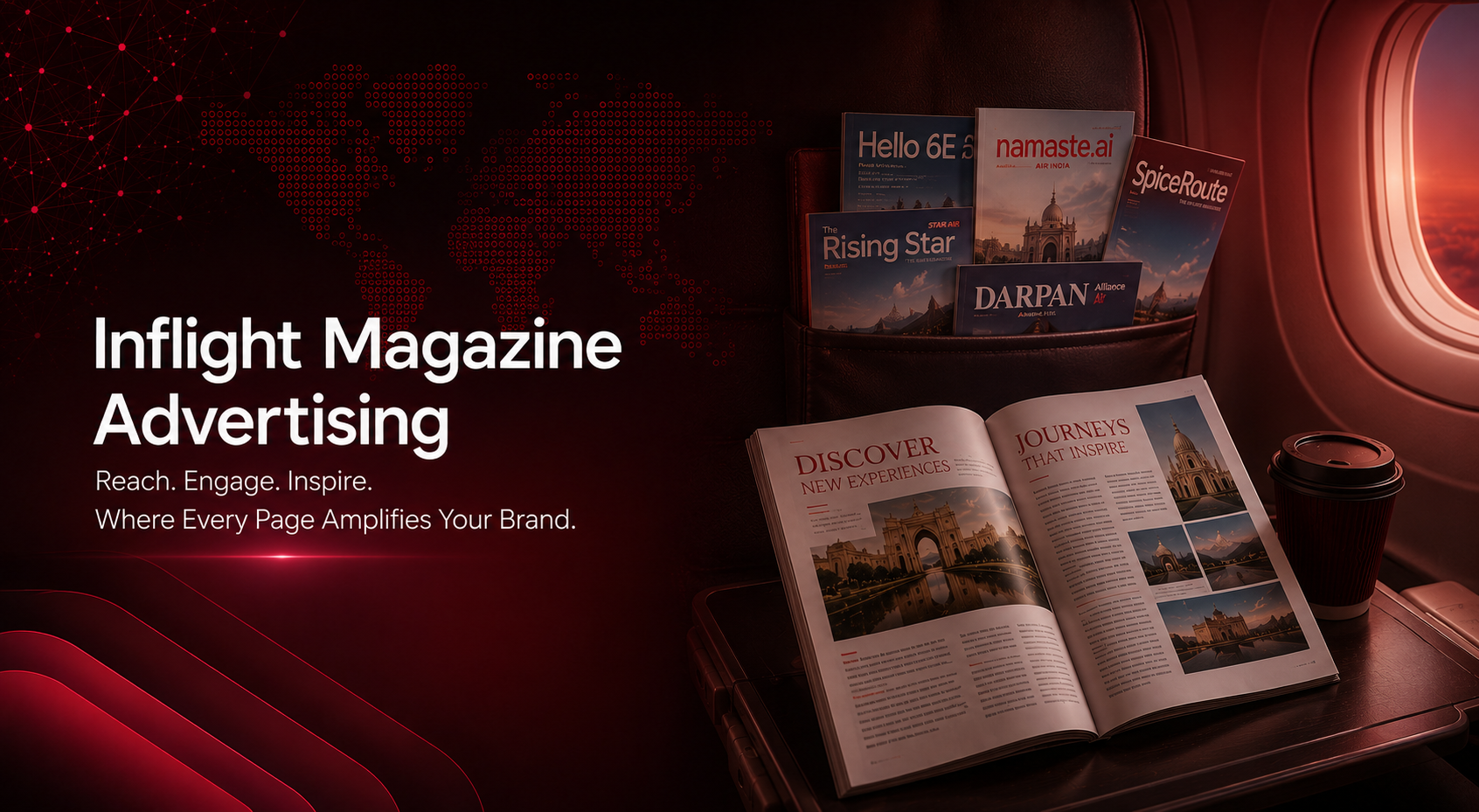
The Complete Guide to Inflight Magazine Advertising
Learn how inflight magazine advertising works, why it remains effective, the leading airline magazines in India, advertising formats, audience insights, campaign planning tips, and best practices to help brands reach premium airline passengers.
Inflight magazine advertising has remained one of the most trusted and premium forms of aviation advertising, enabling brands to engage with a highly attentive audience of business travellers, leisure passengers, corporate decision-makers, and affluent consumers. Unlike many traditional and digital advertising channels that compete for limited attention, airline magazines are read in a distraction-free environment where passengers have the time to explore editorial content, travel stories, lifestyle features, and brand advertisements at their own pace.
As India's aviation industry continues to expand, airlines have strengthened their inflight publications by combining engaging editorial content with carefully curated advertising opportunities. Whether passengers are travelling for business meetings, family vacations, international holidays, or educational purposes, inflight magazines provide advertisers with a unique platform to communicate with readers during an uninterrupted journey. This combination of premium readership, longer engagement time, and a high-quality reading environment makes inflight magazine advertising an effective medium for building brand awareness, enhancing credibility, and influencing purchasing decisions.
This comprehensive guide explains everything you need to know about inflight magazine advertising in India, including how airline magazines work, why they remain relevant in today's digital landscape, the different advertising formats available, passenger demographics, leading inflight magazines, campaign planning strategies, and best practices for creating successful advertisements. Whether you are exploring airline magazine advertising for the first time or evaluating it as part of an integrated marketing strategy, this guide will help you understand the medium and make informed advertising decisions.
Inflight magazine advertising has remained one of the most trusted and premium forms of aviation advertising, enabling brands to engage with a highly attentive audience of business travellers, leisure passengers, corporate decision-makers, and affluent consumers. Unlike many traditional and digital advertising channels that compete for limited attention, airline magazines are read in a distraction-free environment where passengers have the time to explore editorial content, travel stories, lifestyle features, and brand advertisements at their own pace.
As India's aviation industry continues to expand, airlines have strengthened their inflight publications by combining engaging editorial content with carefully curated advertising opportunities. Whether passengers are travelling for business meetings, family vacations, international holidays, or educational purposes, inflight magazines provide advertisers with a unique platform to communicate with readers during an uninterrupted journey. This combination of premium readership, longer engagement time, and a high-quality reading environment makes inflight magazine advertising an effective medium for building brand awareness, enhancing credibility, and influencing purchasing decisions.
This comprehensive guide explains everything you need to know about inflight magazine advertising in India, including how airline magazines work, why they remain relevant in today's digital landscape, the different advertising formats available, passenger demographics, leading inflight magazines, campaign planning strategies, and best practices for creating successful advertisements. Whether you are exploring advertising in Air India Magazine for the first time or evaluating it as part of an integrated marketing strategy, this guide will help you understand the medium and make informed advertising decisions.
What is Inflight Magazine Advertising?
Inflight magazine advertising is a form of aviation advertising where brands promote their products, services, or campaigns through magazines distributed to passengers onboard commercial flights. These magazines are typically placed in the seat pockets of aircraft and are available throughout the journey, allowing passengers to read them before take-off, during the flight, and prior to landing. Unlike many traditional advertising channels that compete for attention in a crowded media environment, inflight magazines offer advertisers access to a focused and highly engaged audience in a premium travel setting.
Airline magazines are much more than promotional publications. They feature carefully curated editorial content covering travel destinations, business insights, lifestyle, fashion, food, technology, wellness, culture, and entertainment. As passengers browse this content during their journey, advertisements become a natural part of the reading experience, often receiving closer attention than advertisements in newspapers or general consumer magazines.
For advertisers, inflight magazine advertising provides an opportunity to connect with a diverse yet high-value audience that includes business professionals, entrepreneurs, corporate executives, frequent flyers, affluent families, international visitors, tourists, students, and decision-makers. Depending on the airline's route network, brands can target domestic travellers, international passengers, or specific regional markets with remarkable precision.
Today, leading airlines in India publish their own inflight magazines, each serving a distinct passenger profile. Popular titles include Hello 6E by IndiGo, Namaste.ai by Air India, SpiceRoute by SpiceJet, The Rising Star by Star Air, and Darpan by Alliance Air. These publications combine engaging editorial content with premium advertising opportunities, enabling brands to build awareness, strengthen credibility, and communicate with passengers in an environment where attention is naturally closer.
Unlike digital advertisements that can be skipped, blocked, or scrolled past, inflight magazine advertisements remain visible throughout the reader's browsing experience. Their premium print quality, longer shelf life, and placement within trusted airline publications contribute to stronger brand recall and a more lasting impression, making inflight magazine advertising an effective medium for businesses seeking meaningful engagement with airline passengers.
Why Airlines Still Publish Inflight Magazines
In an era dominated by smartphones, streaming platforms, and digital content, many people assume that printed magazines have become obsolete. Yet, almost every major airline in India and around the world continues to publish its own inflight magazine. This is because inflight magazines serve a much broader purpose than simply entertaining passengers—they enhance the overall travel experience, strengthen the airline's brand identity, and provide a premium platform for advertisers to connect with travellers.
For airlines, inflight magazines are an extension of their customer experience. They offer passengers carefully curated articles on travel destinations, business, lifestyle, food, culture, wellness, and emerging trends, making journeys more engaging and informative. These publications also showcase the airline's network, onboard services, loyalty programmes, and destination partnerships, reinforcing the airline's relationship with its customers.
Passengers are naturally more receptive to reading during a flight than in many other environments. With limited distractions and uninterrupted travel time, they often browse through the inflight magazine to discover travel inspiration, business insights, or lifestyle recommendations. This creates an ideal environment for advertisements to be noticed alongside trusted editorial content rather than competing with countless digital messages.
Inflight magazines also provide airlines with an additional revenue stream through advertising while maintaining a premium editorial standard. Brands benefit from appearing in a publication that passengers associate with quality, reliability, and a well-curated travel experience. This positive association enhances brand credibility and helps advertisements feel like a natural part of the magazine rather than an interruption.
Today, many airline magazines are also evolving beyond print by integrating QR codes, social media, websites, and digital experiences. This allows advertisers to combine the credibility of print with the convenience of digital engagement, creating campaigns that continue even after passengers leave the aircraft.
The continued presence of inflight magazines across leading airlines demonstrates that they remain an important communication and marketing platform. Rather than competing with digital media, they complement it by offering brands a unique opportunity to engage with travellers in a focused, premium, and trusted environment.
How Inflight Magazine Advertising Works
Inflight magazine advertising follows a structured process that begins with defining campaign objectives and ends with reaching passengers onboard commercial flights. Whether the objective is brand awareness, product promotion, lead generation, or destination marketing, advertisers work closely with airline media representatives or advertising agencies to identify the most suitable publication, advertising format, and campaign schedule.
The first step is understanding the target audience. Every airline serves a unique mix of passengers based on its route network, fare structure, and customer profile. Full-service airlines often attract corporate travellers, international passengers, and premium customers, while low-cost carriers generally offer broader domestic reach. Selecting the right airline magazine ensures that the advertisement is seen by the audience most relevant to the campaign.
Once the airline and magazine have been shortlisted, advertisers choose the most appropriate advertising format. Options typically include full-page advertisements, double-page spreads, inside front cover, inside back cover, back cover, and other premium placements. The selection depends on campaign objectives, creative requirements, and desired visibility within the magazine.
The advertisement is then designed according to the magazine's artwork specifications, including dimensions, resolution, bleed, colour profile, and submission guidelines. Most publishers review the creative before publication to ensure it complies with editorial standards and advertising policies.
After approval, the advertisement is included in the selected issue and distributed across the airline's operating network. Passengers receive the magazine onboard and can browse it throughout their journey, allowing brands to engage readers in a premium, distraction-free environment. Unlike many digital advertisements that disappear after a few seconds, inflight magazine advertisements remain accessible for the duration of the flight and are often revisited by passengers.
Many modern campaigns also integrate print with digital engagement by incorporating QR codes, personalised landing pages, promotional offers, or social media links. This enables advertisers to extend the customer journey beyond the aircraft and measure campaign performance through enquiries, website visits, downloads, or lead generation.
Typical Inflight Magazine Advertising Process
- Define campaign objectives and target audience.
- Select the most suitable airline and inflight magazine.
- Choose the advertising format and placement.
- Finalise the campaign schedule and publication issue.
- Design the advertisement as per artwork specifications.
- Submit the creative for review and approval.
- The advertisement is published in the selected magazine.
- Magazines are distributed onboard across the airline's network.
- Passengers engage with the advertisement during their journey.
- Track campaign performance through enquiries, QR codes, website visits, or other marketing metrics.
Understanding this process helps advertisers plan campaigns more effectively, minimise production delays, and ensure their advertisements are published in the right magazine, at the right time, and for the right audience.
Types of Inflight Magazine Advertisements
Inflight magazines offer a variety of advertising formats that allow brands to choose placements based on their marketing objectives, creative requirements, and desired level of visibility. From standard full-page advertisements to premium cover positions and innovative inserts, each format provides a unique opportunity to engage passengers during their journey. Selecting the right advertisement type depends on factors such as campaign goals, budget, brand positioning, and the level of attention a business wants to achieve.
Premium placements generally receive higher visibility because they appear at the beginning or end of the magazine, while standard interior pages provide an effective and cost-efficient option for sustained brand communication. Some airlines also offer customised advertising opportunities that enable brands to create more interactive and memorable experiences for readers.
Full Page Advertisement: A full-page advertisement is the most commonly used format in inflight magazines. It provides sufficient space to showcase a product, service, campaign, or brand story using high-quality visuals and compelling messaging. Full-page advertisements offer a balanced combination of visibility, affordability, and creative flexibility, making them suitable for businesses across various industries.
Double Page Spread: A double-page spread extends across two facing pages, creating a larger visual canvas for impactful storytelling. This format is ideal for product launches, destination promotions, automotive brands, luxury products, hospitality campaigns, and large-format creative designs that require maximum visual appeal.
Inside Front Cover: Positioned immediately after the magazine cover, the inside front cover is one of the most premium advertising locations. Since it is among the first pages viewed by readers, it attracts exceptional attention and is often preferred by brands seeking strong visibility and enhanced brand recall.
Inside Back Cover: The inside back cover is another premium advertising position that benefits from high readership towards the end of the magazine. Advertisements placed here remain highly noticeable and leave a lasting impression on passengers before they finish reading.
Back Cover Advertisement: The back cover is widely regarded as one of the most prestigious advertising placements in an inflight magazine. Its prominent location ensures excellent exposure and high recall, making it a preferred choice for established brands, premium campaigns, and major product launches.
Gatefold Advertisement: Some inflight magazines offer gatefold advertisements that unfold into a larger display area than a standard page. This innovative format provides additional creative space and is particularly effective for immersive brand storytelling, destination marketing, and visually rich campaigns.
Inserts and Loose Leaf Advertisements: Inserts are printed flyers, brochures, postcards, coupons, or promotional materials placed inside the magazine. They encourage passengers to interact with the advertisement directly and are often used for special offers, QR code-based campaigns, event promotions, or product catalogues.
Sponsored Editorial Features: Certain airline magazines offer branded editorial opportunities where advertisers can present informative articles, travel features, interviews, or thought leadership content in collaboration with the editorial team. These features allow brands to educate readers while maintaining the magazine's editorial style.
Customised Advertising Solutions: Many airlines also provide bespoke advertising opportunities beyond conventional print formats. These may include interactive QR code integrations, destination guides, themed supplements, product sampling, or special editions designed around seasonal campaigns and strategic partnerships. Such customised solutions help brands create memorable experiences and strengthen passenger engagement throughout the journey.
Who Should Advertise in Inflight Magazines?
Inflight magazine advertising is suitable for businesses that want to reach a premium, well-travelled, and high-spending audience. Airline passengers often include corporate executives, business owners, entrepreneurs, professionals, affluent families, international visitors, students, and frequent leisure travellers. As a result, inflight magazines provide an effective platform for brands seeking to build awareness, enhance credibility, generate enquiries, or promote products and services among consumers with significant purchasing power.
The versatility of inflight magazines also means they can support a wide range of marketing objectives, from launching new products and promoting travel experiences to driving website visits through QR codes and reinforcing long-term brand positioning. Industries that benefit the most include:
Travel & Tourism: Tourism boards, travel agencies, hotels, resorts, airlines, cruise operators, and destination management companies use inflight magazines to inspire passengers while they are already in a travel mindset. These advertisements often promote holiday packages, weekend getaways, luxury stays, and international destinations.
Hospitality & Food: Hotels, restaurants, cafes, fine dining establishments, food delivery platforms, and hospitality brands leverage inflight magazines to attract both business and leisure travellers looking for accommodation or dining experiences at their destination.
Real Estate: Real estate developers promote residential projects, luxury apartments, commercial properties, plotted developments, holiday homes, and investment opportunities to financially capable travellers who are more likely to consider high-value purchases.
Banking & Financial Services: Banks, insurance companies, investment firms, fintech platforms, and wealth management companies use airline magazines to communicate with professionals, entrepreneurs, and high-net-worth individuals seeking financial products and advisory services.
Healthcare & Wellness: Hospitals, speciality clinics, diagnostic centres, wellness resorts, medical tourism providers, and healthcare brands advertise to passengers seeking quality healthcare services, preventive care, or wellness experiences.
Education & EdTech: Universities, business schools, international education consultants, online learning platforms, and professional certification providers use inflight magazines to reach students, parents, and working professionals interested in higher education and skill development.
Automobile Industry: Automobile manufacturers and premium vehicle brands showcase new launches, electric vehicles, luxury cars, SUVs, and mobility solutions to an audience with strong purchasing potential.
Consumer Electronics & Technology: Smartphone manufacturers, laptop brands, consumer electronics companies, software providers, SaaS businesses, and technology firms use inflight magazines to build awareness among tech-savvy professionals and business travellers.
Fashion, Jewellery & Luxury Brands: Luxury fashion labels, watchmakers, jewellery brands, cosmetics, fragrances, and lifestyle products benefit from the premium environment of airline magazines, where readers are more receptive to aspirational and high-value purchases.
Retail & E-commerce: Retail chains, online marketplaces, shopping destinations, and premium consumer brands use inflight magazines to introduce new collections, seasonal campaigns, exclusive offers, and flagship stores to a nationwide audience.
Government & Public Sector: Government departments, tourism boards, public sector undertakings, and infrastructure organisations use inflight magazines to promote national campaigns, investment initiatives, cultural events, and public awareness programmes among domestic and international travellers.
Events & Entertainment: Event organisers, exhibition companies, sports leagues, music festivals, streaming platforms, cinemas, and entertainment brands use airline magazines to generate awareness for upcoming events and experiences.
Regardless of the industry, inflight magazine advertising is most effective for organisations that want to communicate with a premium audience in a trusted and distraction-free environment. By selecting the right airline magazine and aligning the campaign with passenger demographics, brands can significantly improve the relevance and impact of their advertising.
Passenger Demographics & Reader Profile
One of the biggest advantages of inflight magazine advertising is its ability to reach a premium and highly engaged audience. Airline passengers generally represent a diverse mix of business professionals, entrepreneurs, corporate executives, affluent families, tourists, students, and international travellers. Compared to many traditional print publications, inflight magazines are read by individuals with higher purchasing power, greater mobility, and stronger decision-making influence.
The exact reader profile varies depending on the airline, route network, and travel class. Full-service carriers typically attract a larger proportion of corporate and international travellers, while low-cost airlines provide extensive reach among domestic passengers and frequent leisure travellers. This diversity enables brands to select airline magazines that closely align with their target audience and campaign objectives.
Age Profile
|
Age Group |
Typical Share |
|
18–24 Years |
12–15% |
|
25–34 Years |
28–32% |
|
35–44 Years |
24–28% |
|
45–54 Years |
16–20% |
|
55 Years & Above |
10–15% |
The majority of readers fall within the 25–44 age group, representing working professionals, entrepreneurs, and individuals with active purchasing and travel lifestyles.
Gender Distribution
|
Gender |
Estimated Share |
|
Male |
58–62% |
|
Female |
38–42% |
The readership has become increasingly balanced in recent years, driven by the growth of both business and leisure travel across India.
Travel Purpose
|
Passenger Type |
Estimated Share |
|
Business Travel |
40–45% |
|
Leisure & Holiday Travel |
35–40% |
|
Family & Personal Travel |
15–20% |
|
Education & Other Travel |
5–10% |
This balanced mix allows advertisers to target both corporate decision-makers and consumer audiences through a single advertising medium.
Income Profile
|
Income Segment |
Typical Presence |
|
SEC A / A+ |
Very High |
|
Upper Middle Income |
High |
|
Affluent Consumers |
Strong Presence |
|
High-Net-Worth Individuals (HNIs) |
Moderate to High |
Many airline passengers belong to upper-income households, making inflight magazines particularly effective for premium products, financial services, luxury brands, real estate, hospitality, healthcare, education, and high-value consumer goods.
Occupation Profile
Inflight magazine readers commonly include:
- Business owners and entrepreneurs
- Corporate executives and senior managers
- Working professionals
- Government officials
- Consultants
- Doctors and healthcare professionals
- Students travelling for higher education
- Domestic and international tourists
This broad professional mix enables brands to reach influential consumers with significant purchasing authority.
Travel Frequency
|
Travel Behaviour |
Estimated Share |
|
Frequent Flyers |
25–30% |
|
Regular Travellers |
35–40% |
|
Occasional Travellers |
30–35% |
Frequent flyers often spend more time engaging with airline services and are more likely to notice advertisements presented within trusted inflight publications.
Why These Demographics Matter for Advertisers
Understanding passenger demographics helps advertisers select the most suitable airline magazine, create relevant messaging, and maximise campaign effectiveness. Whether the objective is to reach business professionals, affluent consumers, tourists, or regional audiences, inflight magazines provide access to readers who are already in a premium travel environment and are more receptive to discovering new brands, products, and services.
Leading Inflight Magazines in India
India's aviation industry is served by several inflight magazines, each catering to a distinct passenger base based on the airline's network, traveller profile, and editorial approach. These publications provide brands with opportunities to engage passengers through premium print advertising while they are travelling in a focused and distraction-free environment. Choosing the right inflight magazine depends on factors such as audience demographics, route coverage, campaign objectives, and brand positioning.
The following are some of the leading inflight magazines available across Indian airlines.
Hello 6E – IndiGo
Hello 6E is IndiGo's official inflight magazine and one of the most widely circulated airline publications in India. It reaches millions of domestic and international passengers travelling across IndiGo's extensive route network. The magazine features travel, lifestyle, business, culture, food, wellness, and destination-related content, making it an ideal platform for brands seeking broad nationwide visibility.
Best suited for: Consumer brands, tourism, hospitality, education, healthcare, fintech, retail, technology, and lifestyle campaigns.
Namaste.ai – Air India
Namaste.ai is Air India's inflight magazine, designed for passengers travelling on both domestic and international routes. The magazine reflects Air India's premium positioning by combining travel features, business insights, global destinations, culture, luxury, and lifestyle content. It offers advertisers access to a high-value audience that includes business executives, international travellers, professionals, and affluent consumers.
Best suited for: Luxury brands, financial services, premium hospitality, international education, healthcare, automobiles, and global tourism.
SpiceRoute – SpiceJet
SpiceRoute is the official inflight magazine of SpiceJet and reaches a large domestic passenger base through the airline's extensive network. The magazine focuses on travel inspiration, destinations, food, entertainment, lifestyle, and business features, providing brands with an engaging platform to communicate with frequent travellers across India.
Best suited for: FMCG, retail, travel, hospitality, consumer electronics, education, healthcare, and regional marketing campaigns.
The Rising Star – Star Air
The Rising Star is the inflight magazine of Star Air, serving passengers travelling across regional and emerging destinations in India. The publication highlights regional tourism, business opportunities, local culture, and travel experiences, making it valuable for advertisers looking to build visibility in Tier II and Tier III markets.
Best suited for: Regional businesses, tourism boards, educational institutions, healthcare providers, real estate developers, and local consumer brands.
Darpan – Alliance Air
Darpan is the official inflight magazine of Alliance Air and primarily serves passengers travelling on regional routes connecting smaller cities across India. The magazine combines informative editorial content with advertising opportunities that help brands reach audiences beyond metropolitan markets.
Best suited for: Government initiatives, regional tourism, public sector campaigns, education, healthcare, infrastructure, banking, and local businesses.
Comparing India's Leading Inflight Magazines
|
Magazine |
Airline |
Primary Audience |
Network Focus |
Best For |
|
Hello 6E |
IndiGo |
Business & Leisure Travellers |
Domestic & International |
Mass reach, consumer brands, nationwide campaigns |
|
Namaste.ai |
Air India |
Premium, Business & International Travellers |
Domestic & International |
Luxury brands, financial services, global campaigns |
|
SpiceRoute |
SpiceJet |
Domestic Leisure & Business Travellers |
Pan India |
Consumer products, hospitality, retail, travel |
|
The Rising Star |
Star Air |
Regional Travellers |
Tier II & Tier III Cities |
Regional branding, education, healthcare |
|
Darpan |
Alliance Air |
Regional & Government Connectivity |
Regional India |
Government campaigns, regional businesses, public awareness |
Each magazine serves a unique passenger segment, making airline selection an important part of campaign planning. By aligning the publication with the target audience, geography, and marketing objectives, brands can improve campaign relevance, maximise engagement, and achieve stronger advertising outcomes.
How to Choose the Right Inflight Magazine for Your Brand
Selecting the right inflight magazine is one of the most important decisions when planning an airline advertising campaign. Every airline caters to a different passenger profile, route network, and travel purpose, which directly influences the audience that will see your advertisement. Rather than selecting a magazine based solely on circulation or popularity, advertisers should evaluate how well its readership aligns with their marketing objectives and target customers.
A well-planned campaign begins by identifying who you want to reach. If your objective is nationwide brand awareness, an airline with extensive domestic connectivity may be more suitable. On the other hand, if your campaign targets premium consumers, international travellers, or business executives, a full-service airline magazine may provide a better fit. Understanding passenger demographics, travel behaviour, and geographic reach helps ensure that your advertising investment delivers meaningful results.
Define Your Campaign Objective: Start by clearly identifying what you want to achieve. Your objective may be to build brand awareness, launch a new product, generate enquiries, promote a destination, increase website traffic, or strengthen brand credibility. A clearly defined objective makes it easier to select the right airline magazine and advertising format.
Understand Your Target Audience: Consider who your ideal customers are. Evaluate factors such as age, income, profession, travel purpose, lifestyle, and purchasing behaviour. Matching your audience with the airline's passenger profile significantly improves campaign relevance and effectiveness.
Evaluate the Airline's Route Network: Different airlines operate different domestic and international routes. Some have extensive nationwide connectivity, while others focus on regional destinations or premium international sectors. Choose an airline whose network closely aligns with your target market.
Compare Passenger Profiles: Every airline attracts a unique mix of travellers. Some carry a higher proportion of business professionals and corporate executives, while others have a larger share of leisure travellers, families, or regional passengers. Understanding these differences helps brands communicate with the most relevant audience.
Select the Right Advertisement Format: The choice of advertisement format should complement your campaign goals and creative strategy. Full-page advertisements are ideal for product launches and brand awareness, while premium cover positions offer maximum visibility. Double-page spreads and inserts are suitable for campaigns that require detailed storytelling or promotional content.
Consider Campaign Duration: Repeated exposure often delivers stronger results than a single insertion. Depending on your marketing objectives and budget, consider advertising across multiple editions or running campaigns over several months to improve brand recall.
Review Editorial Relevance: The effectiveness of an advertisement also depends on the magazine's editorial environment. Publications featuring travel, business, lifestyle, luxury, food, and culture naturally complement advertisements from brands operating in similar sectors, creating a more engaging reading experience.
Work with an Experienced Advertising Partner: Planning an inflight magazine campaign involves selecting the right publication, negotiating placements, coordinating artwork, managing publication schedules, and ensuring timely execution. Working with an experienced aviation advertising agency can simplify the process and help optimise campaign performance across multiple airline magazines.
Quick Checklist Before Selecting an Inflight Magazine
- Clearly define your campaign objective.
- Identify your target audience.
- Compare airline passenger demographics.
- Evaluate domestic and international route coverage.
- Select the appropriate advertisement format.
- Decide the campaign duration and publication schedule.
- Review editorial compatibility with your brand.
- Compare multiple airline magazines before making a decision.
- Plan campaign measurement and lead tracking.
- Seek professional media planning support for the best results.
Choosing the right inflight magazine is not simply about reaching the largest audience—it is about reaching the right audience. A carefully selected publication, supported by a compelling creative strategy and well-planned campaign schedule, can significantly enhance brand visibility, audience engagement, and overall advertising effectiveness.
Benefits of Inflight Magazine Advertising
Inflight magazine advertising offers a unique combination of premium audience reach, high reader engagement, and long-lasting brand visibility. Unlike many traditional and digital advertising channels where consumers are constantly exposed to competing messages, airline magazines are read in a calm, distraction-free environment. This allows brands to communicate with passengers when they have more time to explore content and advertisements, resulting in stronger engagement and improved brand recall.
Whether the objective is increasing brand awareness, launching a new product, promoting a destination, or reaching high-value consumers, inflight magazines provide several advantages that make them an important component of an integrated marketing strategy.
Access to a Premium Audience: Inflight magazines are read by business professionals, entrepreneurs, corporate executives, affluent families, frequent flyers, and international travellers. These audiences often have higher purchasing power and greater influence over personal and business buying decisions.
High Reader Engagement: Passengers typically spend considerable time onboard with fewer distractions than in their everyday environment. As they browse travel stories, business articles, and lifestyle content, advertisements receive more focused attention compared to many other media channels.
Enhanced Brand Credibility: Advertising within a professionally produced airline magazine enhances a brand's credibility. Being featured alongside trusted editorial content and a recognised airline creates a positive brand association and reinforces consumer confidence.
Longer Advertisement Lifespan: Unlike online advertisements that disappear within seconds, inflight magazine advertisements remain available throughout the passenger's journey. Many travellers revisit different sections of the magazine during the flight, increasing the likelihood of multiple exposures to the same advertisement.
Strong Brand Recall: The combination of premium content, quality printing, and an uninterrupted reading environment helps advertisements leave a lasting impression. Well-designed campaigns are more likely to be remembered even after the journey has ended.
Reach Business and Leisure Travellers Together: Airline magazines provide access to a balanced mix of business travellers, leisure passengers, tourists, students, and families. This diversity enables brands to communicate with multiple customer segments through a single advertising platform.
Nationwide and International Visibility: Depending on the airline selected, advertisers can reach passengers travelling across major metropolitan cities, emerging regional markets, and international destinations. This flexibility allows campaigns to support both local and national marketing objectives.
Supports Premium Brand Positioning: Luxury products, hospitality brands, financial institutions, healthcare providers, education companies, and high-value consumer brands often use inflight magazines to reinforce a premium market image and communicate with quality-conscious audiences.
Complements Digital Marketing Campaigns: Modern inflight advertisements frequently incorporate QR codes, dedicated landing pages, promotional offers, and social media integrations. This allows brands to connect the credibility of print advertising with measurable digital engagement and lead generation.
Flexible Advertising Opportunities: Airline magazines offer a range of advertising formats, including full-page advertisements, double-page spreads, premium cover positions, inserts, and sponsored editorial features. This flexibility enables brands to select solutions that align with their objectives and budgets.
Ideal for Long-Term Brand Building: While inflight magazine advertising can support short-term promotional campaigns, it is particularly effective for long-term brand building. Consistent visibility across multiple editions helps strengthen brand recognition, improve customer trust, and maintain top-of-mind awareness among frequent travellers.
When planned strategically and aligned with the right airline magazine, inflight magazine advertising delivers far more than simple visibility. It enables brands to connect with premium audiences in a trusted environment, strengthen brand perception, and support integrated marketing campaigns across both print and digital channels.
Understanding Inflight Magazine Advertising Rates
Inflight magazine advertising rates vary depending on the airline, magazine circulation, passenger demographics, advertisement size, placement, and campaign duration. While every airline follows its own media plan, businesses can use the following indicative pricing as a general benchmark when planning their advertising budget.
|
Advertisement Format |
Indicative Rate (Per Edition) |
|
Full Page Colour (FPC) |
₹60,000 – ₹7,00,000+ |
|
Premium Full Page (Inside Front Cover, Inside Back Cover, Back Cover) |
₹75,000 – ₹8,00,000+ |
|
Double Page Spread |
Typically 1.8x–2x the Full Page rate |
The final advertising cost depends on factors such as the selected airline, passenger reach, circulation, premium placements, number of insertions, seasonal demand, and any value-added opportunities such as sponsored content or inserts. Advertisers planning multi-edition campaigns may also benefit from package pricing and negotiated commercial terms.
While these indicative rates provide a useful starting point, every airline publishes its own media plan and advertising guidelines. Comparing readership quality, passenger profile, and campaign objectives is often more important than comparing rates alone.
Looking for airline-wise advertising rates? Explore our detailed Inflight Magazine Advertising guide to compare India's leading airline magazines, understand advertising options, review the latest media plans, and request customised quotations for your campaign.
Factors Affecting Inflight Magazine Advertising Cost
The cost of inflight magazine advertising can vary significantly depending on the airline, readership profile, advertisement placement, campaign duration, and several other factors. Unlike conventional print publications, airline magazines reach a highly targeted audience of business travellers, affluent consumers, frequent flyers, and decision-makers, making them a premium advertising medium. Understanding the factors that influence pricing helps businesses plan campaigns more effectively and choose advertising opportunities that align with their marketing objectives and budget.
1. Airline and Passenger Reach
One of the biggest factors affecting advertising cost is the airline itself. Airlines with larger passenger volumes, extensive domestic and international networks, and strong brand recognition generally command higher advertising rates due to their wider audience reach.
2. Magazine Circulation and Readership
Advertising rates are closely linked to the magazine's circulation and estimated readership. Publications distributed on high-frequency routes or across a larger fleet typically offer greater exposure, which can influence advertising costs.
3. Advertisement Size
The size of the advertisement plays an important role in determining pricing. A double-page spread generally costs more than a full-page advertisement because it offers greater visual impact and occupies more editorial space within the magazine.
4. Advertisement Placement
Premium positions such as the Back Cover, Inside Front Cover, Inside Back Cover, opening pages, or special editorial sections usually attract higher rates because they receive greater reader attention and visibility throughout the publication.
5. Campaign Duration
Long-term advertising campaigns involving multiple editions often provide better value compared to a single insertion. Businesses planning sustained brand visibility frequently choose multi-month campaigns to improve audience recall and campaign effectiveness.
6. Domestic vs. International Distribution
Magazines distributed on international routes may have different pricing structures compared to publications focused primarily on domestic flights. International readership often includes global business travellers and higher-spending consumers, which can influence advertising value.
7. Passenger Demographics
Airlines serving premium corporate travellers, luxury tourists, or high-income passengers generally offer access to a more affluent audience. Advertisers targeting these customer segments may find premium placements more valuable despite higher advertising costs.
8. Seasonal Demand
Advertising demand often increases during festive seasons, holiday travel periods, tourism campaigns, major sporting events, and new product launches. Higher demand during these periods may influence advertisement availability and pricing.
9. Creative Requirements
Standard print advertisements typically have straightforward production requirements, while customised formats such as inserts, gatefolds, sponsored editorial content, or innovative print executions may involve additional production and implementation costs.
10. Value-Added Advertising Opportunities
Some airline publications offer integrated marketing opportunities beyond print advertisements, including QR code integration, promotional features, destination guides, sponsored articles, contests, or digital extensions. These value-added options can influence the overall campaign investment while enhancing audience engagement.
Inflight magazine advertising should be evaluated based on the quality of audience engagement rather than price alone. A well-planned campaign placed in the right airline magazine can deliver strong brand visibility, higher recall, and long-term marketing value among a premium travelling audience.
If you're looking for detailed information on airline-wise advertising options, advertisement formats, media planning, booking process, and the latest pricing, explore our comprehensive guide on Inflight Magazine Advertising. The guide covers leading airline magazines in India, advertising opportunities, campaign planning, and everything you need to know before launching an inflight magazine advertising campaign.
Common Myths About Inflight Magazine Advertising
Despite being one of the most established forms of aviation advertising, inflight magazine advertising is often surrounded by misconceptions. Many marketers assume that printed airline magazines have lost their relevance in the digital era, while others believe they are suitable only for luxury brands or large corporations. In reality, inflight magazines continue to evolve alongside digital media and remain an effective platform for reaching premium, highly engaged audiences. Understanding these myths helps businesses make informed advertising decisions based on facts rather than assumptions.
Myth 1: Nobody Reads Inflight Magazines Anymore
Reality: Airline passengers continue to browse inflight magazines during different stages of their journey, particularly when electronic devices are not in use or when they want to explore travel, lifestyle, and destination content. The distraction-free cabin environment encourages longer reading sessions compared to many other print publications.
Myth 2: Inflight Magazine Advertising Is Only for Luxury Brands
Reality: While luxury brands frequently advertise in airline magazines, they are equally effective for industries such as education, healthcare, tourism, hospitality, banking, real estate, technology, retail, consumer electronics, government campaigns, and public awareness initiatives. The right airline magazine depends on the target audience rather than the industry alone.
Myth 3: Digital Advertising Has Replaced Inflight Magazines
Reality: Digital advertising and inflight magazine advertising serve different purposes and often complement each other. Many successful campaigns combine print advertisements with QR codes, landing pages, promotional offers, and social media, allowing brands to extend customer engagement beyond the flight.
Myth 4: Airline Magazines Only Reach Business Travellers
Reality: Modern airlines carry a diverse mix of passengers, including leisure travellers, families, students, professionals, entrepreneurs, international visitors, and frequent flyers. This diversity enables advertisers to reach multiple customer segments through a single publication.
Myth 5: Print Advertising Cannot Be Measured
Reality: Campaign performance can be evaluated using QR codes, dedicated landing pages, unique promotional codes, enquiry tracking, website analytics, and campaign-specific contact details. These tools help advertisers understand customer engagement and campaign effectiveness.
Myth 6: Only Large Companies Can Afford Inflight Magazine Advertising
Reality: Businesses of different sizes use inflight magazines to achieve various marketing objectives. By selecting the appropriate airline, advertisement format, campaign duration, and placement, organisations can plan campaigns that align with their marketing budgets.
Myth 7: All Airline Magazines Offer the Same Audience
Reality: Every airline has its own passenger profile, route network, and readership characteristics. A publication serving premium international travellers differs significantly from one focused on regional domestic routes. Selecting the right airline magazine is often more important than simply choosing the largest publication.
Myth 8: A Single Advertisement Is Enough
Reality: Like most advertising media, consistent visibility generally delivers better results than a one-time insertion. Running advertisements across multiple editions improves brand recall, reinforces messaging, and increases the likelihood of reaching repeat travellers.
Myth 9: Inflight Magazine Advertising Is Only About Brand Awareness
Reality: While brand awareness is a major objective, inflight magazine advertisements can also support lead generation, product launches, tourism promotion, event marketing, website traffic, app downloads, and customer enquiries when integrated with effective calls-to-action and digital touchpoints.
Myth 10: Inflight Magazine Advertising Is Becoming Obsolete
Reality: Airline magazines continue to evolve by combining premium print experiences with digital technologies such as QR codes, online content, and interactive campaigns. As global air travel grows and passengers seek quality reading material during their journey, inflight magazines remain an important communication platform for both airlines and advertisers.
Businesses that understand these realities are better positioned to leverage inflight magazine advertising as part of a broader marketing strategy. Rather than viewing it as a standalone print medium, many brands now integrate airline magazine advertising with digital marketing, airport advertising, and other media channels to maximise campaign reach and effectiveness.
Best Practices for Creating High-Impact Inflight Magazine Advertisements
Creating an effective inflight magazine advertisement requires more than an attractive design. Since passengers typically spend several minutes reading airline magazines, advertisements should be visually engaging, easy to understand, and aligned with the interests of the target audience. A well-planned advertisement can capture attention, communicate a clear message, and encourage readers to take action long after the flight has ended.
Whether the objective is brand awareness, lead generation, product promotion, or destination marketing, following proven advertising best practices can significantly improve campaign performance and maximise return on investment.
Focus on a Single Message: Avoid trying to communicate too many ideas in one advertisement. A single, well-defined message is easier to understand and more memorable. Highlight the primary benefit or value proposition and support it with concise copy.
Use High-Quality Visuals: Professional photography, premium product images, and clean graphic design create a stronger visual impact. High-resolution visuals not only attract attention but also reinforce brand quality and credibility.
Write Clear and Compelling Headlines: The headline is often the first element readers notice. Keep it short, relevant, and benefit-driven so passengers immediately understand what the advertisement is about.
Keep the Content Easy to Read: Inflight advertisements should use concise paragraphs, sufficient white space, and readable typography. Avoid excessive text and ensure the most important information is visible at a glance.
Include a Strong Call-to-Action: Guide readers towards the next step by including a clear call-to-action such as visiting a website, scanning a QR code, downloading an app, making an enquiry, or contacting your business.
Integrate QR Codes: QR codes allow readers to move seamlessly from print to digital. They can direct passengers to landing pages, product catalogues, booking platforms, promotional offers, videos, or social media profiles, making campaign performance easier to measure.
Maintain Consistent Branding: Use consistent colours, fonts, logos, and messaging that align with your overall brand identity. Consistency helps strengthen brand recognition across both print and digital channels.
Design for the Airline Audience: Consider the profile of the passengers reading the magazine. Tailor your visuals, messaging, and offers to match their interests, travel behaviour, purchasing power, and lifestyle.
Optimise for Premium Placements: If the campaign budget allows, premium positions such as the inside front cover, inside back cover, or back cover can provide greater visibility and improve advertisement recall.
Plan for Multiple Insertions: Repeated exposure across multiple editions often delivers stronger results than a single advertisement. Consistent presence helps reinforce brand awareness and increases the likelihood of reaching frequent flyers.
Review Artwork Before Submission: Carefully verify all text, contact information, website URLs, QR codes, and visual elements before final submission. Ensuring compliance with the magazine's artwork specifications helps avoid production delays and printing errors.
Measure Campaign Performance: Track the effectiveness of your campaign using dedicated landing pages, QR code analytics, enquiry forms, unique phone numbers, promotional codes, website traffic, and conversion metrics. Measuring performance helps refine future campaigns and improve overall marketing outcomes.
A thoughtfully designed inflight magazine advertisement combines compelling storytelling, premium visuals, and a clear call-to-action to create a lasting impression on airline passengers. By following these best practices, brands can maximise engagement, strengthen brand perception, and achieve better results from their aviation advertising campaigns.
How to Book Inflight Magazine Advertising
Booking an inflight magazine advertisement involves more than simply selecting an airline and submitting artwork. A successful campaign requires careful planning, audience analysis, creative development, publication scheduling, and coordination with the airline or its advertising representative. Understanding the booking process helps businesses plan campaigns efficiently and ensures advertisements are published in the right magazine, at the right time, and for the right audience.
Whether you are launching a new product, promoting a destination, building brand awareness, or running a long-term branding campaign, following a structured approach can significantly improve campaign effectiveness.
Step 1: Define Your Marketing Objective
Begin by identifying the purpose of your campaign. Your objective may be increasing brand awareness, promoting a product or service, generating enquiries, launching a new business, or strengthening brand positioning among airline passengers.
Step 2: Identify Your Target Audience
Understand who you want to reach based on factors such as age, profession, income level, travel purpose, geography, and purchasing behaviour. This will help determine the most suitable airline magazine for your campaign.
Step 3: Select the Right Airline Magazine
Choose an inflight magazine whose readership closely matches your target audience. Consider factors such as the airline's route network, passenger demographics, publication frequency, and overall brand positioning.
Step 4: Choose the Advertisement Format
Select the advertising format that best supports your campaign objectives. Options may include full-page advertisements, double-page spreads, premium cover positions, inserts, or customised advertising solutions.
Step 5: Finalise the Campaign Schedule
Plan the publication month, campaign duration, and number of insertions. Multi-edition campaigns often deliver stronger brand recall and improve overall campaign visibility.
Step 6: Prepare the Advertisement Artwork
Design the advertisement according to the magazine's technical specifications, including page dimensions, bleed area, colour profile, image resolution, and file format. Ensure all content, branding, and contact details are accurate before submission.
Step 7: Submit for Approval
The advertisement is reviewed by the publisher or airline to ensure it complies with editorial guidelines and advertising policies. Once approved, it is scheduled for publication in the selected issue.
Step 8: Publication and Distribution
After printing, the magazine is distributed onboard the airline's flights and made available to passengers throughout their journey. Your advertisement reaches readers across the airline's operating network during the campaign period.
Step 9: Measure Campaign Performance
Monitor campaign effectiveness using QR codes, dedicated landing pages, enquiry forms, promotional codes, website analytics, or customer feedback. Performance insights help optimise future advertising campaigns.
Need Assistance with Inflight Magazine Advertising?
Planning an inflight magazine campaign across multiple airlines can be time-consuming, especially when comparing readership profiles, advertisement formats, publication schedules, and campaign opportunities. Working with an experienced aviation advertising partner can simplify the entire process and help ensure your campaign reaches the right audience.
The Media Spaces assists brands with airline selection, media planning, advertisement booking, artwork coordination, campaign scheduling, and end-to-end execution across leading inflight magazines in India.
Phone: +91 93114 49829
Email: enquiry@themediaspaces.com
Whether you are planning a single-airline campaign or a multi-airline advertising strategy, our team can help you identify the most suitable opportunities based on your business objectives and target audience.
Frequently Asked Questions (FAQs)
1. What is inflight magazine advertising?
Inflight magazine advertising is a print advertising medium where businesses promote their products or services through magazines distributed onboard commercial flights. These magazines are read by passengers during their journey, providing brands with access to a premium and highly engaged audience.
2. Are inflight magazines still effective for advertising?
Yes. Despite the growth of digital media, inflight magazines continue to be effective because they are read in a distraction-free environment. Passengers often spend considerable time browsing editorial content, resulting in higher engagement and stronger advertisement recall.
3. Who reads inflight magazines?
Inflight magazines are read by business travellers, corporate executives, entrepreneurs, professionals, leisure travellers, families, students, international visitors, and frequent flyers. The exact readership profile varies depending on the airline and its route network.
4. Which industries benefit the most from inflight magazine advertising?
Travel and tourism, hospitality, healthcare, education, banking, financial services, real estate, luxury brands, retail, consumer electronics, automobiles, government organisations, and technology companies are among the industries that frequently advertise in inflight magazines.
5. Which are the leading inflight magazines in India?
Some of India's leading inflight magazines include Hello 6E (IndiGo), Namaste.ai (Air India), SpiceRoute (SpiceJet), The Rising Star (Star Air), and Darpan (Alliance Air). Each publication serves a unique passenger segment and offers different advertising opportunities.
6. How do I choose the right inflight magazine for my business?
The right magazine depends on your campaign objective, target audience, passenger demographics, airline network, geographic coverage, advertisement budget, and marketing goals. Selecting a publication that aligns with your customer profile generally produces better campaign results.
7. What types of advertisements can be placed in inflight magazines?
Advertisers can choose from full-page advertisements, double-page spreads, inside front cover, inside back cover, back cover, inserts, sponsored editorial features, and other premium advertising opportunities offered by individual airlines.
8. How long does an advertisement remain visible to passengers?
Inflight magazine advertisements remain available throughout the passenger's journey. Many readers browse the magazine multiple times during a flight, increasing the opportunity for repeated exposure and stronger brand recall.
9. How far in advance should I plan an inflight magazine campaign?
Most advertisers begin planning several weeks before publication to allow sufficient time for airline selection, media planning, artwork development, approvals, and printing. Larger campaigns or premium placements may require earlier booking.
10. What makes inflight magazine advertising different from newspaper advertising?
Unlike newspapers, inflight magazines are read in a controlled environment with limited distractions. Their readership typically consists of airline passengers with higher purchasing power, and advertisements remain visible for a longer period during the journey.
11. Is inflight magazine advertising suitable for small and medium-sized businesses?
Yes. Businesses of all sizes can benefit from inflight magazine advertising by selecting the appropriate airline, advertisement format, and campaign duration based on their marketing objectives and budget.
12. Can QR codes be included in inflight magazine advertisements?
Yes. QR codes are widely used to connect print advertisements with digital experiences such as websites, booking platforms, product catalogues, videos, promotional offers, mobile applications, or enquiry forms.
13. Can inflight magazine advertising be combined with airport advertising?
Absolutely. Many brands integrate inflight magazine advertising with airport media such as digital screens, airport lounges, baggage belts, luggage trolleys, and outdoor displays to create a consistent aviation marketing campaign.
14. How can I measure the success of an inflight magazine advertising campaign?
Campaign performance can be measured using QR code scans, website traffic, dedicated landing pages, enquiry forms, promotional codes, phone enquiries, lead generation, customer feedback, and brand recall studies.
15. Is inflight magazine advertising suitable for B2B companies?
Yes. Airline magazines frequently reach business owners, decision-makers, investors, consultants, and corporate executives, making them an effective platform for B2B branding and lead generation.
16. Can international brands advertise in Indian inflight magazines?
Yes. Many international brands use Indian airline magazines to promote tourism, luxury products, education, healthcare, hospitality, financial services, and other offerings to domestic and international travellers.
17. What should an effective inflight magazine advertisement include?
An effective advertisement should feature a compelling headline, high-quality visuals, concise messaging, consistent branding, a clear call-to-action, and, where appropriate, a QR code or website link to encourage further engagement.
18. How do I book an advertisement in an inflight magazine?
The process generally involves selecting the airline, choosing the advertisement format, finalising the publication schedule, preparing artwork according to specifications, obtaining approval, and confirming the booking before the publication deadline.
19. Should I advertise in one airline magazine or multiple airline magazines?
The answer depends on your campaign objectives and target audience. Single-airline campaigns can be effective for focused marketing, while multi-airline campaigns provide broader reach across different passenger segments and geographic markets.
20. Where can I get professional assistance for inflight magazine advertising?
If you need guidance with airline selection, media planning, advertisement booking, artwork coordination, or campaign execution, you can consult an experienced aviation advertising agency such as The Media Spaces, which manages inflight magazine advertising campaigns across leading airlines in India.
Conclusion
Inflight magazine advertising continues to be one of the most effective ways for brands to connect with premium airline passengers in a trusted and distraction-free environment. As India's aviation sector continues to expand, airline magazines remain an integral part of the passenger experience, offering businesses a unique opportunity to engage with corporate executives, entrepreneurs, leisure travellers, affluent consumers, and frequent flyers through high-quality editorial publications.
Unlike many advertising channels that compete for limited consumer attention, inflight magazines provide extended reading time, strong brand visibility, and a premium context that enhances advertisement credibility. Whether the objective is increasing brand awareness, launching a new product, promoting tourism, generating enquiries, or strengthening long-term brand positioning, inflight magazine advertising can become a valuable component of an integrated marketing strategy.
Choosing the right airline magazine, selecting an appropriate advertisement format, and aligning the campaign with the target audience are essential for achieving the best results. Businesses should evaluate factors such as passenger demographics, route coverage, campaign objectives, publication schedules, and creative execution before investing in airline magazine advertising.
If you are planning an inflight magazine advertising campaign, The Media Spaces can help you identify the most suitable airline magazines, compare advertising opportunities, coordinate media planning, and manage end-to-end campaign execution across leading airlines in India.
Contact The Media Spaces
Phone: +91 93114 49829
Email: enquiry@themediaspaces.com
Website: https://themediaspaces.com
Our team can assist you with airline selection, advertising formats, campaign planning, artwork coordination, media buying, and multi-airline advertising solutions tailored to your marketing objectives.
Latest Posts
-
-
-
August 01, 2026