
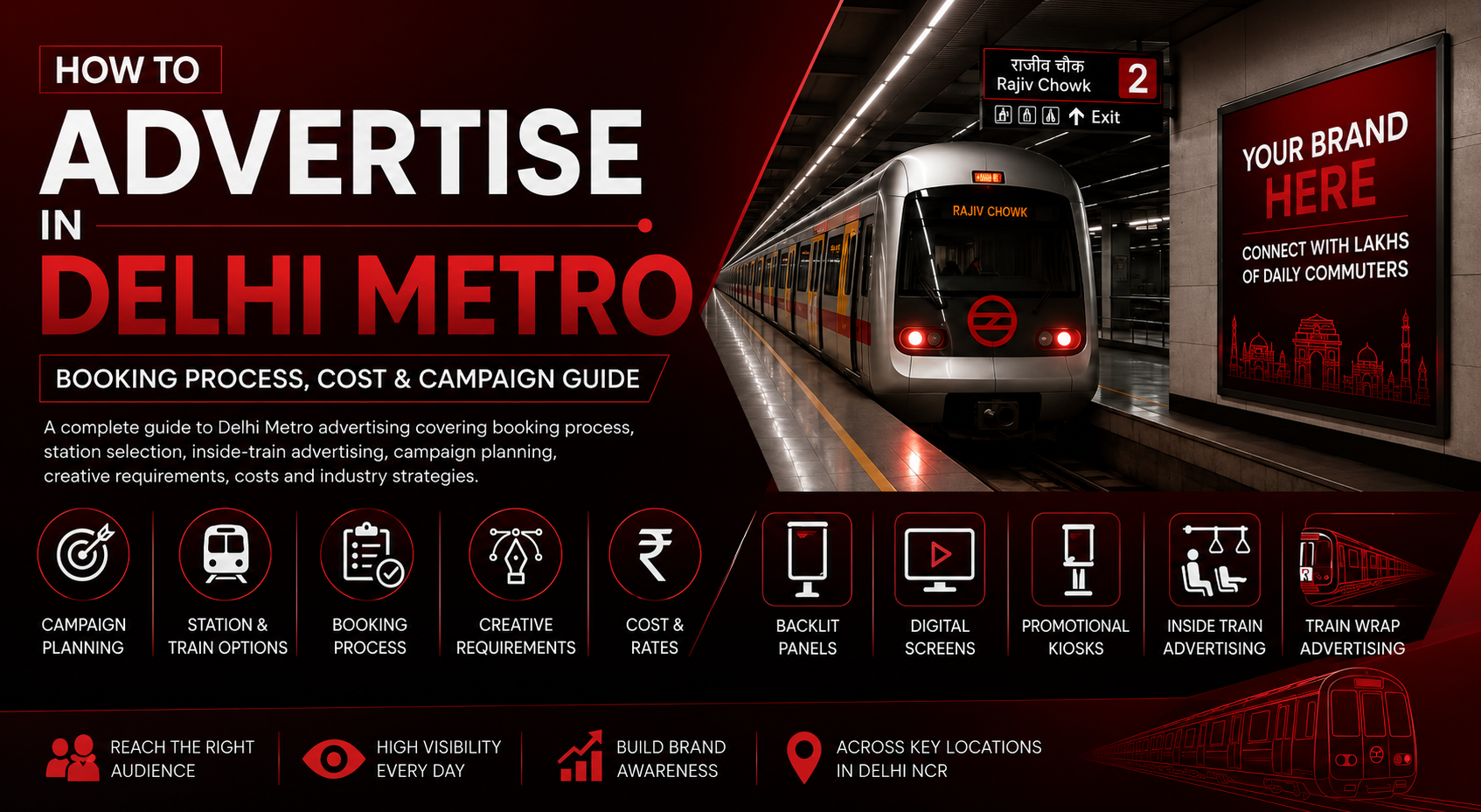
How to Advertise in Delhi Metro: Booking Process, Campaign Planning & Industry Guide
Advertising in the Delhi Metro gives brands access to one of India's largest urban commuter networks, connecting major business districts, residential areas, educational hubs, shopping destinations, transport interchanges, and commercial centres across Delhi NCR. However, an effective metro advertising campaign requires more than simply selecting a station and installing an advertisement. Station selection, audience targeting, media format, campaign duration, creative planning, budget allocation, and execution all influence campaign performance.
For advertisers exploring how to advertise in Delhi Metro, the process generally starts with defining the campaign objective and target audience, followed by selecting suitable metro lines, stations, and advertising formats. Media availability is then checked for the required campaign period, after which the advertising locations are finalised, creatives are prepared and approved, and the campaign moves into production and installation.
A well-planned Delhi Metro advertising campaign can support different marketing objectives, including brand awareness, product launches, lead generation, admissions, property enquiries, dealership visits, app downloads, and retail footfall. The strategy can also be adapted according to the industry, allowing real estate companies, educational institutions, FMCG brands, automobile companies, banks, financial services providers, healthcare brands, and other advertisers to reach relevant commuter segments.
This guide explains the complete Delhi Metro advertising booking process, campaign planning approach, station and media selection, creative requirements, industry-specific strategies, budgeting considerations, campaign duration, and performance measurement to help advertisers plan Delhi Metro campaigns more effectively.
How Does Delhi Metro Advertising Work?
Delhi Metro advertising allows brands to reach commuters through advertising opportunities available across metro stations, inside metro trains, and on train exteriors. Campaigns can be planned at individual stations, across multiple stations, on selected metro routes, inside trains, or through a combination of station and train advertising depending on the campaign objective, target audience, geographic market, and budget.
The process begins by defining the campaign objective and target audience. A real estate developer may want to reach potential homebuyers travelling between Delhi, Noida, and Gurugram, while an educational institution may focus on routes and stations frequently used by students. FMCG brands may prioritise high-footfall stations and inside-train advertising for repeated commuter exposure, while banks, fintech companies, and automobile brands may target routes serving major corporate and commercial districts.
Once the audience is identified, suitable Delhi Metro lines, stations, trains, and advertising formats are shortlisted. Station advertising can provide strong visibility at entry and exit points, concourses, platforms, and other high-movement areas. Inside-train advertising reaches passengers during their journey, when they spend several minutes inside the coach, creating opportunities for repeated and sustained brand exposure. Train exterior advertising, including train wraps, provides moving brand visibility as trains operate across the network.
Advertisers can use these environments individually or combine them within the same campaign. For example, a brand may use high-visibility advertising at selected stations while simultaneously running inside-train media on relevant routes. Larger campaigns may combine station advertising, inside-train advertising, and train wraps to build visibility across multiple stages of the commuter journey.
After the locations and formats are shortlisted, the required advertising inventory is checked for availability for the proposed campaign period. Availability can vary by station, metro line, train, media format, and campaign dates, particularly for premium locations and high-demand advertising inventory.
Once the media plan and inventory are finalised, creatives are prepared according to the dimensions and technical specifications of each selected advertising unit. The artwork then goes through the applicable approval process before production, printing, installation, or digital deployment.
After installation, campaign execution should be monitored throughout the scheduled period. Installation photographs, display verification, and campaign reports help advertisers confirm that the selected station and train advertising inventory has been executed according to the approved media plan.
The Delhi Metro advertising process can therefore be understood as:
Campaign Objective → Target Audience → Metro Line & Station Selection → Station / Inside-Train / Train Exterior Media Selection → Inventory Availability → Media Finalisation → Creative Development & Approval → Production → Installation → Campaign Monitoring
Following this structured approach helps advertisers plan Delhi Metro campaigns around the complete commuter journey rather than viewing metro advertising only as station-based media.
Delhi Metro Advertising Booking Process
The Delhi Metro advertising booking process involves selecting the right advertising locations and formats, checking media availability, finalising the campaign period, completing the required approvals, and coordinating production and installation. Since advertising inventory can differ across stations, metro lines, and trains, advertisers should plan the campaign before the intended launch date.
1. Define the Campaign Objective
The first step is to determine what the campaign needs to achieve. Objectives may include brand awareness, product launch, lead generation, property enquiries, admissions, retail footfall, dealership visits, app downloads, or promotion of a specific offer. The objective influences the locations, formats, campaign duration, and overall media strategy.
2. Identify the Target Audience
Advertisers should define the commuter segments they want to reach. Delhi Metro serves office professionals, business travellers, students, shoppers, tourists, residents, government employees, and daily commuters across Delhi NCR. Understanding the target audience helps identify the metro routes and stations most relevant to the campaign.
3. Select Metro Lines, Stations and Routes
The next step is deciding where the campaign should run. Selection should consider station footfall, interchange connectivity, surrounding residential and commercial catchments, nearby business districts, educational hubs, shopping destinations, and connectivity with Noida, Gurugram, Ghaziabad and Faridabad.
Advertisers planning inside-train campaigns should also evaluate the routes on which their target audience is most likely to travel.
4. Choose the Advertising Format
Depending on campaign requirements and available inventory, brands can choose between station advertising, inside-train advertising, and train exterior advertising.
Station campaigns can use formats such as Backlit Panels, Digital LED Screens, Promotional Kiosks, Experiential Activations, and Full Station Branding. Inside-train campaigns use approved advertising spaces within metro coaches, while Train Wrap Advertising provides high-impact branding on train exteriors.
A campaign can use one format or combine multiple formats to reach commuters at different stages of their journey.
5. Check Advertising Inventory Availability
Once the preferred stations, routes, and formats have been shortlisted, availability needs to be checked for the required campaign dates. Metro advertising inventory is subject to availability, and premium media units at high-footfall or strategically important stations may have greater advertiser demand.
For this reason, availability should be confirmed before the final media plan or creative production is completed.
6. Finalise the Media Plan and Campaign Duration
After checking availability, the final media plan is prepared with the confirmed stations, routes, media formats, number of units, campaign period, and applicable advertising cost.
Campaign duration should be aligned with the marketing objective. A product launch or event campaign may require concentrated visibility for a shorter period, while sustained brand-building campaigns may benefit from longer exposure.
7. Prepare and Submit the Creative
Artwork is prepared according to the specifications of the selected advertising inventory. Creative dimensions can vary significantly between backlit panels, digital screens, inside-train media, and train wraps, so advertisers should avoid developing final artwork before receiving the required media specifications.
The creative is then submitted for the applicable approval process.
8. Production and Installation
Once the creative has been approved, the campaign moves into production. Static media may require printing and fabrication, while digital campaigns require correctly formatted creative files. Inside-train advertising and train wraps also require production according to their respective specifications.
The approved advertising material is then installed or deployed on the confirmed media inventory.
9. Verify Campaign Execution
Advertisers should receive installation photographs or other proof of execution after the campaign goes live. This is particularly important for campaigns running across multiple stations or trains, as it helps verify that the booked advertising inventory has been deployed at the agreed locations.
10. Monitor the Campaign
Campaign monitoring should continue throughout the booked duration rather than ending after installation. Advertisers should verify that the advertising remains displayed for the complete campaign period and address any execution or maintenance issues that may arise.
A properly managed booking process therefore covers the complete campaign lifecycle — from media planning and availability checking to approvals, installation, verification, and ongoing campaign monitoring.
How to Plan a Delhi Metro Advertising Campaign
Effective Delhi Metro advertising campaign planning requires the right combination of audience, geography, metro routes, stations, advertising formats, frequency, campaign duration, and budget. Instead of selecting media only based on station footfall or cost, advertisers should build the campaign around where their target audience travels and how frequently they can be exposed to the brand.
Start With the Campaign Objective: The media plan should begin with a clearly defined marketing objective. A brand-awareness campaign may require wider coverage across high-footfall stations and metro routes, while a lead-generation campaign may concentrate advertising around specific catchment areas. Product launches may benefit from a combination of station and train advertising, whereas local businesses may achieve better efficiency by focusing on selected stations close to their service areas.
Plan Around the Target Audience: Different parts of the Delhi Metro network serve different commuter profiles. Corporate corridors attract office professionals and business executives, university and coaching areas have a stronger student audience, commercial markets attract shoppers and traders, while major interchange stations bring together passengers travelling from several parts of Delhi NCR.
Advertisers should therefore identify who they want to reach before deciding where to advertise. Audience relevance can often be more valuable than simply choosing the station with the highest passenger movement.
Select the Right Geographic Market: Delhi Metro connects Delhi with important NCR markets including Noida, Gurugram, Ghaziabad and Faridabad. Geographic targeting should reflect where customers live, work, study, shop, or travel.
For example, a property developer promoting a project in Noida may concentrate the campaign on routes carrying commuters towards Noida rather than spreading the same budget across unrelated parts of the network. Similarly, a business targeting corporate professionals can prioritise metro corridors serving major office and commercial districts.
Decide Between Station and Train Advertising: Station and train advertising perform different roles within a campaign.
Station advertising is useful when the advertiser wants visibility at specific geographic locations. Backlit Panels, Digital LED Screens, Promotional Kiosks, Experiential Activations, and Full Station Branding can help brands dominate selected commuter touchpoints.
Inside-train advertising travels with passengers and provides exposure during the journey. It can be particularly useful for campaigns seeking repeated visibility among commuters using the same routes regularly.
Train Wrap Advertising creates large-format moving visibility and can support high-impact brand-awareness and product-launch campaigns.
Brands can also combine station, inside-train, and train exterior advertising to build multiple touchpoints across the commuter journey.
Balance High-Footfall and Targeted Stations: High-footfall and interchange stations can provide large-scale visibility, but they should not automatically receive the entire campaign budget. A smaller station located directly within the advertiser's target market may sometimes deliver a more relevant audience.
A balanced media plan can combine major interchange stations for reach with strategically selected stations for geographic and audience relevance.
Build Frequency Into the Campaign: Metro advertising benefits from the repetitive nature of daily commuting. Many passengers travel on similar routes several times each week, giving brands opportunities for repeated exposure.
Campaign planning should therefore consider not only how many commuters may see the advertising but also how often the target audience is likely to encounter it. Inside-train advertising, station media on regular commuter routes, and multi-station campaigns can all contribute to stronger frequency.
Allocate the Budget Strategically: The campaign budget should be distributed according to the marketing objective rather than simply divided equally among stations. Premium stations, larger formats, extensive station branding, inside-train campaigns, and train wraps can require different levels of investment.
When the budget is limited, concentrating on fewer but highly relevant locations can be more effective than spreading the campaign too thinly across the network.
Plan the Campaign Duration: Campaign duration should provide sufficient time for the target audience to receive repeated exposure. Short campaigns can support events, limited-period offers, launches, or announcements, while longer campaigns are better suited to sustained awareness, property marketing, admissions, financial services, automobile campaigns, and other categories with longer customer decision cycles.
Combine Reach, Relevance and Repetition: A strong Delhi Metro media plan should ultimately balance three factors:
Reach — how many relevant commuters the campaign can potentially expose.
Relevance — whether the selected stations and routes match the intended audience and geographic market.
Repetition — how frequently commuters may encounter the campaign during the advertising period.
The most effective Delhi Metro advertising strategy is therefore not necessarily the one with the maximum number of stations. It is the one that places the brand at the right commuter touchpoints, on the right routes, using appropriate advertising formats for long enough to build meaningful visibility and recall.
How to Choose the Right Delhi Metro Stations for Advertising
Choosing the right stations is one of the most important decisions in a Delhi Metro advertising campaign. High passenger footfall is valuable, but footfall alone should not determine the media plan. The best stations are those that combine strong commuter movement with the advertiser's target audience, geographic market, campaign objective, and budget.
Select Stations Based on Target Audience: Different Delhi Metro stations attract different commuter profiles depending on their location and surrounding catchment. Stations serving major office districts provide access to corporate professionals and employees, while stations near universities and educational hubs can be more relevant for student-focused campaigns. Similarly, stations connected with shopping markets, residential areas, tourist destinations, hospitals, and transport hubs provide access to different audience groups.
Advertisers should therefore evaluate who uses a station and why they travel through it, rather than selecting stations solely because they are well known.
Consider High-Footfall and Interchange Stations: Major interchange stations provide access to commuters moving between different metro lines and can generate significant advertising visibility. Stations such as Rajiv Chowk metro station, Kashmere Gate, Hauz Khas, Mandi House, New Delhi and Botanical Garden can be important locations because they connect major routes and attract passengers travelling across different parts of Delhi NCR.
These stations can be particularly suitable for large-scale brand awareness, product launches, consumer brands, financial services, technology companies, and other campaigns seeking broad commuter exposure.
Target Business and Corporate Corridors: Brands targeting working professionals, executives, business owners, and corporate audiences can prioritise stations serving major commercial and office districts.
Locations around Connaught Place, Barakhamba Road, Gurugram business districts and major Noida commercial corridors can be relevant for banking, fintech, insurance, automobile, technology, B2B, premium consumer, and corporate campaigns.
Use Geographic Targeting for Local Campaigns: Not every campaign requires network-wide visibility. Advertisers with a strong geographic objective can concentrate their budget around stations that serve their business or customer catchment.
A real estate developer promoting a residential project in Noida, for example, can prioritise stations and routes used by commuters travelling towards Noida. Similarly, a hospital, shopping centre, educational institution, automobile dealership, or local retailer can focus advertising around stations within its primary catchment area.
This approach can reduce media wastage and make the campaign more relevant to potential customers.
Consider Stations Near Transport Hubs: Metro stations connected with or located close to major railway stations, bus terminals, and airports can provide access to a broader mix of daily commuters and travellers. New Delhi, Anand Vihar, Kashmere Gate and Airport Express-connected locations can be useful when the campaign needs exposure among business travellers, tourists, interstate passengers, railway passengers, and airport travellers in addition to regular metro commuters.
Evaluate the Advertising Inventory Available at Each Station: A strategically relevant station may not always have the advertising format required for a particular campaign. Available inventory can vary by station and campaign period.
Advertisers should therefore evaluate the actual media locations available inside the shortlisted stations, including their visibility, placement, size, passenger movement around the unit, and suitability for the creative concept. The quality and relevance of the advertising location can be as important as the overall popularity of the station.
Combine Major and Targeted Stations: For larger campaigns, a combination of high-footfall interchange stations and audience-specific stations can provide a better balance between reach and targeting.
For example, a campaign may use Rajiv Chowk or Kashmere Gate for broad visibility while adding selected stations in Noida, Gurugram, South Delhi, East Delhi, or other relevant catchments to strengthen geographic targeting.
This creates a network where major stations generate scale while targeted stations improve audience relevance.
Do Not Limit Station Selection to Footfall: The busiest station is not automatically the best station for every advertiser. Station selection should consider:
Audience Profile + Catchment Area + Metro Connectivity + Commuter Movement + Advertising Inventory + Campaign Objective + Budget
The right Delhi Metro stations for advertising are ultimately those where the advertiser's target customers are most likely to travel and where suitable media inventory can deliver meaningful visibility throughout the campaign.
Choosing the Right Delhi Metro Advertising Format
Selecting the right Delhi Metro advertising format is as important as selecting the right stations and routes. Each format creates a different type of visibility and commuter interaction, so the choice should depend on the campaign objective, target audience, required reach, campaign duration, creative strategy, and budget.
Delhi Metro campaigns can broadly use station advertising, inside-train advertising, and train exterior advertising. Advertisers can select a single format or combine multiple formats to create visibility across different stages of the commuter journey.
Backlit Panels: Backlit Panels provide illuminated static advertising visibility at selected locations within metro stations. They are suitable for brand campaigns that require clear and continuous display throughout the campaign period.
The format can work well for real estate, education, banking, financial services, healthcare, automobiles, consumer brands, retail, and technology companies. Strong branding, a concise message, and easy-to-read creative are particularly important because passengers may encounter the advertisement while moving through the station.
Digital LED Screens: Digital LED Screens allow brands to display dynamic advertising creatives at selected metro stations. Motion, multiple creative frames, product demonstrations, promotional messages, and campaign variations can make digital screens useful for brands seeking more flexible communication.
They can be particularly effective for product launches, entertainment, OTT platforms, smartphones, automobiles, fintech, e-commerce, FMCG, retail promotions, and time-sensitive campaigns.
Creative should remain simple despite the ability to use motion. Commuters often see screens for only a limited period while walking through the station, so the brand and primary message should be immediately recognisable.
Inside-Train Advertising: Inside Delhi Metro train advertising reaches passengers after they enter the coach and remains visible during their journey. Unlike media that commuters may pass while entering or leaving a station, in-coach advertising can provide longer viewing opportunities and repeated exposure among passengers who regularly travel on the same routes.
Inside-train media can be useful for education, fintech, apps, e-commerce, FMCG, healthcare, real estate, consumer services, entertainment, and other brands that benefit from repeated communication.
Campaigns should use the approved in-coach advertising inventory available for the selected trains and routes, with creatives designed according to the specifications of each media unit.
Train Wrap Advertising: Delhi Metro Train Wrap Advertising transforms the exterior of a metro train into a large-format moving branding medium. As the train travels across the route and enters different stations, the campaign receives visibility across multiple locations instead of remaining restricted to one station.
Train wraps are particularly suitable for large product launches, automobile brands, consumer electronics, FMCG, real estate, entertainment, e-commerce, financial services, and national brand campaigns seeking high visual impact.
Because of the scale of the format, creative design should prioritise strong brand identity, large visual elements, and a message that can be understood quickly.
Promotional Kiosks: Promotional Kiosks allow brands to create a more direct presence at selected metro stations. Depending on the approved activity and location, they can support product demonstrations, sampling, lead generation, customer interaction, registrations, enquiries, and promotional campaigns.
This makes kiosks particularly useful for advertisers that want commuter engagement rather than visibility alone.
Experiential Activations: Experiential Activations can turn metro advertising into an interactive brand experience. Campaigns may be designed around product launches, demonstrations, engagement activities, technology experiences, or other approved promotional concepts.
They are especially relevant when the objective is to encourage commuters to interact with, experience, or remember the brand, rather than simply view an advertisement.
Full Station Branding: Full Station Branding provides extensive visibility across multiple approved advertising assets within a selected station. Instead of relying on a single media unit, brands can create a stronger presence by using several touchpoints across the commuter environment.
This format is generally more suitable for major launches, large awareness campaigns, market-entry campaigns, and brands seeking high-impact dominance at strategically important stations.
Which Delhi Metro Advertising Format Should You Choose?
There is no single format that works best for every campaign. The selection should depend on what the advertiser wants to achieve.
Station Advertising is useful for location-specific visibility and geographic targeting.
Inside-Train Advertising is useful for sustained passenger exposure and repeated visibility during journeys.
Train Wrap Advertising is suited to high-impact moving brand visibility.
Digital Screens can support dynamic and frequently changing communication.
Promotional Kiosks and Experiential Activations are more appropriate when direct commuter interaction is required.
Full Station Branding can create strong brand dominance at selected locations.
For larger campaigns, combining station media + inside-train advertising + train exterior advertising can create multiple brand touchpoints before, during, and after the commuter journey. The final format mix should be determined by audience relevance, available inventory, campaign objective, creative requirements, duration, and budget rather than selecting media solely based on size or visibility.
Delhi Metro Advertising Creative Requirements
Creative requirements for Delhi Metro advertising depend on the selected media format, location, and available inventory. A Backlit Panel, Digital LED Screen, inside-train advertising unit, Train Wrap, Promotional Kiosk, or Full Station Branding campaign can have different dimensions and production specifications. Advertisers should therefore obtain the specifications for the confirmed media inventory before preparing final artwork.
Follow the Specifications of the Selected Media Unit: There is no single standard creative size applicable to every Delhi Metro advertising format. Dimensions can vary between stations and media units, while inside-train and train exterior advertising have their own specifications.
Once inventory is confirmed, advertisers should prepare artwork according to the exact dimensions, orientation, file format, resolution, and production requirements provided for the selected media.
Final artwork should not be sent for printing or production until the applicable specifications and creative have been approved.
Design for Commuter Viewing Conditions: Metro passengers are frequently walking through entrances, concourses, platforms, interchange areas, and exits. Advertising placed in these environments must communicate quickly.
Creatives should generally prioritise a prominent brand identity, clear headline, strong visual hierarchy, limited copy, and easily identifiable product or service. Important information should remain readable from the expected viewing distance.
Inside-train advertising provides a different viewing environment because passengers may spend more time near the media. This can allow slightly more detailed communication, but the creative should remain clear and uncluttered.
Keep the Main Message Simple: Trying to communicate too many offers, features, contact details, or messages within one creative can reduce its impact. The advertisement should ideally have one primary communication objective.
A property campaign, for example, may prioritise the project name, location, starting price or key proposition and enquiry CTA. An education campaign may focus on admissions, programme, institution and application CTA. A consumer brand may rely more heavily on product imagery and a short brand message.
Use Clear Calls to Action: Campaigns designed to generate enquiries or measurable responses should include an appropriate call to action (CTA). Depending on the campaign, this could include a website, QR code, phone number, app-download instruction, store location, admission enquiry, property enquiry, or campaign-specific landing page.
The CTA should be easy to understand and should not compete visually with the main brand message.
Use QR Codes Carefully: QR codes can connect offline metro advertising with digital actions such as landing-page visits, app downloads, registrations, property enquiries, admission forms, offers, or product information.
However, their usefulness depends on placement. A QR code is more practical where commuters have sufficient time and proximity to scan it, such as selected waiting areas or inside trains. It may be less effective for advertising that passengers see only briefly while moving.
Prepare Digital Creatives for Screen-Based Media: For Digital LED Screen Advertising, creative files should follow the technical requirements of the selected screen inventory. Advertisers may use motion or multiple frames where permitted, but the essential brand message should appear quickly.
Digital creative should not depend on long sequences to communicate the main message because commuters may enter the viewing area at different points during playback.
Plan Inside-Train Creatives for Longer Exposure: Inside-train advertising offers an opportunity to communicate with passengers during their journey. Creative can therefore be designed differently from fast-viewing station media.
Brands may use this environment for product benefits, service information, campaign storytelling, QR-led actions, offers, or lead-generation messaging, provided the advertisement remains easy to read and follows the specifications of the approved in-coach inventory.
Train Wrap Creative Requires a Different Approach: Train Wrap Advertising should be designed for visibility at scale. Since the train itself becomes a moving advertising surface, the creative should rely on strong branding, large visual elements, simple messaging, and high brand recognition.
Small text and excessive information should be avoided because passengers may view the train from varying distances and for relatively short periods.
Creative Approval Before Production: Creative material should go through the applicable approval process before printing, fabrication, installation, or digital deployment. Advertisers should account for this stage when planning the campaign timeline rather than completing artwork immediately before the proposed launch date.
Any required creative revisions should be completed before production begins.
Maintain Consistency Across Multiple Formats: Campaigns using station advertising, inside-train media, digital screens, and train wraps should maintain a consistent brand identity, core message, visual language, and CTA while adapting the artwork to each format.
The creative should not simply be resized from one media unit to another. Each format should be designed around its dimensions, viewing distance, commuter dwell time, and placement.
Effective Delhi Metro advertising creative combines technical compliance with simplicity and visibility. The objective is not to place the maximum amount of information on the available space, but to communicate the most important message clearly within the time and environment in which commuters will see it.
Delhi Metro Advertising by Industry
Different industries use Delhi Metro advertising for different marketing objectives. A real estate company may focus on generating enquiries in a specific geographic corridor, while an FMCG brand may prioritise mass visibility and repeated exposure. Educational institutions can target student-heavy routes, whereas banks, fintech companies, automobile brands, and healthcare providers may select stations and metro routes according to their customer profiles.
Industry-specific planning helps determine the right combination of stations, routes, inside-train advertising, train wraps, media formats, campaign duration, and creative messaging.
Real Estate Advertising in Delhi Metro: Delhi Metro advertising for real estate can be particularly effective because property marketing is strongly influenced by location. Developers can plan campaigns around metro routes connecting potential homebuyers with residential and commercial projects across Delhi NCR.
For a project in Noida, the campaign can prioritise relevant routes and stations connecting Delhi with Noida. Projects in Gurugram can focus on commuter corridors used by corporate professionals and potential buyers travelling towards major business districts. Similar location-based strategies can be developed for projects in Delhi, Ghaziabad, and Faridabad.
Backlit Panels and Digital LED Screens can build visibility at selected stations, while inside-train advertising can provide repeated exposure during regular commuter journeys. Train Wrap Advertising and Full Station Branding can be considered for larger project launches requiring stronger market presence.
Real estate creatives should communicate the project name, location, key proposition, price or offer where applicable, and a clear enquiry CTA without overcrowding the advertisement.
Education Advertising in Delhi Metro: Universities, colleges, schools, coaching institutes, training centres, edtech companies, and professional education providers can use Delhi Metro advertising for education campaigns, particularly during admission and enrolment periods.
Campaign planning should focus on routes and stations used by students, young professionals, parents, and commuters travelling towards educational areas. Inside-train advertising can be useful where brands want more time to communicate courses, admissions, entrance preparation, or career-related information.
Station advertising can support geographic targeting around campuses and educational catchments, while Digital LED Screens can promote admission deadlines, new programmes, scholarships, entrance examinations, or other time-sensitive communication.
A strong education creative should make the institution, programme, admission message, application period, and response mechanism immediately clear.
FMCG Advertising in Delhi Metro: FMCG brands generally require high reach, strong visibility, and repeated consumer exposure. The large and diverse commuter audience makes Delhi Metro advertising for FMCG brands suitable for product launches, brand-building campaigns, new variants, seasonal promotions, and mass-consumer communication.
High-footfall stations and interchange locations can support broad visibility, while inside-train advertising can reinforce the campaign through repeated commuter exposure. Digital Screens can be used for product-focused creative, and Train Wrap Advertising can provide large-format moving visibility across a metro route.
FMCG creative should generally remain product-led, visually distinctive, and easy to understand quickly. For new launches, combining station and train advertising can help increase campaign frequency across multiple commuter touchpoints.
Automobile and EV Advertising in Delhi Metro: Automobile manufacturers, EV companies, two-wheeler brands, dealerships, mobility platforms, and automotive service companies can use Delhi Metro advertising to reach working professionals, business executives, families, and urban consumers.
Campaigns can be planned around corporate districts, residential catchments, premium commercial areas, and locations near dealerships. New vehicle launches can use Digital LED Screens, Backlit Panels, Train Wrap Advertising, and high-impact station branding to create visibility, while inside-train media can communicate product features, finance offers, test-drive campaigns, or EV benefits in greater detail.
A clear CTA directing commuters towards test-drive bookings, dealership visits, product pages, or QR-based enquiries can help connect metro visibility with measurable consumer action.
Banking, Finance and Fintech Advertising in Delhi Metro: Banks, insurance companies, investment platforms, credit-card providers, NBFCs, payment companies, and fintech brands can use Delhi Metro advertising for financial services to reach salaried professionals, business owners, students, families, and digitally active urban consumers.
Stations and routes serving major office and business districts can be particularly relevant for campaigns promoting banking products, credit cards, loans, investment services, insurance, digital payments, and financial apps.
Inside-train advertising provides an opportunity to explain a proposition in greater detail, while station media can build strong brand visibility. QR codes and concise CTAs can direct interested commuters towards applications, eligibility checks, app downloads, or product information.
Financial advertising should keep the primary benefit clear while ensuring that any necessary terms, disclaimers, and other applicable requirements are appropriately incorporated into the creative.
Healthcare Advertising in Delhi Metro: Hospitals, diagnostic centres, healthcare networks, speciality clinics, wellness providers, and other healthcare brands can use metro advertising to build awareness within relevant geographic catchments.
Station selection can be based on proximity to healthcare facilities, residential areas, office districts, and routes used by the intended patient audience. For hospitals and diagnostic networks with multiple locations, campaigns can also be planned across several stations to build broader regional visibility.
Backlit Panels and Digital LED Screens can communicate hospital services, speciality departments, health packages, or new facilities, while inside-train advertising can provide additional space for informative communication.
Healthcare campaigns should prioritise clear branding, location information, contact or appointment details, and simple messaging that commuters can understand easily.
Match the Metro Strategy to the Industry: The same Delhi Metro media plan should not be applied to every advertiser. Each industry has a different audience, geographic requirement, customer decision cycle, and campaign objective.
A real estate advertiser may prioritise location and lead generation, an education brand may focus on students and admission periods, FMCG may require reach and repetition, automobile brands may focus on launch visibility and test drives, financial services may target working and digitally active commuters, while healthcare advertisers may prioritise local catchment and accessibility.
The strongest industry-specific campaigns therefore combine the right audience + metro route + station + advertising format + campaign duration + creative message, rather than relying on a generic network-wide approach.
Delhi Metro Advertising Strategy by Campaign Objective
The right Delhi Metro advertising strategy depends on what the campaign is expected to achieve. A campaign designed for mass brand awareness requires a different media mix from one focused on property enquiries, admissions, app downloads, retail visits, or product launches. Defining the objective before selecting stations and advertising formats helps advertisers use their budget more efficiently.
Brand Awareness: For brand-awareness campaigns, the primary objective is to build visibility and recall among a large commuter audience. Advertisers can prioritise high-footfall stations, major interchange stations, inside-train advertising, Train Wrap Advertising, and multi-station campaigns to increase reach and frequency.
Large brands may also combine Full Station Branding with train advertising to maintain visibility across multiple stages of the commuter journey.
Brand-awareness creatives should generally focus on a strong brand identity, memorable visuals, and a concise message rather than multiple offers or detailed information.
Product or Service Launch: Delhi Metro advertising can support the launch of a new product, service, store, app, vehicle, property project, financial product, or consumer offering by creating concentrated visibility during the launch period.
Digital LED Screens can provide dynamic product communication, while Backlit Panels can maintain continuous visibility at selected stations. Train Wrap Advertising can create high-impact moving visibility, and inside-train media can provide additional opportunities to communicate product features and benefits.
For major launches, combining station and train advertising can create a stronger presence than relying on a single media format.
Lead Generation: Campaigns for real estate, education, financial services, healthcare, automobile dealerships, and other enquiry-driven businesses can be planned specifically around lead generation.
Instead of maximising network-wide reach, advertisers can concentrate on stations and routes that closely match their target customers. The creative should include a clear response mechanism such as a QR code, enquiry number, landing page, registration link, or other trackable CTA.
Inside-train advertising and suitable station locations can be particularly useful where commuters have enough time to understand the offer and take action.
Retail and Store Footfall: Retailers, restaurants, shopping centres, entertainment destinations, clinics, dealerships, and other location-based businesses can use metro advertising to influence visits within a specific catchment.
Stations close to the business location are generally more relevant than distant high-footfall stations. Creative can highlight the store or destination name, nearby location, offer, distance where appropriate, and a clear directional or visit-focused CTA.
This approach makes metro advertising a geographically targeted medium rather than simply a mass-awareness channel.
App Downloads and Digital Actions: Fintech companies, e-commerce platforms, OTT services, food delivery apps, mobility services, gaming companies, and other digital businesses can connect metro advertising with online user acquisition.
QR codes, memorable URLs, promotional codes, and clear download instructions can encourage commuters to move from the physical advertisement to a digital platform. Inside-train media can be particularly useful for this objective because passengers may have more time to scan a QR code or interact with their phones during the journey.
Campaign-specific landing pages or tracking mechanisms can also help measure responses generated during the advertising period.
Admissions and Enrolments: Universities, colleges, coaching institutes, training centres, and education platforms can align metro campaigns with admission cycles, entrance examinations, application deadlines, and new academic sessions.
Station and route selection should focus on student and parent audiences, while the creative should clearly communicate the institution, programme, admission status, important dates, and application CTA.
A campaign can begin with broader awareness and become more response-driven as the application deadline approaches.
Property Enquiries and Project Launches: Real estate campaigns can use Delhi Metro advertising to reach prospective buyers based on the location of the project and the routes they use.
A new project launch may use high-impact station media or Train Wrap Advertising to build awareness, while Backlit Panels and inside-train media can maintain repeated exposure over a longer campaign period. QR codes, enquiry numbers, project websites, and site-visit CTAs can support lead generation.
The media plan should connect the project location with the commuter catchment, rather than selecting stations solely on overall footfall.
Events, Offers and Short-Term Promotions: Metro advertising can also support events, exhibitions, festivals, sales, seasonal promotions, and limited-period offers. These campaigns generally require concentrated visibility within a defined period.
Digital LED Screens can be useful when dates, offers, or campaign messages need greater flexibility, while station advertising can target commuters close to the event or participating locations.
For time-sensitive campaigns, planning and approvals should be completed sufficiently in advance so that the media goes live for the full intended promotional period.
Match Media Selection With the Campaign Goal: There is no universal Delhi Metro advertising strategy suitable for every marketing objective. Media selection should follow the desired outcome:
Brand Awareness → Reach + Frequency
Product Launch → Visibility + Impact
Lead Generation → Audience Relevance + Response
Retail Footfall → Geographic Proximity + CTA
App Downloads → Repeated Exposure + Digital Action
Admissions → Student Targeting + Timing
Real Estate → Catchment Targeting + Enquiries
A campaign becomes more effective when stations, routes, inside-train media, train exterior advertising, campaign duration, and creative communication are selected around a clearly defined marketing objective rather than treated as separate media-buying decisions.
How Much Budget Should You Allocate for Delhi Metro Advertising?
The budget required for a Delhi Metro advertising campaign depends on the stations, routes, advertising formats, number of media units, campaign duration, and scale of the campaign. There is no single fixed budget suitable for every advertiser because a campaign using a few selected station media units will have a very different cost structure from Full Station Branding, inside-train advertising, or Train Wrap Advertising.
Instead of starting with a fixed number of stations, advertisers should first determine their campaign objective, target audience, geographic market, and preferred duration. The available budget can then be allocated towards the locations and formats most likely to support those objectives.
Station Selection Affects the Budget: Delhi Metro Advertising costs can vary across Delhi Metro stations. Premium, high-footfall, strategically located, and major interchange stations may command higher rates than other locations.
However, the most expensive station is not necessarily the best choice for every campaign. A real estate project, hospital, educational institution, retailer, or dealership may achieve better audience relevance by investing in stations closer to its target catchment.
For limited budgets, selecting fewer but strategically relevant stations can often provide a more focused campaign than spreading the same investment across too many locations.
Advertising Format Influences Campaign Cost: Different Delhi Metro advertising formats have different cost structures. A Backlit Panel or individual Digital LED Screen campaign may require a different level of investment from Promotional Kiosks, Experiential Activations, Full Station Branding, inside-train advertising, or Train Wrap Advertising.
Larger formats and campaigns that use extensive station or train inventory generally require higher investment, while selected individual media units can provide a more focused entry point for advertisers with controlled budgets.
Inside-Train and Train Wrap Campaigns Require Separate Planning: Inside-train advertising should be budgeted according to the available in-coach inventory, number of units or trains involved, selected routes, and campaign duration.
Train Wrap Advertising is a larger-format branding opportunity and generally requires planning for the train inventory as well as creative adaptation, production, installation, and other applicable execution requirements.
Advertisers considering train media should therefore evaluate the total campaign investment, rather than comparing only the media cost with an individual station advertising unit.
Campaign Duration Changes the Overall Investment: The longer a campaign runs, the greater the total media investment is likely to be. However, campaign duration also influences repetition and brand recall because regular metro commuters can encounter the advertising multiple times.
A short-duration campaign may be suitable for an event, offer, or time-sensitive promotion, while real estate, education, financial services, automobile, healthcare, and sustained brand-awareness campaigns may require longer visibility.
The duration should therefore be decided according to the customer decision cycle and campaign objective, not simply by choosing the shortest possible booking period.
Include Production and Execution Costs: Advertisers should distinguish between the media cost and the complete campaign cost. Depending on the format, additional expenditure may include creative adaptation, printing, fabrication, mounting, installation, removal, technical production, or other execution requirements.
Digital campaigns may have fewer physical production requirements, while static displays, inside-train media, Train Wraps, and extensive station branding can involve additional production and installation costs.
These expenses should be considered at the planning stage to avoid underestimating the final campaign budget.
Focus the Budget Where It Matters Most: For advertisers with a limited budget, it is generally better to build concentration and relevance rather than attempting to cover the entire Delhi Metro network. A campaign can prioritise:
High-relevance stations where the target audience is concentrated.
Relevant routes used regularly by potential customers.
Appropriate formats based on viewing environment and campaign objective.
Sufficient duration to generate repeated commuter exposure.
Larger advertisers can expand this strategy through multiple stations, inside-train media, Train Wrap Advertising, or broader network coverage.
The right Delhi Metro advertising budget is therefore not simply the lowest or highest amount an advertiser can spend. It is the investment required to achieve an effective balance between reach, audience relevance, frequency, media visibility, and campaign duration while remaining aligned with the marketing objective.
How Long Should a Delhi Metro Advertising Campaign Run?
The ideal Delhi Metro advertising campaign duration depends on the campaign objective, industry, audience, budget, and type of advertising format selected. There is no single duration that works for every advertiser. A short promotional campaign may require concentrated visibility around specific dates, while brand-building, real estate, education, automobile, healthcare, or financial campaigns may benefit from longer and repeated commuter exposure.
Short-Term Campaigns: Short-term Delhi Metro campaigns are generally suitable for events, exhibitions, sales, limited-period offers, entertainment releases, seasonal promotions, and time-sensitive announcements.
The objective in these campaigns is to generate visibility within a defined period. Station advertising and Digital LED Screens can be useful when advertisers need to communicate dates, offers, launches, or promotional messages quickly.
The campaign should ideally begin early enough to create awareness before the event, offer, or promotion reaches its final date.
One-Month Campaigns: A one-month campaign can provide brands with repeated exposure among regular metro commuters who travel on similar routes throughout the working week. It can be suitable for product launches, retail campaigns, app promotions, admissions, consumer services, financial products, and local awareness campaigns.
Instead of spreading the available budget across too many locations, advertisers can use a one-month campaign to build stronger frequency at a carefully selected group of stations or routes.
Multi-Month Campaigns: Longer campaigns can be useful when the customer's decision process extends over several weeks or months. Categories such as real estate, higher education, automobiles, banking, insurance, healthcare, and long-term brand building may require sustained visibility rather than a short burst of exposure.
Multi-month campaigns allow regular commuters to encounter the advertising repeatedly, which can help reinforce brand familiarity and recall over time.
Inside-train advertising can also support this approach because regular passengers using the same routes may see the campaign multiple times during their daily journeys.
Campaign Duration for Product Launches: Product launches often benefit from concentrated visibility around the launch period. Brands can build awareness before the launch and maintain advertising after the product becomes available.
A campaign may combine Digital LED Screens, Backlit Panels, inside-train advertising, Train Wrap Advertising, or high-impact station media depending on the scale of the launch.
The duration should provide enough time for the campaign to move beyond initial visibility and build repeated audience exposure.
Campaign Duration for Real Estate: Property purchases have a relatively long consideration cycle. Real estate advertisers should therefore avoid evaluating a metro campaign solely on immediate enquiries during the first few days.
Longer campaigns can maintain project visibility among prospective buyers and investors while supporting project launches, site visits, enquiries, and sustained brand awareness within relevant commuter catchments.
Campaign Duration for Education: Education campaigns should be aligned with the admission and enrolment calendar. Advertising can begin during the awareness and consideration stage and increase closer to application or admission deadlines.
Universities, colleges, coaching institutes, and training providers can also change their creative during the campaign to move from general awareness messaging to more urgent application-focused communication as deadlines approach.
Consider Frequency, Not Just Number of Days: Campaign duration should ultimately be evaluated together with frequency. One of the strengths of metro advertising is the repetitive travel behaviour of daily commuters.
A passenger who uses the same station or route regularly may encounter the same campaign several times during its run. This repeated exposure can be particularly valuable for advertisers trying to build familiarity and recall.
The appropriate Delhi Metro advertising campaign duration should therefore balance campaign objective, customer decision cycle, commuter frequency, media format, geographic coverage, and available budget. Rather than simply keeping a campaign live for as long as possible, advertisers should ensure that it runs long enough to generate meaningful and repeated exposure among the intended audience.
How to Measure Delhi Metro Advertising Campaign Performance
Measuring the performance of a Delhi Metro advertising campaign requires a combination of media delivery verification, estimated audience exposure, and business-response indicators. Unlike digital advertising, where clicks and conversions can be tracked directly, metro advertising operates in a physical environment. Advertisers should therefore define measurable campaign objectives before the campaign begins and select suitable metrics for evaluating results.
Reach and Estimated Impressions: Reach and impressions help advertisers understand the potential scale of a metro campaign. Estimates can be developed using factors such as station footfall, passenger movement, selected locations, number of advertising units, routes, campaign duration, and expected frequency of exposure.
For inside-train advertising, campaign assessment can also consider the routes covered, number of coaches or media units, passenger volumes, and duration of the campaign.
Reach and impression figures should be treated as estimates unless they are supported by an established audience-measurement methodology.
Proof of Execution: Campaign measurement should begin by confirming that the booked media has actually been deployed. Advertisers should receive installation photographs, location-wise execution reports, or other applicable proof of display for the confirmed station and train inventory. For campaigns running across multiple locations, reporting should make it possible to verify individual advertising units.
This is important because campaign performance cannot be assessed properly unless the agreed media has been executed correctly.
Campaign Monitoring: Monitoring should continue after installation. Advertising units should remain displayed for the complete booked campaign period, subject to the applicable operating conditions.
Regular monitoring can help identify damaged creatives, display interruptions, installation issues, or other execution problems that could reduce the campaign's effective exposure.
QR Code Scans: QR codes can provide a direct connection between metro advertising and digital activity. Advertisers can use campaign-specific QR codes for property enquiries, admission forms, app downloads, registrations, offers, appointment bookings, product information, or landing-page visits.
Tracking scans by campaign or creative can provide an indication of direct commuter engagement.
Website and Landing-Page Traffic: Brands can monitor website activity during the campaign period, particularly when the advertisement promotes a specific website or landing page.
Campaign-specific URLs or landing pages make attribution easier than directing every campaign to the advertiser's general homepage. Changes in direct traffic, location-specific traffic, enquiry-page visits, and conversions can then be compared with the pre-campaign period.
Enquiries and Lead Generation: For real estate, education, healthcare, financial services, automobiles, and other lead-driven categories, advertisers can track calls, enquiry forms, WhatsApp enquiries, registrations, test-drive requests, site visits, or appointment bookings generated during the campaign.
Dedicated phone numbers, QR codes, landing pages, or enquiry forms can improve attribution where appropriate.
App Downloads and Registrations: App-based businesses can use dedicated QR codes, promotional codes, or campaign-specific links to track downloads, registrations, sign-ups, or other digital actions.
This can be particularly useful for fintech, e-commerce, OTT, mobility, food delivery, entertainment, and other digital-first brands.
Store, Dealership and Location Visits: Retail stores, shopping destinations, automobile dealerships, hospitals, clinics, educational institutions, and other physical locations can compare visitor activity before, during, and after a geographically targeted metro campaign.
Where suitable measurement technology or customer data is available, advertisers can also analyse changes in visits from areas surrounding the targeted metro stations.
Branded Search and Direct Traffic: A strong awareness campaign may influence consumers even when they do not respond immediately to the advertisement. Advertisers can monitor changes in branded search volume, direct website traffic, product searches, social engagement, and other brand-related digital activity during the campaign.
These indicators are particularly relevant for campaigns designed primarily to build awareness rather than generate immediate leads.
Compare Results With the Original Objective: Campaign performance should ultimately be evaluated against the objective established during planning.
A brand-awareness campaign should focus more heavily on reach, frequency, visibility, and brand-response indicators.
A lead-generation campaign should prioritise enquiries, registrations, QR scans, calls, and conversions.
A retail campaign can focus on store visits, offer redemptions, and location-based responses.
An app campaign can measure downloads, registrations, and campaign-specific digital actions.
An effective Delhi Metro advertising measurement strategy therefore combines execution verification + estimated audience exposure + trackable consumer response + business outcomes. This provides a more meaningful assessment than relying on a single metric to judge the entire campaign.
Common Mistakes to Avoid in Delhi Metro Advertising
A successful Delhi Metro advertising campaign depends not only on selecting advertising space but also on making the right decisions about stations, routes, formats, creative, duration, and execution. Avoiding common planning mistakes can help advertisers improve campaign visibility, audience relevance, and overall media efficiency.
Selecting Stations Only based on Footfall
One of the most common mistakes is assuming that the busiest metro station will automatically deliver the best results. High-footfall stations provide scale, but they may not always provide the most relevant audience for a particular advertiser.
Station selection should consider target audience, surrounding catchment, metro connectivity, commuter profile, campaign objective, available inventory, and budget alongside passenger movement.
Ignoring Inside-Train Advertising: Planning a Delhi Metro campaign only around station media can overlook an important part of the commuter journey. Inside-train advertising allows brands to remain visible while passengers travel and can provide longer viewing opportunities than some station placements.
Depending on the campaign objective and available inventory, combining station media with inside-train advertising can create stronger frequency and repeated brand exposure.
Choosing Too Many Stations With a Limited Budget: Spreading a limited budget across a large number of stations can reduce campaign concentration. In many cases, a smaller group of strategically selected stations and routes can provide greater relevance and repeated exposure among the intended audience.
The objective should be to achieve the right reach and frequency within the target market, rather than simply maximising the number of stations.
Using the Same Creative for Every Format: A Backlit Panel, Digital LED Screen, inside-train advertising unit, and Train Wrap are viewed under different conditions. Simply resizing one artwork for every format can reduce its effectiveness.
Creative should be adapted according to media dimensions, viewing distance, passenger dwell time, placement, and whether the advertising unit is static, digital, inside a coach, or moving with the train.
Overloading the Creative With Information: Metro commuters may have only a few seconds to notice and understand some advertising formats. Excessive copy, multiple offers, small text, and too many contact details can make the advertisement difficult to process.
A clear brand identity, strong visuals, concise proposition, and relevant CTA will usually communicate more effectively than attempting to include every product feature in one creative.
Using QR Codes in Unsuitable Locations: QR codes can be valuable for lead generation and digital engagement, but their effectiveness depends on where the advertising is placed.
Inside-train media and suitable waiting areas may provide passengers with enough time to scan a code, whereas fast-moving commuter areas may not. QR-led campaigns should therefore consider viewing time, distance, placement, and ease of interaction.
Booking Too Close to the Campaign Launch: Metro advertising requires inventory availability checks, media finalisation, creative preparation, applicable approvals, production, and installation. Starting the process too close to the intended launch date can restrict media choices and create unnecessary execution pressure.
Advertisers should allow adequate lead time, particularly for larger campaigns, premium inventory, inside-train media, Train Wrap Advertising, and extensive station branding.
Focusing Only on Delhi Metro Advertising Cost: Choosing inventory solely because it is cheaper can result in poor audience relevance or weaker visibility. Advertisers should compare the cost with the quality of the media location, commuter profile, target catchment, format, expected exposure, and campaign objective.
The lowest-cost media option does not necessarily provide the best campaign value.
Treating Installation as the End of the Campaign: Campaign management should not stop once the advertising has been installed. Advertisers should verify execution and monitor the campaign during the booked period.
Installation photographs, location-wise verification, and periodic monitoring can help confirm that the advertising remains displayed as planned and that execution issues are identified promptly.
Failing to Define Measurement Before Launch: If an advertiser wants to measure enquiries, QR scans, app downloads, registrations, calls, or website visits, the tracking mechanism should be prepared before the campaign goes live.
Dedicated QR codes, landing pages, promotional codes, enquiry forms, or other attribution methods are much harder to introduce after the advertising has already been produced and installed.
Avoiding these mistakes helps ensure that a Delhi Metro advertising campaign is planned as an integrated media strategy rather than simply a purchase of advertising inventory. The strongest campaigns align audience, geography, station and route selection, media format, creative, duration, execution, and measurement around the same marketing objective.
Why Work With a Delhi Metro Advertising Agency?
Planning a Delhi Metro advertising campaign involves multiple decisions, including station and route selection, media availability, advertising formats, campaign duration, creative specifications, approvals, production, installation, and campaign monitoring. Working with an experienced Delhi Metro Advertising Agency can help advertisers manage these activities through a coordinated campaign-planning and execution process.
Strategic Media Planning: An advertising agency can help identify suitable metro stations, routes, and media formats based on the advertiser's target audience, geographic market, campaign objective, duration, and budget.
Instead of selecting locations purely on footfall, the media plan can consider commuter profile, surrounding catchment, interchange connectivity, business districts, residential areas, educational hubs, and other factors relevant to the campaign.
Access to Station and Train Advertising Options: Delhi Metro campaigns are not limited to advertising within stations. Depending on available inventory, advertisers can consider station advertising, inside-train advertising, and Train Wrap Advertising.
An agency can evaluate these options together and recommend whether the campaign should focus on selected stations, train media, or a combination of both to create multiple commuter touchpoints.
Media Availability and Booking Coordination: Advertising inventory can vary across stations, routes, formats, and campaign periods. An agency can coordinate availability checks for shortlisted media and help advertisers compare suitable alternatives when preferred inventory is unavailable.
This is particularly useful for campaigns involving multiple stations, premium locations, inside-train inventory, or extensive branding requirements.
Creative Specification and Approval Coordination: Different metro advertising formats require different artwork dimensions and technical specifications. An agency can provide the applicable specifications for confirmed inventory and coordinate the creative submission and approval process before production.
This helps reduce problems caused by preparing artwork in incorrect dimensions or sending creatives for production before the required approvals are completed.
Production and Installation Management: Static station advertising, inside-train media, Train Wraps, and other physical formats can require printing, fabrication, mounting, and installation. Digital advertising requires creatives to be prepared and deployed according to the technical requirements of the selected screens.
A Delhi Metro advertising agency can coordinate these execution stages so that the approved creative is produced and installed on the confirmed inventory according to the campaign schedule.
Campaign Verification and Monitoring: Media execution should be verified after installation and monitored throughout the booked campaign period. Advertisers can receive installation photographs, location-wise execution updates, and other applicable campaign reports to confirm that the booked media has been deployed.
Ongoing monitoring is especially important for multi-location campaigns because it helps identify and address execution issues during the campaign rather than after it has ended.
Working With The Media Spaces
The Media Spaces provides end-to-end planning and execution support for Delhi Metro advertising campaigns, including media planning, station and route selection, advertising format selection, availability coordination, creative specifications, production support, installation coordination, and campaign monitoring.
Campaigns can be planned across selected metro stations, inside metro trains, and on train exteriors depending on the advertiser's target audience, campaign objective, budget, and available inventory.
For brands planning to advertise in Delhi Metro, working with an experienced agency can simplify the process by bringing media selection, booking coordination, creative requirements, execution, and monitoring under a single campaign plan.
Frequently Asked Questions About Delhi Metro Advertising
1. How can I advertise in Delhi Metro?
To advertise in Delhi Metro, advertisers generally need to define their campaign objective, identify the target audience, select suitable metro lines and stations, choose advertising formats, check inventory availability, finalise the campaign duration, prepare creatives according to the required specifications, complete the applicable approval process, and coordinate production and installation.
2. What advertising options are available in Delhi Metro?
Delhi Metro advertising opportunities can include Backlit Panels, Digital LED Screens, Promotional Kiosks, Experiential Activations, Full Station Branding, inside-train advertising, and Train Wrap Advertising, depending on the inventory available at the selected stations, routes, and campaign dates.
3. Can brands advertise inside Delhi Metro trains?
Yes. Inside Delhi Metro train advertising is available through approved in-coach advertising inventory. It allows brands to reach passengers during their journeys and can provide longer viewing opportunities and repeated exposure among regular commuters. Availability and specifications depend on the applicable train and media inventory.
4. Can I advertise on the exterior of a Delhi Metro train?
Yes. Train Wrap Advertising provides branding opportunities on metro train exteriors, subject to inventory availability and applicable specifications and approvals. It can be suitable for brands seeking high-impact moving visibility across a metro route.
5. How do I choose the right Delhi Metro stations for advertising?
Station selection should be based on the target audience, campaign objective, surrounding catchment, metro connectivity, commuter profile, available advertising inventory, and budget. High footfall is important for some campaigns, but a strategically located station with a more relevant audience may provide greater value for geographically targeted advertising.
6. Can I advertise at only one Delhi Metro station?
Yes. A campaign can be planned around a single station when the advertiser has a highly specific geographic or audience objective. Campaigns can also cover multiple stations, selected routes, inside-train media, or a combination of station and train advertising.
7. How much does Delhi Metro advertising cost?
Delhi Metro advertising cost varies according to the station, advertising format, media location, number of units, campaign duration, train inventory, and overall campaign scale. Production, printing, fabrication, installation, and other execution costs may also apply depending on the selected format.
8. How long should a Delhi Metro advertising campaign run?
Campaign duration depends on the marketing objective. Short-term campaigns can support events, offers, launches, and time-sensitive promotions, while longer campaigns may be more appropriate for brand building, real estate, education, automobiles, financial services, healthcare, and other categories with longer customer decision cycles.
9. How far in advance should Delhi Metro advertising be booked?
Advertisers should begin planning sufficiently before the intended launch date to allow time for inventory availability checks, media finalisation, creative preparation, approvals, production, and installation. Additional lead time may be required for large campaigns, premium inventory, train advertising, or extensive station branding.
10. Are creative sizes the same across all Delhi Metro advertising formats?
No. Creative dimensions and technical requirements vary by media format and inventory. Backlit Panels, Digital LED Screens, inside-train advertising, Train Wraps, and other formats can require different artwork specifications. Final creatives should therefore be prepared after the specifications for the confirmed inventory have been received.
11. Which industries can advertise in Delhi Metro?
Delhi Metro advertising can be used by a wide range of sectors, including real estate, education, FMCG, automobiles and EVs, banking, insurance, fintech, healthcare, retail, technology, e-commerce, entertainment, consumer services, and other brands, subject to applicable advertising policies and approvals.
12. Is Delhi Metro advertising suitable for local businesses?
Yes. Local businesses can use geographically targeted metro advertising by selecting stations close to their stores, hospitals, educational institutions, dealerships, offices, projects, or service areas instead of investing in a wider network campaign.
13. Can Delhi Metro advertising generate leads?
Metro advertising can support lead-generation campaigns when media selection and creative are designed around that objective. Advertisers can use QR codes, dedicated landing pages, enquiry numbers, registration forms, promotional codes, or other trackable CTAs to connect offline exposure with measurable consumer actions.
14. How can Delhi Metro advertising campaign performance be measured?
Performance can be evaluated using a combination of proof of execution, estimated reach and impressions, QR scans, website traffic, enquiries, calls, registrations, app downloads, store or dealership visits, and other campaign-specific business outcomes. Metrics should be selected before the campaign begins based on its primary objective.
15. Who can help plan and book a Delhi Metro advertising campaign?
Advertisers can work with an experienced Delhi Metro Advertising Agency such as The Media Spaces for media planning, station and route selection, inventory coordination, creative specifications, production support, installation coordination, and campaign monitoring across station and train advertising opportunities.
Plan Your Delhi Metro Advertising Campaign
Advertising in Delhi Metro can help brands reach commuters across key residential, commercial, educational, retail, and business corridors throughout Delhi NCR. However, campaign performance depends on more than simply choosing a high-footfall station. The right strategy should bring together target audience, metro routes, station selection, advertising format, campaign duration, creative communication, budget, and execution.
The Media Spaces helps brands plan and execute New Delhi Metro advertising campaigns across station advertising, inside-train advertising, and train exterior advertising. Depending on campaign requirements and available inventory, advertisers can choose from Backlit Panels, Digital LED Screens, Promotional Kiosks, Experiential Activations, Full Station Branding, inside-train media, and Train Wrap Advertising.
Campaign planning can be customised for real estate, education, FMCG, automobile and EV brands, banking, finance, fintech, healthcare, retail, technology, e-commerce, entertainment, and other industries. Media recommendations are developed according to the advertiser's audience, geographic market, marketing objective, campaign period, and available budget.
From initial media planning and inventory availability to creative specifications, production coordination, installation, and campaign monitoring, The Media Spaces provides end-to-end support for brands looking to advertise in Delhi Metro.
For advertisers ready to plan a campaign, the next step is to share the campaign objective, target audience, preferred locations or metro routes, advertising period, and approximate budget. Based on these requirements, a suitable Delhi Metro media plan can be developed with relevant station and train advertising options.
Plan your Delhi Metro advertising campaign with The Media Spaces and reach your target audience across one of Delhi NCR's most important daily commuter networks.
Latest Posts
-
-
-
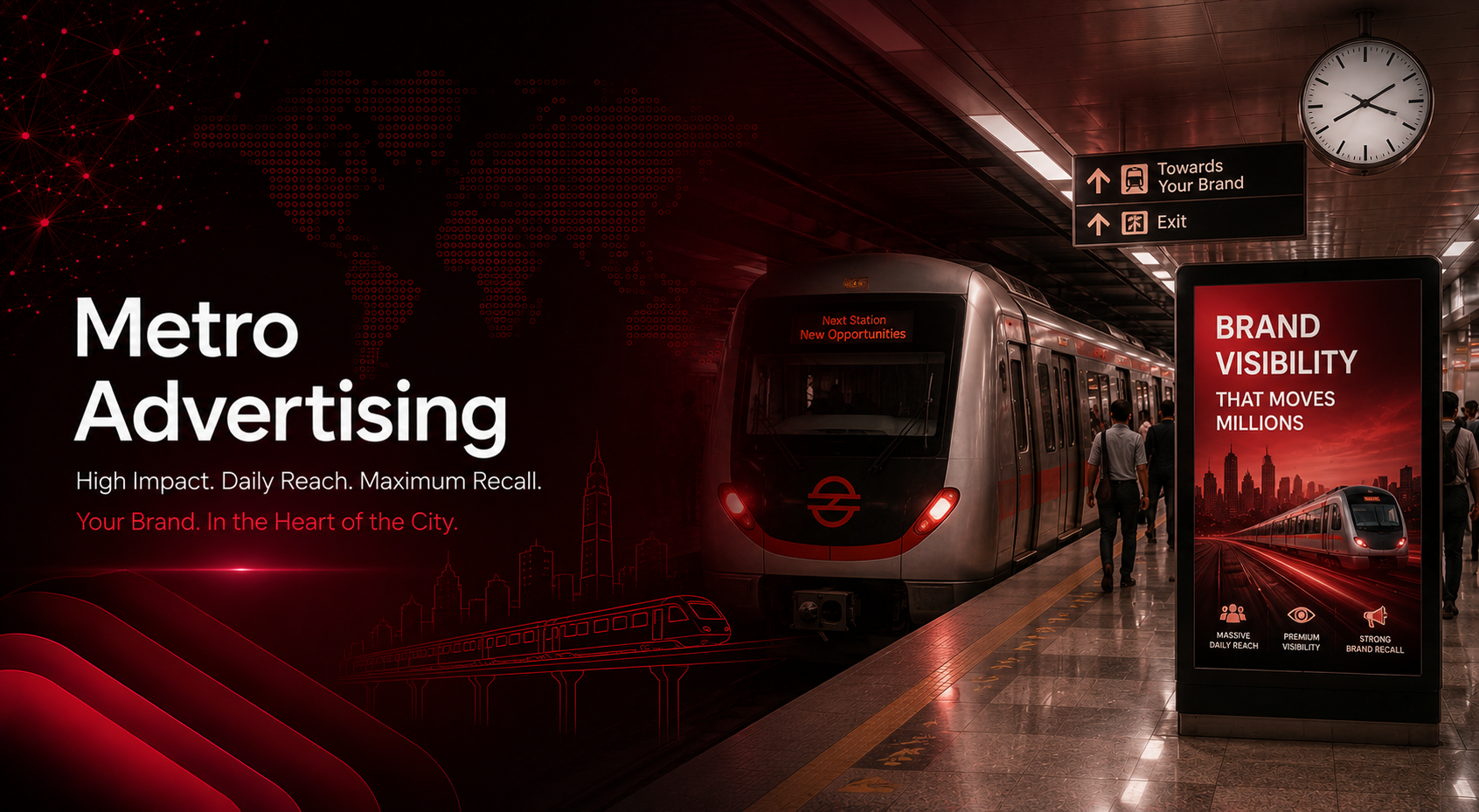
August 01, 2026