
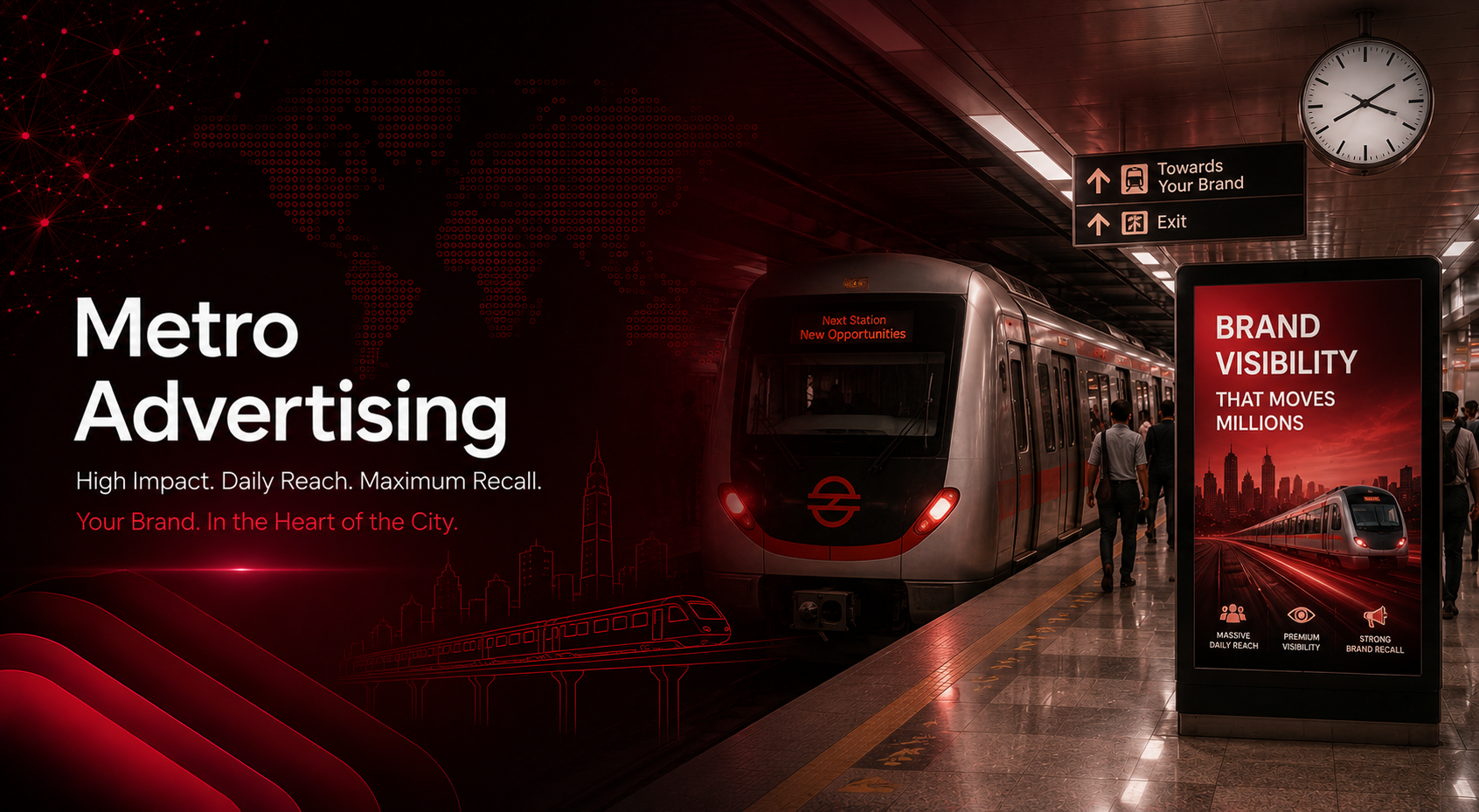
Metro Advertising: The Complete Guide
Metro advertising has become one of India's fastest-growing Out-of-Home (OOH) advertising mediums, enabling brands to reach millions of daily commuters across major cities. This comprehensive guide explains how metro advertising works, available advertising formats, costs, campaign planning, benefits, industry trends, and best practices to help businesses make informed advertising decisions.
Metro Advertising has become one of the fastest-growing transit advertising mediums, enabling brands to connect with millions of daily commuters across India's rapidly expanding metro rail networks. As urban populations grow and public transportation becomes an integral part of everyday life, metro systems have evolved beyond being just a mode of transport—they have become high-impact advertising environments where brands can engage consumers throughout their journey. From station entrances and ticketing areas to platforms, train interiors, digital screens, and train wraps, metro advertising provides multiple touchpoints to build brand awareness and reinforce marketing messages.
Unlike many traditional advertising channels, metro advertising offers consistent exposure to a diverse urban audience that includes working professionals, business executives, students, families, tourists, and daily commuters. Passengers typically spend several minutes inside metro stations and trains, giving brands repeated opportunities to communicate their message in a relatively uncluttered environment. This combination of high footfall, frequent exposure, and strategic media placements makes metro advertising an effective choice for both national campaigns and location-specific promotions.
India's metro rail infrastructure has witnessed remarkable growth over the past decade, with operational metro networks across several major cities and many more under development. As metro connectivity continues to expand, advertisers have access to an increasing range of media options, including station branding, train wraps, platform advertising, digital displays, LED video walls, escalator branding, floor graphics, and experiential marketing activations. These advertising formats allow businesses to target audiences based on city, station, commuter profile, and campaign objectives.
This comprehensive Metro Advertising Guide explores everything businesses need to know about metro advertising, including how it works, the different advertising formats available, industry trends, campaign planning, advertising costs, and best practices. Whether you are planning your first metro advertising campaign or looking to optimise an existing one, this guide will help you understand how to leverage metro media effectively to reach urban audiences and maximise your marketing impact.
What is Metro Advertising?
Metro Advertising is a form of transit advertising that enables brands to promote their products and services across metro rail networks through strategically placed media inside metro stations and trains. As one of the fastest-growing segments of out-of-home (OOH) advertising, metro advertising reaches millions of commuters every day during their daily journeys. Advertisements are displayed at multiple touchpoints, including station entrances, ticketing areas, security zones, platforms, train interiors, train exteriors, digital screens, escalators, and concourse areas, ensuring continuous brand visibility throughout the commuter experience.
Unlike traditional outdoor advertising, metro advertising targets a highly engaged urban audience that includes office professionals, students, business travellers, shoppers, tourists, and daily commuters. Since passengers spend time waiting at stations, travelling inside trains, and moving through different station areas, they are exposed to advertisements multiple times during a single journey. This repeated exposure helps improve brand recall, increase message retention, and strengthen consumer awareness.
Metro advertising offers a wide range of media formats to suit different campaign objectives. Businesses can choose from station branding, train wrap advertising, train interior panels, platform branding, digital screens, LED video walls, floor graphics, escalator branding, smart card advertising, ticket counter branding, and experiential marketing activities. Depending on the campaign strategy, advertisers can target a single station, an entire metro line, or multiple metro networks across different cities.
Whether the objective is launching a new product, increasing brand awareness, driving footfall, promoting a retail outlet, or supporting a city-specific marketing campaign, metro advertising provides an effective platform to connect with consumers in high-footfall urban environments. With metro rail networks continuing to expand across India, metro advertising has become an essential marketing channel for brands looking to reach large, diverse, and mobile audiences in a cost-effective and impactful manner.
Evolution of Metro Advertising
Metro advertising has evolved significantly alongside the rapid expansion of urban metro rail networks. In the early years, advertising opportunities were primarily limited to static media such as posters, backlit panels, wall wraps, and signboards placed inside stations. These formats helped brands achieve visibility among daily commuters but offered limited creativity and engagement.
As metro systems expanded and commuter volumes increased, advertisers began exploring a wider range of media formats. Train wrap advertising, train interior panels, platform branding, pillar wraps, escalator branding, and station domination campaigns enabled brands to create a stronger visual presence across the entire commuter journey. Instead of relying on a single advertising location, businesses could now engage passengers at multiple touchpoints, resulting in higher message frequency and improved brand recall.
The introduction of Digital Out-of-Home (DOOH) advertising further transformed metro advertising. Modern metro stations now feature high-definition digital screens, LED video walls, interactive kiosks, and dynamic display networks capable of delivering real-time content. Unlike traditional static media, digital advertising allows brands to schedule campaigns, update creatives instantly, and display multiple advertisements throughout the day, making campaigns more flexible and efficient.
Today, metro advertising is moving towards smarter, technology-driven experiences. Interactive displays, QR code integration, NFC-enabled campaigns, and experiential activations are helping brands create meaningful engagement with commuters. Advertisers are also combining metro advertising with digital marketing channels such as social media, search advertising, and mobile applications to create seamless omnichannel campaigns that extend beyond the metro station.
As India's metro infrastructure continues to grow with new lines, modern stations, and smart city initiatives, metro advertising is expected to become even more innovative. The integration of artificial intelligence, programmatic DOOH, audience analytics, and data-driven campaign planning will enable brands to deliver more personalised, measurable, and impactful advertising experiences, making metro advertising one of the most dynamic segments of the out-of-home advertising industry.
Metro Advertising Industry in India
India's metro rail network has emerged as one of the country's most important urban transportation systems, carrying millions of passengers every day across major metropolitan cities. With increasing urbanisation, rising traffic congestion, and continuous investments in public transport infrastructure, metro rail has become the preferred mode of travel for office commuters, students, business professionals, and tourists. This rapid growth has also positioned metro networks as one of the most valuable transit advertising platforms for brands seeking consistent exposure among urban audiences.
Today, metro rail systems are operational in several Indian cities, including Delhi NCR, Mumbai, Bengaluru, Hyderabad, Chennai, Kolkata, Kochi, Ahmedabad, Nagpur, Pune, Lucknow, Noida, Gurgaon, Jaipur, and Kanpur, with additional networks under construction or expansion. As metro connectivity continues to improve, advertisers can now execute campaigns at city, regional, or multi-city levels, depending on their marketing objectives and target audience.
Unlike many traditional advertising environments, metro stations and trains provide multiple opportunities for repeated brand exposure throughout a commuter's journey. Passengers encounter advertisements while entering stations, purchasing tickets, passing through security checks, waiting on platforms, travelling inside trains, and exiting stations. This combination of high daily footfall and repeated exposure makes metro advertising highly effective for building brand awareness and improving message recall.
Modern metro stations have also evolved into commercial and lifestyle destinations. Many stations now feature retail outlets, food courts, convenience stores, ATMs, digital information systems, and premium passenger amenities. This transformation has expanded the range of available advertising formats, including digital screens, LED video walls, station branding, train wraps, platform advertising, escalator branding, and experiential marketing activities, enabling brands to engage commuters in more innovative and impactful ways.
As India continues to invest in smart cities and sustainable urban mobility, metro rail networks are expected to witness further expansion in both infrastructure and ridership. This ongoing development will create even greater opportunities for advertisers to connect with highly engaged urban consumers, making metro advertising an increasingly important component of integrated marketing and out-of-home (OOH) advertising strategies.
Metro Advertising in India: Key Highlights
|
Metric |
Insight |
|
Operational Metro Networks |
20+ cities with operational metro services |
|
Daily Ridership |
Millions of passengers commute via metro every day |
|
Audience Profile |
Office professionals, students, families, business travellers, tourists, and daily commuters |
|
Popular Advertising Formats |
Train Wraps, Station Branding, Digital Screens, LED Video Walls, Platform Advertising, Train Interior Panels, Escalator Branding |
|
Campaign Coverage |
Single station, metro corridor, entire network, or multiple cities |
|
Growth Drivers |
Urbanisation, metro expansion, smart city projects, increasing public transport adoption |
|
Key Benefits |
High frequency, repeated exposure, premium urban audience, city-wide visibility |
Why Metro Advertising is Growing in India
Metro advertising has witnessed significant growth in recent years as businesses increasingly look for advertising platforms that deliver consistent reach, high visibility, and repeated audience engagement. With rapid urbanisation, expanding metro rail networks, and a growing preference for public transportation, metro systems have become one of the most effective environments for connecting brands with millions of urban consumers every day. Unlike many traditional advertising channels, metro advertising offers advertisers the opportunity to engage commuters throughout their daily journey in a focused and relatively clutter-free setting.
One of the primary reasons for this growth is the continuous expansion of metro rail infrastructure across India. New metro lines, stations, and corridors are being developed in major metropolitan cities as well as emerging urban centres, improving connectivity and increasing daily ridership. As the number of commuters continues to rise, metro advertising provides brands with access to a large and diverse audience through a single advertising platform.
Another key driver is the predictable and repetitive nature of metro commuting. Unlike one-time exposure through many other advertising mediums, metro passengers often travel the same routes every day. This repeated interaction with advertisements at station entrances, ticketing areas, platforms, train interiors, digital screens, and escalators helps reinforce brand messaging and significantly improves brand recall over time.
The modernisation of metro stations has also contributed to the growing popularity of metro advertising. Many stations have evolved into vibrant urban spaces featuring retail outlets, restaurants, convenience stores, digital information displays, and commercial zones. These environments create additional opportunities for advertisers to engage commuters through innovative formats such as digital screens, LED video walls, station domination campaigns, train wraps, and experiential marketing activities.
The rapid adoption of Digital Out-of-Home (DOOH) advertising has further accelerated the growth of metro advertising. Digital media enables advertisers to display dynamic content, update creatives instantly, schedule campaigns throughout the day, and deliver more engaging visual experiences. Combined with data-driven campaign planning and audience insights, these capabilities allow brands to execute smarter and more effective advertising campaigns.
As India's cities continue to grow and public transportation becomes increasingly important for sustainable urban mobility, metro advertising is expected to play an even larger role in brand communication. Its ability to deliver high-frequency exposure, reach diverse commuter segments, and integrate with modern digital technologies makes metro advertising one of the fastest-growing segments of the out-of-home advertising industry.
Understanding the Metro Commuter Journey
An effective metro advertising campaign begins with understanding how commuters move through the metro network. Unlike many other advertising mediums where exposure is limited to a single location, metro advertising allows brands to interact with commuters at multiple touchpoints during their journey. From entering a station to boarding a train and exiting at the destination, passengers encounter numerous advertising opportunities that reinforce brand messaging and improve recall.
Station Entry: The commuter journey begins at the station entrance. Large-format billboards, digital displays, entrance arches, and station façade branding create the first point of contact with commuters. These high-visibility placements are ideal for building immediate brand awareness.
Ticketing & AFC Gates: Passengers purchasing tickets or using smart cards naturally pause at ticket counters, vending machines, and Automatic Fare Collection (AFC) gates. Advertising around these areas provides repeated exposure while commuters wait to enter the paid zone.
Security Screening: Security checkpoints are mandatory for every commuter, making them one of the most valuable advertising locations inside a metro station. Queue branding, digital screens, wall panels, and security tray advertising (where available) help brands capture attention during waiting time.
Concourse & Retail Area: Many modern metro stations include retail outlets, convenience stores, food kiosks, ATMs, and commercial spaces. Advertising within these areas allows brands to engage commuters who are already browsing, shopping, or spending time before boarding their train.
Platforms: Passengers typically spend several minutes waiting on platforms, making them ideal locations for repeated brand exposure. Platform panels, illuminated displays, digital screens, pillar branding, and platform domination campaigns ensure advertisements remain highly visible until the train arrives.
Inside the Train: Once commuters board the train, advertisements continue through train wraps, interior panels, grab handles, seat backs, digital displays, and route maps. Since passengers spend several minutes inside the train with limited distractions, this stage offers excellent opportunities for message retention and brand recall.
Destination Station: The advertising journey continues after commuters reach their destination. Exit corridors, escalators, staircases, lift branding, and station concourses provide another opportunity to reinforce brand messaging before passengers leave the metro system.
Exit & Last-Mile Connectivity: The final stage includes station exits, bus terminals, parking areas, auto-rickshaw stands, taxi pick-up points, and pedestrian walkways. Advertisements in these locations extend campaign visibility beyond the station and help maintain brand recall even after commuters complete their metro journey.
By strategically combining advertising formats across multiple commuter touchpoints instead of relying on a single placement, brands can create a seamless and highly effective advertising experience. This continuous exposure throughout the commuter journey is one of the biggest advantages of metro advertising and a key reason why it delivers strong brand awareness, higher recall, and consistent audience engagement.
Types of Metro Advertising
Metro rail networks offer a wide range of advertising formats that enable brands to engage commuters throughout their journey. From high-impact station branding to immersive train wraps and digital displays, each format serves a different marketing objective and audience. By selecting the right combination of media, businesses can build brand awareness, increase visibility, and create a consistent presence across the metro network.
Below are some of the most popular metro advertising formats available across major metro networks in India.
Metro Train Wrap Advertising: Train wrap advertising transforms an entire metro train into a moving billboard by covering its exterior with branded graphics. As the train travels across multiple stations and routes, it provides exceptional city-wide visibility and creates a strong visual impact. This format is ideal for large-scale brand awareness campaigns, product launches, and government initiatives.
Metro Train Interior Advertising: Train interior advertising includes display panels, overhead panels, door stickers, seat-back branding, grab handle branding, and digital screens placed inside metro coaches. Since commuters spend considerable time inside trains, these advertisements benefit from prolonged exposure and higher message retention.
Metro Station Advertising: Metro station advertising covers a variety of media placed throughout station premises, including wall panels, illuminated displays, backlit lightboxes, station columns, and concourse branding. These formats help brands engage passengers from the moment they enter the station until they board the train.
Platform Advertising: Platforms are among the busiest areas within a metro station, making them highly effective for advertising. Platform panels, digital displays, LED screens, and illuminated backlit media provide repeated visibility while passengers wait for their trains.
Digital Screens & LED Video Walls: Digital screens and LED video walls have become an integral part of modern metro stations. These high-definition displays allow advertisers to showcase dynamic content, videos, animations, and multiple advertisements throughout the day. Digital advertising also enables real-time content updates and flexible campaign scheduling.
Escalator & Staircase Branding: Escalators and staircases connect different levels of metro stations and experience constant commuter movement. Side panel branding, step graphics, and wall wraps along these areas help brands capture attention as passengers move between station levels.
Pillar & Column Branding: Structural pillars and columns located inside station concourses and platforms offer additional branding opportunities. These formats provide repeated visibility without obstructing passenger movement and are particularly effective in high-footfall stations.
Floor Graphics: Floor graphics use creative designs and directional messaging to engage commuters as they walk through station corridors, platforms, and concourses. This format is often combined with other media to create an integrated station branding campaign.
AFC Gate & Ticketing Area Branding: Automatic Fare Collection (AFC) gates, ticket counters, and ticket vending machine areas receive continuous commuter traffic throughout the day. Branding around these locations ensures high-frequency exposure during the ticketing process.
Station Domination: Station domination is one of the most impactful metro advertising formats, allowing a single brand to occupy multiple advertising locations within an entire station. By combining entrance branding, wall panels, digital screens, platform displays, escalator branding, and concourse media, advertisers can create an immersive brand experience that dominates the commuter journey.
Experiential Marketing & Activations: Metro stations also provide opportunities for experiential marketing, product demonstrations, sampling campaigns, interactive installations, and promotional events. These activities enable brands to engage directly with commuters, encourage participation, and create memorable customer experiences.
Why Brands Invest in Metro Advertising
Metro advertising has become one of the most preferred transit advertising mediums for brands looking to reach large urban audiences consistently and cost-effectively. Every day, millions of commuters rely on metro rail for work, education, shopping, and leisure, creating a predictable flow of passengers through stations and trains. This regular commuter movement provides advertisers with repeated opportunities to communicate their message and reinforce brand recall throughout the customer journey.
One of the biggest advantages of metro advertising is its ability to reach a diverse and high-frequency audience. Metro commuters include office professionals, students, business executives, entrepreneurs, shoppers, tourists, and families from various demographic and income groups. Since many passengers travel on the same routes every day, advertisements receive repeated exposure, making metro advertising highly effective for long-term brand building.
Another reason brands invest in metro advertising is the extended engagement time. Commuters spend time entering stations, purchasing tickets, passing through security, waiting on platforms, travelling inside trains, and exiting at their destination. Unlike roadside advertising, which is often viewed for only a few seconds, metro advertising allows passengers to interact with the same brand multiple times during a single journey, significantly improving message retention and brand recall.
Metro advertising also offers excellent geographic targeting. Brands can choose to advertise at specific stations, along particular metro corridors, or across an entire metro network based on their campaign objectives. For example, campaigns targeting corporate professionals can focus on business districts, while retail brands may select stations located near shopping centres or commercial hubs. This flexibility enables businesses to optimise media investment while reaching the most relevant audience.
The availability of multiple advertising formats further enhances the effectiveness of metro campaigns. Businesses can combine train wraps, station branding, platform advertising, digital screens, LED video walls, escalator branding, and experiential activations to create an integrated advertising strategy that maintains visibility throughout the commuter journey.
In addition to its marketing benefits, metro advertising offers a strong balance between reach and cost efficiency. Compared to many premium advertising channels, metro advertising provides access to a large daily audience through repeated exposure, making it suitable for both nationwide campaigns and city-specific promotions. Whether the objective is increasing brand awareness, launching a new product, promoting a retail outlet, or strengthening market presence, metro advertising enables brands to connect with urban consumers in a highly visible and engaging environment.
As metro rail networks continue to expand across India, metro advertising will remain one of the most effective ways for businesses to build brand recognition, engage daily commuters, and achieve long-term marketing success.
Industries That Benefit Most from Metro Advertising
Metro advertising is an effective marketing medium for businesses across a wide range of industries. With millions of people commuting through metro stations every day, brands can reach office professionals, students, business executives, shoppers, tourists, and families in a high-frequency urban environment. Whether the objective is increasing brand awareness, promoting a product, driving store visits, or supporting a city-specific campaign, metro advertising provides flexible solutions for businesses of all sizes.
Real Estate: Real estate developers frequently use metro advertising to promote residential projects, commercial developments, office spaces, and investment opportunities. Since metro stations are often located in densely populated residential and commercial areas, they provide excellent visibility among potential homebuyers and investors.
Banking & Financial Services: Banks, insurance companies, fintech firms, and investment platforms use metro advertising to promote savings accounts, credit cards, loans, insurance plans, digital payment solutions, and wealth management services. The daily commuter audience includes working professionals and salaried individuals who are ideal customers for financial products.
Retail & Shopping Malls: Retail brands, shopping malls, supermarkets, fashion outlets, and lifestyle stores leverage metro advertising to increase footfall and promote seasonal offers, new store openings, and festive campaigns. Stations located near commercial hubs are particularly effective for retail promotions.
Education & EdTech: Universities, colleges, coaching institutes, online learning platforms, and overseas education consultants use metro advertising to reach students, parents, and working professionals seeking educational opportunities and skill development programs.
Healthcare: Hospitals, diagnostic centres, clinics, pharmaceutical companies, wellness brands, and healthcare providers use metro advertising to create awareness about medical services, preventive healthcare, health check-up packages, and specialised treatments.
Automobile Industry: Automobile manufacturers and dealerships use metro advertising to launch new vehicles, promote test drives, and strengthen brand visibility. Large-format station branding and train wraps are particularly effective for creating high-impact automotive campaigns.
FMCG & Consumer Brands: Food and beverage companies, personal care brands, household products, and consumer goods manufacturers use metro advertising to reach large urban audiences. Product launches, promotional campaigns, and brand-building initiatives benefit significantly from repeated commuter exposure.
Technology & Telecommunications: Technology companies, smartphone brands, internet service providers, and telecom operators use metro advertising to promote new products, digital services, mobile applications, and broadband solutions to digitally connected urban consumers.
Entertainment & OTT Platforms: Streaming platforms, movie studios, music services, gaming companies, and event organisers frequently advertise in metro stations to promote new releases, concerts, live events, and subscription services among younger, digitally active audiences.
Government & Public Awareness Campaigns: Government departments, public sector organisations, and civic authorities use metro advertising for public awareness campaigns, health initiatives, road safety messages, environmental programs, tourism promotion, and social welfare schemes.
Regardless of the industry, metro advertising enables brands to connect with a broad and diverse commuter base in a structured urban environment. By selecting the right metro network, stations, and advertising formats, businesses can improve brand visibility, enhance customer engagement, and achieve measurable marketing results across India's growing metro cities.
Major Metro Networks for Advertising in India
India's expanding metro rail network offers advertisers access to millions of commuters across some of the country's busiest metropolitan regions. From large-scale networks such as Delhi Metro to rapidly growing systems in Pune, Nagpur, and Ahmedabad, metro advertising provides brands with the flexibility to run city-specific, regional, or multi-city campaigns. The choice of metro network depends on campaign objectives, target audience, commuter demographics, and budget.
Major metro systems serve business districts, residential neighbourhoods, educational institutions, shopping destinations, airports, and commercial hubs, making them ideal for brands seeking broad urban reach. These networks also offer a wide range of advertising opportunities, including train wraps, station branding, platform displays, digital screens, LED video walls, train interior advertising, escalator branding, and experiential activations.
The table below highlights some of India's major metro networks and their advertising potential.
|
Metro Network |
Coverage |
Advertising Advantage |
|
Delhi Metro (DMRC) |
Delhi NCR |
India's largest metro network with extensive coverage and one of the highest daily riderships. Ideal for nationwide brands and premium campaigns. |
|
Mumbai Metro |
Mumbai Metropolitan Region |
Reaches one of India's busiest commercial cities with a strong mix of business professionals and daily commuters. |
|
Bengaluru Metro (Namma Metro) |
Bengaluru |
Excellent platform for technology, startup, education, and corporate brands targeting IT professionals. |
|
Hyderabad Metro |
Hyderabad |
Connects major IT corridors, business districts, residential hubs, and shopping destinations. |
|
Chennai Metro |
Chennai |
Suitable for industrial, automobile, healthcare, education, and corporate campaigns. |
|
Kolkata Metro |
Kolkata |
India's oldest metro system with extensive commuter traffic across key commercial areas. |
|
Noida Metro (Aqua Line) |
Noida & Greater Noida |
Reaches residential communities, educational institutions, and corporate parks in the NCR region. |
|
Rapid Metro Gurgaon |
Gurugram |
Targets corporate professionals, multinational companies, and premium residential communities. |
|
Pune Metro |
Pune |
Growing network connecting IT parks, educational institutions, and commercial districts. |
|
Ahmedabad Metro |
Ahmedabad |
Emerging advertising platform for Gujarat's commercial and industrial hub. |
|
Kochi Metro |
Kochi |
Strong reach among urban commuters, tourists, and business travellers. |
|
Nagpur Metro |
Nagpur |
Expanding metro network offering affordable advertising opportunities in Central India. |
As metro connectivity continues to expand across India, advertisers have greater flexibility to select networks that align with their target audience and campaign objectives. Brands can focus on a single city for localised marketing or combine multiple metro networks to build a broader urban presence across different regions.
Metro Advertising Cost in India
The cost of metro advertising in India depends on several factors, including the metro network, station location, advertising format, campaign duration, and commuter footfall. Larger metro systems such as Delhi Metro, Mumbai Metro, and Bengaluru Metro generally have higher advertising rates because they attract significantly more daily passengers and offer premium advertising locations. Regional metro networks often provide a more economical option for brands looking to target specific cities or local markets.
There is no standard pricing for metro advertising, as every campaign is planned according to the advertiser's objectives, media selection, and duration. High-impact advertising formats such as train wraps, station domination campaigns, and large digital displays typically require a higher investment than standard station panels or train interior advertisements. Similarly, advertising at interchange stations and high-footfall locations usually costs more than media placed at smaller stations.
In addition to media rental, advertisers should also consider production, printing, fabrication, installation, and maintenance costs for static advertising formats. Digital campaigns generally eliminate printing expenses but may require creative adaptation for different screen sizes and display specifications. Experiential marketing activities and station branding campaigns may involve additional execution and operational costs depending on the scale of the activation.
The table below provides indicative price ranges for some of the most popular metro advertising formats in India. Actual costs may vary based on the metro authority, station category, campaign duration, and media availability.
|
Advertising Format |
Indicative Cost* |
|
Train Wrap Advertising |
₹8,00,000 – ₹40,00,000+ per train/month |
|
Train Interior Advertising |
₹50,000 – ₹5,00,000+ per train/month |
|
Station Branding |
₹2,00,000 – ₹25,00,000+ per station/month |
|
Platform Advertising |
₹50,000 – ₹5,00,000+ per media/month |
|
Digital Screens |
₹25,000 – ₹3,00,000+ per screen/month |
|
LED Video Walls |
₹1,00,000 – ₹10,00,000+ per month |
|
Escalator & Pillar Branding |
₹50,000 – ₹3,00,000+ per location/month |
|
Station Domination |
On Request |
|
Experiential Marketing |
Based on campaign scope |
The above prices are indicative and may vary depending on the metro network, station location, media format, campaign duration, production requirements, and inventory availability.
While cost is an important consideration, advertisers should evaluate the overall value offered by each advertising format. Selecting the right stations, media locations, and campaign duration often has a greater impact on campaign success than simply choosing the lowest-cost option. Understanding the factors that influence metro advertising costs will help businesses make informed decisions and maximise their return on investment.
Factors Affecting Metro Advertising Cost
Metro advertising rates are influenced by a combination of operational, geographic, and campaign-related factors. While the advertising format plays an important role, the final cost also depends on the metro network, station category, commuter traffic, campaign duration, and the level of visibility offered by the selected media. Understanding these factors helps businesses choose the right advertising options while optimising their marketing budget.
1. Metro Network
The city in which you advertise has a significant impact on pricing. Large metro networks such as New Delhi Metro, Mumbai Metro, Bengaluru Metro, and Hyderabad Metro generally have higher advertising rates because they serve larger commuter populations and offer extensive network coverage.
2. Station Category & Footfall
Advertising rates vary depending on the station's daily commuter traffic. Stations located in commercial districts, business hubs, shopping areas, interchange points, and central business districts usually command higher prices due to greater visibility and higher passenger volumes.
3. Advertising Format
Different advertising formats have different pricing structures. Large-scale train wraps, station domination campaigns, LED video walls, and premium digital displays typically require a higher investment than train interior panels, platform displays, or static station branding.
4. Media Location
The exact placement of the advertisement within the metro system also affects pricing. Media located at station entrances, ticketing areas, AFC gates, platforms, escalators, concourses, and train interiors receive different levels of exposure based on commuter movement and visibility.
5. Campaign Duration
Longer advertising campaigns generally provide better commercial value than short-term bookings. Businesses planning campaigns over several months may benefit from more competitive pricing while achieving stronger brand recall through repeated commuter exposure.
6. Number of Stations or Metro Lines
Campaigns covering multiple stations, an entire metro corridor, or the complete metro network naturally involve a larger investment than campaigns focused on a single station. However, broader coverage often delivers greater reach and better cost efficiency on a per-impression basis.
7. Production & Installation
Static advertising formats require additional expenses for artwork production, printing, fabrication, installation, maintenance, and removal. Digital advertising eliminates most printing costs but may require creative adaptation for different display formats and screen resolutions.
8. Peak Season & Demand
Advertising demand typically increases during festive seasons, major sporting events, exhibitions, product launches, and shopping festivals. Higher demand for premium advertising locations can influence both pricing and media availability.
9. Exclusivity & Station Domination
Brands seeking exclusive ownership of an entire station or multiple media formats within a station can opt for station domination campaigns. While these campaigns require a higher investment, they provide unmatched visibility by creating a fully branded commuter environment.
10. Campaign Objectives & Custom Requirements
Custom campaigns involving experiential marketing, product launches, live activations, interactive installations, or non-standard branding solutions may require additional planning, permissions, logistics, and execution costs based on the campaign scope.
By considering these factors during the planning stage, businesses can develop a metro advertising strategy that balances reach, visibility, and budget. Rather than focusing solely on advertising costs, selecting the right combination of metro networks, stations, media formats, and campaign duration will deliver stronger brand recall and better long-term marketing results.
How to Plan an Effective Metro Advertising Campaign
A successful metro advertising campaign starts with a clear strategy rather than simply choosing an advertising format. Every campaign should be planned around specific business objectives, the target audience, commuter behaviour, and the metro network that best aligns with the brand's marketing goals. A well-structured approach helps maximise visibility, optimise media investment, and deliver better campaign outcomes.
Step 1: Define Your Campaign Objectives
Begin by identifying what you want to achieve through metro advertising. Your objective may be increasing brand awareness, launching a new product, promoting a retail store, generating enquiries, driving website traffic, or supporting a seasonal marketing campaign. Having a clear objective will guide every decision throughout the campaign.
Step 2: Understand Your Target Audience
Identify who you want to reach before selecting a metro network or advertising format. Consider factors such as age, profession, income level, commuting habits, lifestyle, and location. Metro networks attract diverse audiences, including office professionals, students, shoppers, tourists, and families, so understanding commuter demographics is essential for effective media planning.
Step 3: Choose the Right Metro Network & Stations
Not every metro station serves the same audience. Business districts, educational hubs, shopping centres, residential areas, and interchange stations each attract different commuter profiles. Selecting stations based on your target audience rather than simply passenger volume helps improve campaign relevance and effectiveness.
Step 4: Select the Most Suitable Advertising Formats
Different advertising formats support different marketing objectives. Train wraps create large-scale city-wide visibility, while train interior advertising provides repeated exposure during the journey. Station branding, digital screens, platform displays, and experiential activations can be combined to create an integrated campaign that reaches commuters at multiple touchpoints.
Step 5: Create High-Impact Creative
Metro commuters often see advertisements while walking through stations or travelling inside trains. Creative designs should be visually appealing, easy to understand, and capable of communicating the message within a few seconds. Strong visuals, concise copy, consistent branding, and a clear call-to-action generally deliver the best results.
Step 6: Decide the Campaign Duration
Campaign duration should align with your marketing objectives. Product launches and promotional campaigns may require short-term visibility, while brand-building initiatives typically perform better over several months through repeated commuter exposure.
Step 7: Execute & Monitor the Campaign
Once the campaign goes live, regular monitoring is essential. Ensure advertisements are installed correctly, remain visible throughout the campaign, and comply with approved specifications. Continuous monitoring helps maintain campaign quality and quickly address any operational issues.
Step 8: Evaluate Campaign Performance
After the campaign concludes, measure its success against the original objectives. Review metrics such as estimated reach, impressions, website traffic, QR code scans, enquiries, lead generation, customer engagement, and overall brand awareness. These insights help refine future metro advertising campaigns and improve return on investment.
A carefully planned metro advertising campaign combines the right audience, the right stations, and the right media formats to create consistent brand visibility across the commuter journey. By following a structured planning process, businesses can maximise campaign effectiveness while building long-term brand recognition among urban audiences.
How to Measure the Success of Metro Advertising
Measuring the performance of a metro advertising campaign is essential to determine whether it has achieved its marketing objectives. While metro advertising is primarily used to build brand awareness and strengthen brand visibility, modern measurement techniques allow businesses to evaluate both branding impact and business outcomes. By monitoring the right performance indicators, advertisers can optimise future campaigns and make more informed media investment decisions.
Brand Reach & Impressions: One of the primary metrics for evaluating a metro advertising campaign is the number of commuters exposed to the advertisement. Estimated reach and impressions are based on station footfall, train ridership, media location, and campaign duration. Stations with higher commuter traffic generally generate greater advertising exposure.
Brand Recall & Awareness: Metro advertising benefits from repeated exposure, as many commuters travel the same routes every day. This frequent visibility helps improve brand recognition and message retention over time. Brand recall studies, customer surveys, and awareness research can be used to assess how effectively the campaign has influenced consumer perception.
Customer Engagement: Interactive metro advertising campaigns can be measured through commuter engagement. Metrics such as QR code scans, website visits, app downloads, social media interactions, contest participation, and enquiries generated from the campaign provide valuable insights into audience response.
Lead Generation & Conversions: For campaigns focused on performance marketing, businesses should track enquiries, registrations, bookings, purchases, or other desired customer actions. Dedicated landing pages, promotional codes, campaign-specific phone numbers, and QR codes make it easier to attribute leads directly to metro advertising.
Digital Performance: When metro advertising is integrated with digital marketing campaigns, advertisers can monitor changes in website traffic, branded search volume, online enquiries, app installs, and social media engagement during the campaign period. Comparing these metrics before, during, and after the campaign helps measure its overall impact.
Return on Investment (ROI): The overall success of a metro advertising campaign should be measured against the campaign objectives and total investment. While immediate sales may be one indicator, long-term improvements in brand awareness, customer trust, market presence, and consumer engagement should also be considered when evaluating return on investment.
Key Metrics to Track
|
Performance Metric |
What It Measures |
|
Estimated Reach |
Number of commuters exposed to the advertisement |
|
Impressions |
Total advertising views during the campaign |
|
Brand Recall |
Improvement in brand awareness and recognition |
|
QR Code Scans |
Direct commuter interaction with the campaign |
|
Website Traffic |
Increase in visits generated through metro advertising |
|
App Downloads |
New users acquired during the campaign |
|
Lead Generation |
Enquiries, registrations, or qualified prospects |
|
Conversion Rate |
Percentage of users completing the desired action |
|
Social Media Engagement |
Shares, mentions, comments, and campaign interactions |
|
Return on Investment (ROI) |
Overall value generated compared to campaign expenditure |
A successful metro advertising campaign is not measured solely by the number of people who see the advertisement. The most effective campaigns combine strategic media placement, compelling creative, repeated commuter exposure, and measurable engagement to deliver both immediate marketing results and long-term brand growth.
Metro Advertising Trends
Metro advertising is evolving rapidly as metro rail systems become smarter, more connected, and increasingly integrated into modern urban infrastructure. Advancements in digital technology, commuter analytics, and innovative media solutions are transforming the way brands communicate with audiences inside metro stations and trains. Today, advertisers are moving beyond traditional static media and adopting dynamic, technology-driven advertising formats that deliver greater engagement, flexibility, and measurable results.
Digital Out-of-Home (DOOH) Advertising: Digital Out-of-Home (DOOH) has become one of the fastest-growing segments of metro advertising. High-definition digital screens and LED video walls installed across metro stations enable brands to display dynamic content, videos, and animations. Unlike static advertisements, digital campaigns can be updated instantly, scheduled for different times of the day, and shared by multiple advertisers, making them highly flexible and cost-efficient.
Programmatic Advertising: Programmatic DOOH is changing how metro advertising campaigns are planned and executed. Automated media buying allows advertisers to schedule advertisements based on time, commuter traffic, audience behaviour, or special events. This data-driven approach helps brands optimise media investment while reaching the most relevant audience at the right time.
Interactive Advertising Experiences: Modern metro advertising increasingly incorporates interactive elements such as QR codes, NFC technology, augmented reality (AR), and touch-enabled digital kiosks. These features encourage commuters to interact directly with advertisements, visit websites, download mobile applications, participate in promotions, or learn more about products and services.
Station Domination Campaigns: Many brands are moving towards station domination campaigns where multiple advertising formats within a station are combined to create an immersive brand experience. By integrating entrance branding, digital screens, platform advertising, escalator branding, train wraps, and floor graphics, advertisers can achieve maximum visibility throughout the commuter journey.
Experiential Marketing: Experiential marketing is becoming increasingly popular across major metro networks. Product demonstrations, live activations, interactive displays, sampling campaigns, and branded installations allow businesses to engage directly with commuters, creating memorable brand experiences that extend beyond traditional advertising.
Data-Driven Media Planning: Metro authorities and media owners are increasingly using commuter data to improve advertising effectiveness. Passenger footfall, station demographics, travel patterns, and peak-hour traffic help advertisers identify the most suitable stations and advertising formats for their target audience, resulting in more efficient campaign planning.
Sustainability in Metro Advertising: Sustainability is becoming an important consideration in metro advertising. Digital displays reduce the need for frequent printing, while environmentally friendly production materials, energy-efficient LED technology, and recyclable branding materials help minimise the environmental impact of advertising campaigns.
Omnichannel Campaign Integration: Metro advertising is increasingly being integrated with digital marketing channels to create a seamless customer experience. Brands combine metro campaigns with search advertising, social media, influencer marketing, mobile applications, and location-based marketing to reinforce messaging across multiple touchpoints and improve campaign performance.
AI & Smart Metro Stations: As metro systems adopt smart technologies, artificial intelligence is expected to play a greater role in metro advertising. AI-powered content scheduling, audience analytics, campaign optimisation, and personalised digital messaging will help advertisers deliver more relevant, engaging, and measurable campaigns while improving the overall commuter experience.
As India's metro infrastructure continues to expand and smart city initiatives accelerate, metro advertising will become increasingly innovative and technology-driven. Brands that embrace these emerging trends will be better positioned to engage urban commuters, strengthen brand visibility, and maximise the effectiveness of their advertising campaigns.
Common Mistakes to Avoid in Metro Advertising
Metro advertising offers excellent opportunities to reach millions of urban commuters, but achieving strong campaign results requires careful planning and execution. Many advertisers focus only on securing media space without considering factors such as audience relevance, creative quality, campaign duration, or measurement. Avoiding these common mistakes can significantly improve campaign effectiveness and maximise return on investment.
Choosing Stations Based Only on Cost: Selecting advertising locations solely because they are less expensive may reduce campaign effectiveness. Stations should be chosen based on commuter demographics, passenger footfall, and proximity to the target audience rather than price alone. A well-targeted campaign at fewer strategic stations often delivers better results than widespread placement in low-relevance locations.
Ignoring the Target Audience: Different metro stations serve different commuter groups, including office professionals, students, shoppers, tourists, and residents. Failing to align station selection with the intended audience can reduce campaign impact and lead to inefficient media spending.
Using Overcrowded Creative Designs: Metro commuters typically have only a few seconds to notice an advertisement while walking through stations or travelling inside trains. Advertisements filled with excessive text, multiple messages, or cluttered visuals are difficult to absorb. Simple layouts, strong visuals, concise messaging, and clear branding generally perform much better.
Selecting the Wrong Advertising Format: Every advertising format serves a different purpose. A train wrap is ideal for building large-scale brand awareness, while digital screens may be more suitable for promotional campaigns that require frequent content updates. Choosing the right format based on campaign objectives is essential for achieving the desired results.
Running Very Short Campaigns: Metro advertising is most effective when commuters see the same message repeatedly during their daily travel. Very short campaigns may not generate sufficient brand recall. Extending campaign duration helps strengthen recognition, improve message retention, and increase overall advertising effectiveness.
Overlooking Production Quality: Poor-quality printing, incorrect installation, damaged displays, or low-resolution creative assets can negatively affect brand perception. High production standards and regular maintenance ensure that advertisements remain attractive and professional throughout the campaign period.
Not Integrating with Digital Marketing: Metro advertising should not operate in isolation. Combining it with digital channels such as search advertising, social media, dedicated landing pages, QR codes, and mobile campaigns creates multiple customer touchpoints and improves overall campaign performance.
Failing to Measure Campaign Performance: Many advertisers conclude a campaign without analysing its effectiveness. Tracking metrics such as estimated reach, website traffic, QR code scans, enquiries, branded search growth, and customer engagement provides valuable insights for improving future campaigns.
Ignoring Seasonal Opportunities: Metro commuter behaviour often changes during festivals, holidays, major sporting events, exhibitions, and shopping seasons. Planning campaigns around these high-engagement periods can significantly increase audience exposure and campaign impact.
Working Without a Clear Strategy: Launching a metro advertising campaign without defined objectives, target audience, media selection criteria, or success metrics often results in inconsistent outcomes. A structured media plan ensures that every aspect of the campaign contributes towards achieving measurable business goals.
By avoiding these common mistakes, businesses can make better use of metro advertising opportunities and create campaigns that are more targeted, engaging, and effective. Careful planning, high-quality creative, appropriate media selection, and continuous performance evaluation are the key ingredients of a successful metro advertising campaign.
How to Choose the Right Metro Advertising Agency
Selecting the right metro advertising agency is just as important as choosing the right advertising format or station. An experienced agency helps businesses identify the most suitable metro networks, negotiate media opportunities, manage campaign execution, and ensure advertisements reach the intended audience effectively. Rather than focusing only on media buying, a professional agency provides strategic guidance that improves campaign performance and maximises the value of your advertising investment.
Experience in Metro Advertising: Choose an agency with proven experience in planning and executing metro advertising campaigns across different cities. An agency that understands metro operations, station categories, commuter behaviour, and available advertising formats is better equipped to recommend effective media solutions.
Access to Multiple Metro Networks: Businesses often need campaigns across several cities rather than a single metro network. Working with an agency that has experience across major metro systems such as Delhi Metro, Mumbai Metro, Bengaluru Metro, Hyderabad Metro, Chennai Metro, Kolkata Metro, Noida Metro, and other expanding networks simplifies campaign planning and ensures consistent execution.
Understanding of Audience & Media Planning: A good metro advertising agency begins with understanding your target audience and campaign objectives. Instead of recommending the same media for every client, the agency should evaluate commuter demographics, station footfall, travel patterns, and business goals before preparing a customised media plan.
Comprehensive Campaign Management: Metro advertising involves much more than booking advertising space. From media planning and creative specifications to production, installation, campaign monitoring, maintenance, and reporting, a capable agency should manage every stage of the campaign efficiently.
Transparent Pricing: A reliable agency provides clear information about media costs, production charges, installation expenses, campaign duration, and any additional operational costs. Transparent pricing helps businesses plan their budgets more accurately and avoid unexpected expenses during campaign execution.
Creative & Production Support: Creative design plays a significant role in the success of metro advertising. An experienced agency should be able to advise on artwork specifications, branding guidelines, and creative best practices while ensuring production quality meets the required standards for each advertising format.
Reporting & Performance Analysis: Campaign reporting is an essential part of modern advertising. Look for an agency that provides campaign updates, proof of execution, media photographs, estimated reach, and post-campaign reporting wherever applicable. These insights help evaluate campaign performance and support future marketing decisions.
Nationwide Advertising Capabilities: For businesses planning multi-city campaigns, it is beneficial to work with an agency that offers integrated advertising solutions across metro networks throughout India. This allows brands to maintain consistent messaging, streamline campaign management, and coordinate execution through a single point of contact.
Questions to Ask Before Hiring a Metro Advertising Agency
Before finalising an agency, consider asking the following questions:
- Do you manage campaigns across multiple metro cities?
- Which metro advertising formats do you recommend for my business objectives?
- What factors influence media selection and campaign planning?
- How are production, installation, and maintenance managed?
- What reporting or campaign documentation will be provided?
- Can the campaign be integrated with other Out-of-Home (OOH) or digital advertising channels?
Choosing the right metro advertising agency is about more than securing media space. The ideal partner should combine strategic planning, market knowledge, operational expertise, creative support, and transparent execution to help brands achieve maximum visibility and measurable marketing results.
Why Choose The Media Spaces for Metro Advertising?
Metro advertising is most effective when it is backed by strategic planning, careful media selection, and seamless execution. At The Media Spaces, we help brands leverage metro advertising opportunities across India's leading metro networks through data-driven planning and end-to-end campaign management. Whether the objective is building brand awareness, launching a new product, promoting a retail location, or executing a nationwide campaign, our team works closely with clients to develop advertising solutions aligned with their business goals.
With experience across multiple advertising platforms, we assist businesses in selecting the most suitable metro networks, stations, and advertising formats based on commuter demographics, campaign objectives, and available budgets. From train wraps and station branding to digital screens, LED video walls, and experiential activations, we ensure that every campaign is designed to maximise visibility and audience engagement.
What Sets The Media Spaces Apart?
Pan-India Metro Advertising Solutions across major metro networks including Delhi, Mumbai, Bengaluru, Hyderabad, Chennai, Kolkata, Noida, Pune, Kochi, Ahmedabad, Nagpur, and other expanding cities.
Strategic Media Planning based on commuter profiles, station footfall, campaign objectives, and market coverage.
Complete Campaign Management, including media planning, bookings, production coordination, installation, monitoring, and campaign reporting.
Access to Multiple Advertising Formats, including train wraps, train interiors, station branding, platform advertising, digital displays, LED video walls, escalator branding, and experiential marketing.
Integrated Advertising Expertise, enabling brands to combine metro advertising with airport advertising, transit advertising, mall advertising, outdoor advertising, digital marketing, and other media channels for a unified campaign.
Transparent Planning & Support, with clear recommendations, efficient project coordination, and dedicated assistance throughout the campaign lifecycle.
Our Metro Advertising Process
- Understand your marketing objectives and target audience.
- Recommend the most suitable metro networks, stations, and advertising formats.
- Prepare a customised media plan and budget.
- Coordinate media bookings and campaign approvals.
- Manage production, printing, fabrication, and installation.
- Monitor campaign execution and ensure quality compliance.
- Provide campaign documentation and post-execution support.
At The Media Spaces, we believe successful metro advertising is not just about placing advertisements—it is about delivering the right message to the right audience at the right locations. By combining industry expertise, strategic planning, and nationwide execution capabilities, we help brands build stronger visibility, improve commuter engagement, and achieve measurable marketing outcomes.
Metro Advertising vs Other Out-of-Home (OOH) Advertising
Choosing the right Out-of-Home (OOH) advertising medium depends on your campaign objectives, target audience, budget, and geographic coverage. While metro advertising provides repeated exposure to urban commuters, other OOH formats such as airport advertising, transit advertising, mall advertising, and outdoor billboards offer different advantages. Understanding these differences helps businesses select the most suitable advertising platform.
|
Advertising Medium |
Best For |
Audience |
Reach |
Engagement |
|
Metro Advertising |
Urban brand awareness, retail, education, real estate |
Daily commuters |
High |
High due to repeated exposure |
|
Airport Advertising |
Premium and affluent audiences |
Business travellers, HNIs, tourists |
Medium |
Very High |
|
Transit Advertising |
City-wide visibility |
Road commuters |
High |
Medium |
|
Mall Advertising |
Retail promotions and product launches |
Shoppers and families |
Medium |
High |
|
Outdoor Billboards |
Mass awareness |
General public |
Very High |
Medium |
|
Digital OOH (DOOH) |
Dynamic campaigns |
Urban audiences |
High |
High |
Metro advertising stands out because commuters interact with the advertising environment throughout their journey—from station entry and platforms to train interiors and exits. This repeated exposure often leads to stronger brand recall compared to many traditional outdoor advertising formats. However, businesses seeking premium audiences may prefer airport advertising, while those aiming for widespread city coverage may benefit from combining metro advertising with transit and outdoor media as part of an integrated marketing strategy.
FAQ's
1. What is metro advertising?
Metro advertising is a form of Out-of-Home (OOH) advertising that allows brands to promote their products and services across metro trains, stations, platforms, concourses, digital screens, escalators, and other commuter touchpoints.
2. How does metro advertising work?
Brands book advertising space through authorised media partners or advertising agencies. Depending on the campaign, advertisements are displayed for a fixed duration across selected metro stations, trains, or digital media.
3. Which cities in India offer metro advertising?
Metro advertising is available in several Indian cities, including Delhi, Mumbai, Bengaluru, Hyderabad, Chennai, Kolkata, Noida, Pune, Kochi, Ahmedabad, Nagpur, Lucknow, Jaipur, and other expanding metro networks.
4. What are the different types of metro advertising?
Popular formats include train wrap advertising, train interior branding, station branding, platform advertising, digital screens, LED video walls, escalator branding, floor graphics, pillar branding, station domination, and experiential marketing.
5. How much does metro advertising cost?
Metro advertising costs vary depending on the city, station category, advertising format, campaign duration, and production requirements. Premium stations and high-impact media generally command higher rates.
6. Which metro stations are best for advertising?
The best stations depend on your target audience. High-footfall interchange stations, commercial hubs, business districts, shopping destinations, and educational areas are often preferred for maximum visibility.
7. Is metro advertising suitable for small businesses?
Yes. Many metro advertising formats can be planned within different budget ranges, allowing startups, SMEs, and large enterprises to reach urban audiences effectively.
8. How long should a metro advertising campaign run?
While campaign duration depends on marketing objectives, many advertisers prefer campaigns lasting one to three months or longer to improve brand recall through repeated commuter exposure.
9. Can metro advertising be combined with digital marketing?
Yes. Metro advertising works well alongside search advertising, social media campaigns, QR codes, landing pages, mobile marketing, and other digital channels to create an integrated customer journey.
10. Is digital advertising available inside metro stations?
Yes. Many metro networks offer digital screens, LED video walls, interactive kiosks, and other Digital Out-of-Home (DOOH) advertising opportunities.
11. What industries use metro advertising?
Industries such as real estate, banking, education, healthcare, retail, FMCG, e-commerce, automobile, technology, entertainment, travel, and government organisations frequently use metro advertising.
12. What is station domination in metro advertising?
Station domination is a premium advertising solution where multiple advertising formats across a metro station are branded by a single advertiser, creating a highly immersive brand experience.
13. Can metro advertising target specific locations?
Yes. Advertisers can select individual stations, specific metro lines, business districts, residential areas, or multiple cities based on their target audience and campaign objectives.
14. How is the success of a metro advertising campaign measured?
Campaign performance can be evaluated through estimated reach, impressions, website traffic, QR code scans, enquiries, branded search growth, customer engagement, and overall brand awareness.
15. Why should I work with a metro advertising agency?
A professional metro advertising agency helps with media planning, station selection, campaign execution, production coordination, installation, monitoring, and reporting, ensuring your campaign achieves maximum visibility and effectiveness.
Ready to Advertise Across India's Metro Networks?
Metro advertising offers brands a unique opportunity to engage millions of daily commuters in some of the country's busiest urban environments. With extensive reach, high visibility, and multiple advertising formats, it remains one of the most effective Out-of-Home advertising solutions for building brand awareness and driving customer engagement.
Whether you are planning a city-specific campaign or a nationwide metro advertising strategy, The Media Spaces can help you identify the right metro networks, select the most impactful advertising formats, and execute campaigns seamlessly from planning to completion.
Get in touch with The Media Spaces today to explore metro advertising opportunities across India's leading metro rail networks and create campaigns that deliver measurable business results.
Latest Posts
-
-
-
August 01, 2026