
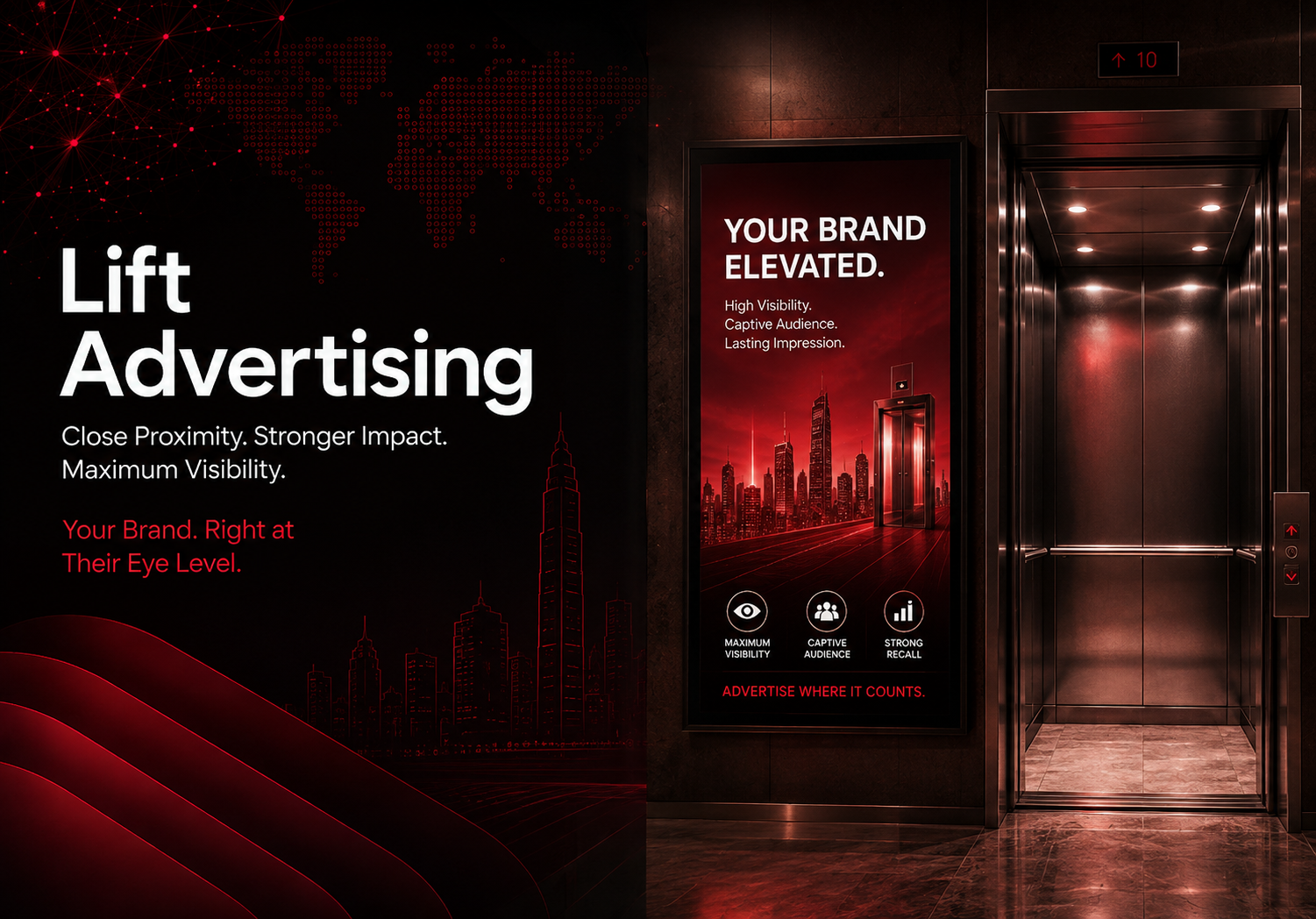
Lift Advertising in India: The Complete Guide to High-Impact Elevator Ad Services, Benefits, Costs & Campaign Strategies
In India, brands are looking for ways to advertise that will really grab people's attention. They do not want to compete with all the billboards on the road, posts on media, commercials on television and banners online. One way to advertise that is getting popular is lift advertising. This is also known as elevator advertising. Lift advertising lets brands talk to people when they are inside elevators in the lobby or in areas of commercial buildings, residential complexes, shopping centres, hotels, hospitals, offices, schools and other places where a lot of people go.
Unlike conventional outdoor advertising, where people may see an advertisement for only a few seconds while travelling past it, lift advertising creates a more enclosed and distraction-controlled environment. A person waiting for or travelling in a lift has limited movement and often spends several seconds looking at the surrounding space. This makes the elevator an interesting medium for delivering short, memorable and visually strong brand messages.
For businesses targeting urban consumers, professionals, residents, shoppers and visitors, lift advertising can become an important part of an integrated out-of-home advertising strategy. However, successful lift advertising is not simply about putting a poster inside an elevator. Effective lift ad services involve location selection, audience profiling, creative planning, media buying, installation, maintenance, campaign monitoring and performance evaluation.
This guide explores the characteristics of lift ad services in India, how the medium works, where it can be used, why brands choose it, what makes an effective elevator advertising campaign, and how businesses can plan campaigns that deliver stronger visibility and recall.
What Are Lift Ad Services in India?
Lift ad services are a form of indoor or out-of-home advertising in which promotional messages are displayed in and around elevators. Depending on the property and advertising network, brands can use elevator doors, interior lift panels, lift walls, digital screens, mirrors, floor stickers, lift lobbies and other approved surfaces to communicate with audiences.
The format is particularly relevant in locations where people spend time waiting, entering or exiting elevators. High-rise office buildings, premium residential societies, mall advertisements, hotels, hospitals, airports, business centres and mixed-use commercial developments can provide valuable environments for this type of advertising.
The key characteristic of lift advertising is its proximity to the audience. Instead of reaching an undefined mass audience from a distance, the advertisement appears within the immediate environment of the viewer. This creates an opportunity for brands to deliver a message at close range and in a setting where attention can be more concentrated.
For example, a premium real estate developer may promote a new residential project inside elevators located in high-income residential communities. A healthcare brand can advertise its services inside elevators of commercial buildings or hospitals, subject to property policies. A restaurant can promote a special offer in a shopping or office complex. A financial services company can communicate a concise investment message to professionals travelling through corporate buildings.
This contextual nature is one of the most important characteristics that differentiates lift advertising from traditional outdoor formats.
Why Is Lift Advertising Becoming Important in India?
India’s urban landscape is changing quickly. Cities such as Delhi-NCR, Mumbai, Bengaluru, Hyderabad, Chennai, Pune, Ahmedabad, Kolkata and Jaipur have experienced significant growth in high-rise residential and commercial infrastructure. As buildings become taller and urban spaces become more crowded, elevators have become an everyday part of modern life.
This creates an advertising opportunity.
A billboard on a busy road may receive a large number of impressions, but viewers often encounter it while driving, walking or commuting. In contrast, a lift advertisement can be experienced at close range in a controlled physical environment.
The growing development of premium residential societies, office towers, malls, hotels and commercial complexes is therefore creating more potential inventory for elevator advertising. Brands are also looking for advertising formats that can complement digital marketing rather than compete with it.
Lift advertising can support this objective because the physical advertisement can include a memorable brand message, QR code, website, campaign hashtag, promotional offer or short call to action. When integrated with digital campaigns, it can help connect offline visibility with online engagement.
Key Characteristics of Lift Ad Services
The effectiveness of lift advertising comes from several characteristics working together. The first is the highly focused environment. A lift is a relatively small physical space, meaning that an advertisement can occupy a meaningful portion of the viewer’s visual field. The second characteristic is repeated exposure. People who work or live in a building may use the same elevator multiple times each day, allowing the same message to appear repeatedly.
Another important characteristic is location targeting. Advertisers can select buildings based on audience profile, neighbourhood, property category, income group, business activity and expected footfall. This makes lift advertising particularly useful for local and city-focused campaigns.
The format also supports creative flexibility. Depending on available inventory, advertisers may use static posters, vinyl wraps, elevator-door branding, digital displays, floor graphics, mirror advertising or combinations of these formats. The creative approach can therefore be adapted to the physical environment.
Lift advertising can also provide strong brand proximity. A consumer may see a brand message only a few feet away rather than from a distant billboard. This allows designers to use larger typography, detailed visuals and direct calls to action while still maintaining readability.
Targeted Audience Reach
One of the strongest advantages of elevator advertising is the ability to target a specific audience through property selection.
A brand does not necessarily need to advertise across an entire city. It can select buildings where its potential customers are more likely to spend time.
For instance, a luxury automobile company could focus on premium commercial and residential properties. A business-to-business software company could choose corporate office towers. A premium food delivery service might advertise in high-density residential communities. A fitness brand could target office complexes and residential buildings in areas with strong demand for fitness services.
This level of targeting makes lift advertising particularly useful for businesses with geographically concentrated customers.
However, advertisers should avoid assuming that every person inside a building belongs to the same demographic group. Visitors, employees, residents, delivery workers and service staff may all interact with the advertising environment. Effective planning therefore requires a realistic understanding of the property's audience.
High Frequency and Repeated Visibility
Advertising works partly through repetition. A consumer who sees the same brand message several times may become more familiar with the brand than someone who encounters it only once.
Lift advertising naturally supports repeated exposure. Employees may use elevators multiple times during a working day, while residents may use them when leaving home, returning from work, shopping or receiving visitors.
This repeated contact can be valuable for brand awareness campaigns. The advertiser can maintain the same creative throughout the campaign or rotate multiple creatives to prevent visual fatigue.
For example, a three-month campaign could use one creative focused on brand awareness during the first month, a product-focused message during the second month and a promotional call to action during the third month. This creates a simple communication journey while maintaining consistent branding.
Captive Attention Environment
The term “captive audience” is sometimes used when discussing elevator advertising, but advertisers should understand it carefully. A lift does not guarantee that every person will actively read an advertisement. People may use their phones, talk to others or simply ignore advertising.
Nevertheless, the environment offers a useful advantage: there are fewer competing advertisements than in many traditional outdoor environments.
A well-designed elevator advertisement can therefore use visual hierarchy to attract attention quickly. The brand name should be immediately identifiable, the main message should be short, and the supporting information should remain easy to read.
The objective is not to fill the entire lift with text. It is to create a visual message that can be understood quickly and remembered later.
Close-Range Brand Communication
Distance is an important factor in advertising design. A roadside billboard must communicate from far away, while a lift advertisement can be viewed from a much shorter distance.
This allows advertisers to experiment with richer visuals, product images, short explanations and QR codes. However, close-range advertising does not mean that the advertisement should become text-heavy.
People generally do not enter a lift expecting to read a long article. Therefore, the strongest elevator advertisements often communicate one primary idea.
A financial brand could use a simple message about saving. A restaurant could highlight one signature dish. A real estate company could show a project image with location and a short CTA. A technology company could promote one product benefit.
The simpler the message, the easier it is to remember.
Multiple Advertising Formats
Modern lift ad services can include several advertising formats rather than a single poster.
Static lift posters remain one of the most commonly used options because they are comparatively simple to produce and install. Elevator-door branding can create a larger visual impact because the creative can use the doors as a single advertising surface.
Interior panels can be used for detailed brand communication because viewers are physically closer to them. Digital screens can provide dynamic content, allowing brands to display multiple messages, videos, offers or time-sensitive campaigns.
Lift-lobby advertising is another valuable option. Consumers may spend additional time waiting for elevators, making the lobby an important part of the advertising journey.
Floor graphics can also be used where property rules permit them. They can direct people toward stores, offices, events or promotional areas.
The availability of each format depends on the property, elevator infrastructure, advertising agreement and safety requirements.
Premium Location Targeting
The quality of a lift advertising campaign depends heavily on the quality of its locations.
Advertising inside a premium business district office tower can create a very different audience profile from advertising inside a budget residential building. Similarly, an advertisement in a luxury hotel may reach travellers and business guests, while an advertisement in a hospital may reach patients, visitors and healthcare professionals.
This makes media planning critical.
Advertisers should evaluate factors such as building category, location, occupancy, number of lifts, approximate daily traffic, tenant profile, visitor volume, campaign duration and available advertising surfaces before finalising a media plan.
Instead of selecting locations only because they are inexpensive, brands should focus on whether the audience matches the campaign objective.
Lift Advertising for Local Businesses
Lift advertising is not limited to large national brands. Local businesses can also benefit when the location is carefully selected.
A salon can advertise within nearby residential societies. A dental clinic can target premium apartments within its service radius. A coaching centre can advertise in residential communities near its branch. A restaurant can promote itself in nearby offices and residential buildings.
The geographic proximity can make the advertisement more actionable. When consumers see a service that is located close to their home or workplace, the distance barrier between awareness and purchase can be lower.
For local businesses, the campaign should generally include a clear location-based call to action.
Lift Advertising for Real Estate Brands
Real estate is one of the sectors that can make strong use of lift advertising because property buyers often belong to specific geographic and income segments.
A developer can advertise a residential project inside elevators of nearby premium societies, office buildings or commercial properties. The creative can showcase the project's location, amenities, configuration, possession status or contact information.
However, real estate advertising should avoid overcrowding the design with too many project details. A lift advertisement should create curiosity and direct interested users to a landing page, phone number or QR code where they can obtain complete information.
This makes elevator advertising a potential awareness and lead-generation support channel rather than a replacement for comprehensive property marketing.
Lift Advertising for Healthcare Brands
Healthcare advertising requires additional sensitivity because audiences may include people in stressful situations. Advertisers should use clear, trustworthy and responsible messaging.
Hospitals, diagnostic centres, pharmacies, wellness brands and healthcare service providers can consider appropriate lift and lobby placements where permitted.
A healthcare campaign might focus on preventive health checks, diagnostic services, specialist consultations or hospital facilities. The message should remain informative rather than overly promotional.
The physical environment can also influence the tone. A clean, professional design may be more appropriate than aggressive sales-oriented creative.
Lift Advertising for FMCG and Consumer Brands
Consumer brands can use elevator advertising to build awareness through repeated exposure. FMCG companies, food brands, personal care products, electronics companies and lifestyle brands can use visually appealing creative to showcase products.
Since many FMCG purchases are driven by familiarity and recall, repeated exposure can be useful. A consumer may see a product advertisement in a lift and later recognise the same product in a supermarket or online marketplace.
The creative should therefore prioritise strong product visibility, brand identity and one memorable benefit.
Lift Advertising in Corporate Offices
Corporate offices can provide an attractive environment for B2B advertising.
Software companies, recruitment firms, financial services providers, business consultants, coworking brands and professional service companies can use elevator advertising to reach employees and business visitors.
The message should reflect the professional environment. Instead of using a generic consumer offer, advertisers can focus on productivity, business growth, technology, financial solutions or professional development.
Office-building campaigns can also support employer branding and recruitment campaigns when targeted appropriately.
Creative Strategy for Effective Lift Advertisements
Creative execution is one of the most important elements of lift advertising.
Because the physical space is limited and exposure time can be short, the advertisement must communicate quickly. A strong creative normally includes a clear brand identity, a compelling headline, one strong visual and a simple action.
Typography should remain readable from the expected viewing distance. Colours should provide sufficient contrast. Important information should not be placed where elevator doors, handles, buttons or other physical components can obstruct it.
QR codes should be large enough to scan easily and should lead to a mobile-friendly page. If a phone number is included, it should be short and visually prominent.
Most importantly, the creative should have one central message.
Trying to communicate five offers, three products, multiple phone numbers, and a long company description in one elevator advertisement can reduce its effectiveness.
Importance of Contextual Advertising
Context can significantly influence advertising performance.
A brand advertising luxury apartments in a premium residential building creates a logical connection between the audience and the product. Similarly, advertising corporate insurance inside an office building can be contextually relevant to professionals and business owners.
Context does not guarantee conversion, but it can make the message feel more relevant.
This is why media planners should think beyond impressions. They should ask where the consumer is, why they are there, what they are likely to need and how the advertisement can naturally connect with that situation.
Digital Integration With Lift Advertising
Offline advertising does not have to remain disconnected from digital marketing.
Advertisers can add QR codes, short URLs, campaign-specific landing pages, WhatsApp calls to action or unique promotional codes to their elevator creatives.
For example, a restaurant can offer a QR-based discount to people who scan the advertisement. A real estate company can provide a project brochure through a landing page. A university can direct prospective students to an admissions page.
Using a dedicated landing page or campaign code can also make measurement easier.
This approach transforms lift advertising from a purely awareness-focused medium into a channel that can contribute to measurable digital engagement.
Measurement and Campaign Performance
One of the challenges associated with physical advertising is measurement. Brands should therefore establish measurement methods before launching the campaign.
Campaign-specific QR codes, landing pages, phone numbers, promotional codes and enquiry forms can help identify responses generated during the campaign.
Advertisers can also compare brand search activity, website traffic, direct enquiries and campaign-period leads against historical benchmarks. While not every conversion can be directly attributed to a lift advertisement, these indicators can provide useful evidence about campaign performance.
Location-level reporting can also help identify which buildings generate stronger engagement.
What Determines the Cost of Lift Advertising?
Lift advertising costs in India can vary significantly. There is no single nationwide rate because pricing depends on several factors.
The city and neighbourhood can influence the cost. Premium commercial districts generally command higher media values than lower-demand areas. Building category, audience quality, number of elevators, advertising surface, campaign duration, production requirements and inventory availability can also affect the final price.
Digital screens may have different pricing structures from static posters. Full lift wraps can require additional production and installation costs compared with standard panels.
Therefore, businesses should request a media plan based on their target audience and campaign objective rather than relying only on a generic “lift advertising rate.”
How to Choose the Right Lift Advertising Service Provider
Selecting the right advertising partner can influence the success of the campaign.
An experienced lift advertising service provider should understand location planning, inventory availability, creative specifications, installation requirements, campaign duration and reporting.
Advertisers should ask about the exact buildings included in the campaign rather than accepting only a broad claim such as “premium locations.” They should also clarify the number of lifts, advertising surfaces, campaign duration, production charges, installation process and maintenance responsibilities.
A transparent media plan helps the advertiser understand what they are actually purchasing.
Lift Advertising vs Billboard Advertising
Billboards and lift advertising serve different purposes.
Billboards are designed for large-scale visibility and can reach people across major roads and public spaces. Lift advertising is more targeted and operates within private or semi-private properties.
A billboard may create broad awareness across a city, while lift advertising can provide repeated exposure to a specific audience in selected buildings.
For many brands, the two formats can work together. A billboard can establish broad visibility while elevator advertising reinforces the message at a closer level.
Lift Advertising vs Digital Advertising
Digital advertising provides sophisticated targeting, optimisation and measurable online actions. Lift advertising provides physical visibility and repeated exposure in real-world environments.
Rather than treating them as competing channels, brands can integrate them.
A consumer might first see a brand on Instagram, encounter the same brand message in an elevator and later search for the company online. Consistent messaging across channels can strengthen overall brand recognition.
The strongest campaigns therefore consider lift advertising as one component of a broader media strategy.
How to Plan a Successful Lift Advertising Campaign
A successful campaign should begin with a clear objective.
If the goal is awareness, the creative should focus on brand recognition. If the objective is lead generation, the advertisement should include a clear action such as scanning a QR code or contacting the business. If the goal is a local promotion, the message should highlight the nearby location or offer.
The next step is audience definition. Advertisers should identify who they want to reach and where those people are likely to live, work or visit.
After audience definition comes location selection. The advertiser should evaluate buildings based on audience quality, occupancy and relevance.
Creative development should then be based on the selected environment. Finally, installation, monitoring and performance evaluation should be handled systematically.
Common Mistakes Brands Should Avoid
One of the most common mistakes is using too much text. Elevator advertising is not the right format for long-form communication.
Another mistake is selecting locations based solely on price. A cheaper location is not necessarily better if the audience has little relevance to the brand.
Poor-quality printing, weak visual contrast, difficult-to-read fonts and misplaced QR codes can also reduce campaign effectiveness.
Brands should also avoid making unsupported performance claims. A professional advertising campaign should distinguish between estimated impressions, actual enquiries and confirmed conversions.
Why Professional Media Planning Matters
Professional media planning can turn lift advertising from a simple poster placement into a structured campaign.
A media planner can help identify suitable properties, compare audience profiles, negotiate inventory, coordinate creative production and manage installation schedules. This can save advertisers time and reduce the risk of selecting inappropriate locations.
For larger campaigns, media planning can also help coordinate lift advertising with metro advertising, airport advertising, mall advertising, billboard campaigns, digital media and social media.
The result is a more consistent brand presence across multiple consumer touchpoints.
Future of Lift Advertising in India
The future of lift advertising is likely to become increasingly technology-driven.
Digital elevator screens can provide dynamic content, while QR-based interactions can connect physical advertising with digital campaigns. Location-specific content can allow brands to adapt messages to different buildings or neighbourhoods.
As India's commercial and residential infrastructure continues to expand vertically, elevator environments may become increasingly relevant to urban advertising strategies.
However, technology alone will not determine success. Strong audience targeting, useful messaging, creative quality and appropriate location selection will remain fundamental.
Final Thoughts
Lift ad services in India offer brands an interesting way to reach audiences in high-density urban environments. Their key characteristics include close-range communication, repeated exposure, location-based targeting, creative flexibility, contextual relevance and integration with digital campaigns.
The greatest opportunity lies in using the medium strategically rather than treating it as simply another advertising surface. A successful campaign begins by understanding the audience, selecting relevant properties and developing a message that can be understood within seconds.
For brands operating in competitive markets, elevator advertising can complement traditional outdoor media and digital marketing by placing the brand directly into the everyday environments where consumers live, work, shop and travel.
Whether the objective is brand awareness, local promotion, product visibility, real estate marketing or customer acquisition, lift advertising can become a valuable part of a broader out-of-home advertising strategy when planned with the right locations, creative approach, campaign duration and measurement framework.
For businesses exploring lift advertising services in India, the most important question is not simply “How much does lift advertising cost?” but rather “Which locations can put my brand in front of the right audience repeatedly?” That shift from buying space to buying relevant audience attention is what can make an elevator advertising campaign more meaningful, measurable and effective.
Latest Posts
-
-
-
August 01, 2026