
- Sort by
- Newest
- Oldest
Cost Guide Advertising
- Sort by (Default)
- Newest
- Oldest


Advertising & Marketing Cost Guide in India: Rates, Agency Fees & Pricing
Advertising & Marketing Cost in India – Overview
The cost of advertising in India can range from a few thousand rupees for a focused local campaign to several lakhs or crores for large-scale campaigns across television, outdoor, airports, airlines, metro networks, OTT platforms and multiple cities. There is no single standard advertising price because the final investment depends on the media selected, target audience, location, reach, frequency, campaign duration, advertising format and level of execution required.
The Advertising & Marketing Cost Guide by The Media Spaces is designed to help businesses understand advertising costs in India, media rates, agency fees, digital marketing costs and campaign budgets before committing to a media or marketing plan. It brings different types of advertising and marketing expenditure together so that brands can understand not only what a particular medium costs, but also what contributes to the final campaign investment.
Advertising expenditure can broadly include media buying, advertising agency fees, creative development, production, printing, installation, campaign management, digital marketing, technology, logistics and applicable taxes. For example, the cost quoted for a billboard may represent only the media rental, while printing and mounting can be additional. Similarly, a digital marketing campaign may involve both the advertising spend paid to the platform and a separate fee for strategy, campaign management, creative development and optimisation.
The pricing model also changes significantly from one advertising medium to another. Television advertising can be priced according to advertisement duration, channel and time band, radio advertising according to spot duration and frequency, outdoor advertising according to location and campaign period, airport and metro advertising according to media units and locations, airline advertising according to passengers, aircraft, advertising units or campaign duration, and inflight magazine advertising according to insertion and advertising position. Digital media commonly uses models such as CPM, CPC, CPL or campaign-based pricing.
Agency and marketing-service costs follow a different structure. The cost of hiring an advertising agency in India may be based on a project fee, monthly retainer, percentage of media spend, media planning and buying fee, creative fee or campaign-management charge. Similarly, the cost of hiring a digital marketing agency depends on the combination of services required, such as SEO, social media marketing, paid advertising, content, creative development, analytics and ongoing campaign management.
This distinction is important because the advertising rate is not necessarily the final advertising cost. A realistic campaign budget may include:
Media Cost + Creative Cost + Production Cost + Execution Cost + Agency/Management Fee + Applicable Taxes = Total Advertising Investment
For advertisers, therefore, the more useful question is not simply “How much does advertising cost?” but “What advertising and marketing investment is required to achieve the desired audience reach, frequency and campaign objective?”
This Cost Guide provides detailed information on media advertising rates, advertising agency costs, digital marketing agency costs, advertising budgets and pricing factors, along with dedicated cost guides for individual advertising platforms and media opportunities. It is intended to help startups, small and medium-sized businesses, established companies and national brands compare costs and make more informed advertising investment decisions.
Advertising Cost in India – Quick Cost Overview
Advertising costs in India vary considerably across media because each advertising platform follows a different pricing model. Some media are priced per second or advertising spot, others per location, screen, aircraft, passenger, insertion or month. Digital advertising may instead be purchased according to impressions, clicks, views or campaign objectives.
The table below provides a broad overview of how major advertising and marketing channels are typically priced. These figures should be used for initial budget planning rather than treated as fixed rate cards, as actual costs depend on the specific media property, location, inventory, campaign scale and commercial terms.
|
Advertising / Marketing Medium |
Indicative Cost / Starting Range |
Common Pricing Basis |
Typical Campaign Budget |
|
Airline Advertising |
₹1.50 onwards |
Passenger / Unit / Aircraft / Month |
₹5 Lakh–₹1 Crore+ |
|
Inflight Magazine Advertising |
₹60,000–₹8 Lakh+ |
Per Insertion |
₹2–₹25 Lakh+ |
|
Airport Advertising |
₹1 Lakh+ |
Media Unit / Month |
₹5–₹50 Lakh+ |
|
Airport Trolley Advertising |
₹1,500–₹3,000+ |
Per Trolley / Month |
₹5–₹30 Lakh+ |
|
Metro Advertising |
₹2,000+ |
Media Unit / Month |
₹2–₹30 Lakh+ |
|
Outdoor / OOH Advertising |
₹50,000+ |
Site / Month |
₹2–₹50 Lakh+ |
|
DOOH Advertising |
₹1 Lakh+ |
Screen / Location / Campaign |
₹5–₹50 Lakh+ |
|
Railway Station Advertising |
₹7,000+ |
Media Unit / Month |
₹2–₹25 Lakh+ |
|
Television Advertising |
₹100+ |
Spot / Duration / Format |
₹5 Lakh–₹1 Crore+ |
|
Radio Advertising |
₹100+ |
Spot / Duration |
₹1–₹20 Lakh+ |
|
Cinema Advertising |
₹700+ |
Screen / Day |
₹1–₹20 Lakh+ |
|
OTT Advertising |
Campaign Based |
CPM / Impressions / Audience |
₹5 Lakh+ |
|
Digital Advertising |
Campaign Based |
CPC / CPM / CPL / CPA |
Flexible |
|
SEO Services |
Project / Monthly Retainer |
Scope / Keywords / Competition |
₹25,000–₹5 Lakh+ per month |
|
Social Media Marketing |
Monthly / Campaign-Based |
Platforms / Content / Scope |
₹25,000–₹5 Lakh+ per month |
|
Advertising Agency Services |
Variable |
Retainer / Project / Media Spend |
Depends on Scope |
|
Digital Marketing Agency Services |
Variable |
Monthly Retainer / Project |
Depends on Services |
The wide difference between these advertising rates does not mean that a medium with a lower starting price is automatically more cost-effective. For example, a ₹2,000 metro advertising unit, a ₹7 lakh inflight magazine advertisement and a ₹10-second television spot provide entirely different levels and types of exposure. They should therefore be evaluated according to reach, frequency, audience profile, geography, engagement and campaign objective rather than price alone.
Another important distinction is between the unit rate and minimum practical campaign budget. A format costing only a few rupees per passenger may require several lakh passenger interactions, while a media format priced at several lakhs may provide access to a much larger or more specialised audience through a single booking. This is why advertisers should calculate the total campaign investment rather than comparing only headline rates.
The same principle applies when comparing advertising agency costs and digital marketing agency costs. Agency pricing can include strategy, planning, media buying, campaign management, creative services and reporting, while the actual media or platform spend may be charged separately.
As the Cost Guide expands, detailed individual guides provide a deeper breakdown of the applicable rates, minimum quantities, campaign budgets and factors affecting the final cost for each advertising medium or marketing service.
Types of Advertising & Marketing Costs in India
The total advertising cost in India is usually made up of several components rather than a single media or agency charge. Understanding these cost components is important when comparing quotations, preparing an advertising budget or evaluating proposals from an advertising agency, media buying agency or digital marketing agency.
A campaign quoted at ₹10 lakh, for example, may not necessarily mean that the entire ₹10 lakh is being spent on media. Depending on the campaign, the budget may include media inventory, creative development, printing, production, installation, agency services, campaign management and taxes. The cost structure also changes according to whether the campaign uses traditional media, digital marketing or a combination of both.
Media Buying Cost: Media buying cost is the amount required to purchase advertising inventory from a media platform or property. This can include television airtime, radio spots, outdoor sites, airport displays, metro media, airline advertising, inflight magazine space, cinema screens, newspaper space, OTT inventory and digital advertising.
The pricing basis varies by medium. A billboard may be purchased per site per month, a magazine advertisement per insertion, television advertising by spot duration, airline advertising by passenger or aircraft, and digital media by impressions, clicks, views or conversions.
For many large advertising campaigns, media buying represents the biggest component of the overall advertising budget.
Advertising Agency Fees: The cost of hiring an advertising agency in India depends on the services required and the agency's commercial model. An agency may charge a fixed project fee, monthly retainer, percentage of media spend, media planning and buying fee, creative fee or campaign-management charge.
Advertising agency fees may cover services such as campaign strategy, media selection, media planning, rate negotiation, media buying, creative coordination, execution and reporting.
Advertisers should therefore establish whether the agency quotation includes media costs or whether agency fees and media spend are charged separately.
Digital Marketing Agency Cost: The cost of hiring a digital marketing agency in India depends on the number and complexity of services included in the engagement. A digital marketing programme may involve SEO, social media management, paid search, paid social, content marketing, performance marketing, creative development, analytics and conversion optimisation.
Some agencies work on monthly retainers, while others charge separately for individual services or campaigns. Paid advertising budgets for Google Ads, Meta Ads and other platforms are also commonly separate from the agency's management fee.
The total digital marketing investment should therefore be evaluated as:
Digital Marketing Agency Fee + Advertising/Platform Spend + Creative & Content Cost + Tools/Technology = Total Digital Marketing Cost
Media Planning Cost: Media planning involves deciding where, when and how the advertising budget should be spent. This includes evaluating the target audience, geography, media mix, campaign duration, reach, frequency and available advertising inventory.
A Media Planning Agency in India may include planning within a broader media buying arrangement or charge separately depending on the scope and complexity of the campaign.
For multi-city or multi-media campaigns, professional media planning can help prevent budget fragmentation and unnecessary duplication across advertising channels.
Creative Development Cost: Advertising requires creative assets appropriate for the selected medium. Creative costs can include campaign concepts, copywriting, graphic design, adaptation, video production, animation, audio production and multiple creative sizes or versions.
A television commercial will have a very different production budget from a billboard artwork, radio spot, magazine advertisement or social media creative.
Creative development should therefore be budgeted separately when it is not included in the agency or campaign fee.
Production and Printing Cost: Offline advertising often involves physical production. This can include billboard skins, vinyl printing, backlit media, metro panels, airport displays, trolley branding, boarding-pass material, branded cups, magazine artwork preparation and other campaign materials.
Production costs generally depend on material, size, quantity, printing quality and advertising format.
A low media rental rate can sometimes become substantially more expensive once production requirements are added, particularly for large-format or high-volume campaigns.
Installation and Mounting Cost: Outdoor, transit, airport and other physical advertising formats may require installation, mounting or fabrication.
These costs can vary according to the media size, location, installation complexity, manpower and campaign duration. Removal or replacement of advertising material may also involve additional charges in some campaigns.
Advertisers comparing media quotations should therefore check whether printing, mounting, installation and removal are included in the quoted advertising rate.
Campaign Management & Execution Cost: Large campaigns require coordination between media owners, production vendors, creative teams and the advertiser. Campaign-management costs can cover booking coordination, artwork submission, production supervision, execution, scheduling, monitoring and reporting.
The complexity increases when a campaign covers multiple cities, airports, stations, media owners or advertising platforms.
An Advertising Agency in India or media agency may include these services within its overall fee or quote them separately depending on the campaign scope.
Technology and Marketing Tools: Digital marketing campaigns can involve additional technology costs for analytics, marketing automation, SEO tools, social media management platforms, landing-page technology, CRM integrations and reporting systems.
These expenses may be included in a digital marketing agency retainer or billed separately, particularly when specialised or third-party platforms are required.
Logistics and Distribution Cost: Certain advertising formats involve physical movement or distribution of materials. Product sampling, airline activations, events, promotional campaigns and multi-city executions can require transportation, warehousing, handling and distribution.
For product sampling campaigns, for example, the media or distribution rate may not include the actual cost of the product being sampled.
Applicable Taxes: Applicable taxes should be considered when calculating the final advertising budget. Media rates, agency fees, production and other services may be quoted before taxes.
Therefore, advertisers should distinguish between the base media rate and final payable campaign amount while comparing advertising proposals.
Understanding the Complete Advertising Cost
A realistic advertising budget should bring all applicable components together rather than focusing only on the media rate.
Total Advertising Cost = Media Buying + Agency Fees + Creative + Production + Installation/Execution + Technology/Logistics + Applicable Taxes
Not every campaign will include every component. A simple magazine advertisement may require only media and creative costs, whereas a nationwide integrated campaign can involve nearly all of them.
Understanding this breakdown makes it easier for businesses to compare advertising agency rates, media rates and digital marketing costs on a like-for-like basis and identify exactly where their advertising budget is being invested.
Advertising Media Cost in India
Advertising media cost in India varies according to the type of media selected, audience reach, location, advertising format, campaign duration and inventory demand. Unlike agency or creative fees, media cost refers specifically to the amount spent on purchasing advertising space, airtime, impressions or other inventory through which the campaign reaches its target audience.
Brands can choose from airline advertising, airport advertising, outdoor advertising, metro and transit advertising, television, radio, cinema, newspapers, magazines, OTT platforms and digital media. Each medium follows a different pricing structure, which makes direct comparison based only on the advertised rate difficult.
Airline Advertising Cost: Airline advertising cost in India depends on the airline, advertising format, campaign scale and passenger coverage. Available opportunities can include E-Tickets, boarding passes, inflight product sampling, meal trays, cup branding, inflight announcements, inflight magazines and other airline media. Pricing may be calculated per passenger, per unit, per aircraft, per month or per campaign.
For example, IndiGo advertising includes formats ranging from passenger-based advertising to aircraft-level campaigns and Hello 6E Magazine placements. Individual airline cost guides provide a more detailed breakdown of current indicative rates and campaign budgets.
Inflight Magazine Advertising Cost: Inflight magazine advertising cost in India is generally calculated per insertion and advertising position. A regular Full Page advertisement usually costs less than premium positions such as the Inside Front Cover, Inside Back Cover or Back Cover, while a Double Page Spread requires a higher investment because of the additional advertising space.
Rates vary considerably between publications such as Hello 6E, Namaste.ai, SpiceRoute and Rising Star, making airline reach, passenger profile, publication frequency and advertising position important factors when comparing costs.
Airport Advertising Cost: Airport advertising cost in India depends primarily on the airport, terminal, advertising location, media format and passenger traffic. Advertising at major airports such as Delhi, Mumbai, Bengaluru and Hyderabad generally requires a different investment from advertising at smaller regional airports.
Available media can include digital screens, LED displays, backlit panels, static displays, baggage-area advertising, arrival and departure media, airport trolley advertising and other terminal branding opportunities. Premium locations with high passenger movement and longer dwell times generally command higher rates.
Outdoor Advertising Cost: Outdoor advertising cost in India is heavily influenced by location, media size, visibility and traffic. Billboards, hoardings, unipoles and other OOH formats located on major arterial roads, commercial districts, high-traffic junctions and premium markets generally command higher rates than similar formats in secondary locations.
The final cost may also include printing, mounting, illumination, fabrication and installation in addition to the monthly media rental.
DOOH Advertising Cost: Digital Out-of-Home or DOOH Advertising Cost depends on screen location, screen size, traffic, campaign duration, advertisement frequency and share of voice. Digital screens at premium commercial locations, airports, malls and high-traffic areas can command significantly higher rates than conventional static outdoor inventory.
Unlike traditional OOH, DOOH campaigns may also be structured according to advertisement loops, duration, frequency or impressions depending on the media owner and technology used.
Metro Advertising Cost: Metro advertising cost in India varies according to the metro network, station, passenger footfall, advertising format and campaign duration. Premium interchange stations and stations located near major commercial districts generally command higher advertising rates because of their larger commuter volumes.
Available options can include backlit panels, digital LED screens, train advertising, promotional kiosks, experiential activations and full station branding, subject to inventory availability within the individual metro network.
Railway Station Advertising Cost: Railway station advertising cost in India depends on the station category, passenger traffic, advertising location and media format. Advertising at major railway terminals with substantial daily passenger movement generally requires a higher investment than smaller stations.
Static media, digital displays and advertising around platforms, entry and exit areas can have different rates depending on visibility and passenger exposure.
Television Advertising Cost: TV advertising cost in India varies according to the television channel, programme, time band, advertisement duration and campaign frequency. Advertising during prime-time programming or high-viewership events generally costs more than advertising during lower-demand time slots.
Television campaigns can include FCT commercials, L-Bands, Aston Bands, sponsorships and programme integrations. The final campaign budget depends not only on the cost of an individual spot but also on how frequently the advertisement is aired.
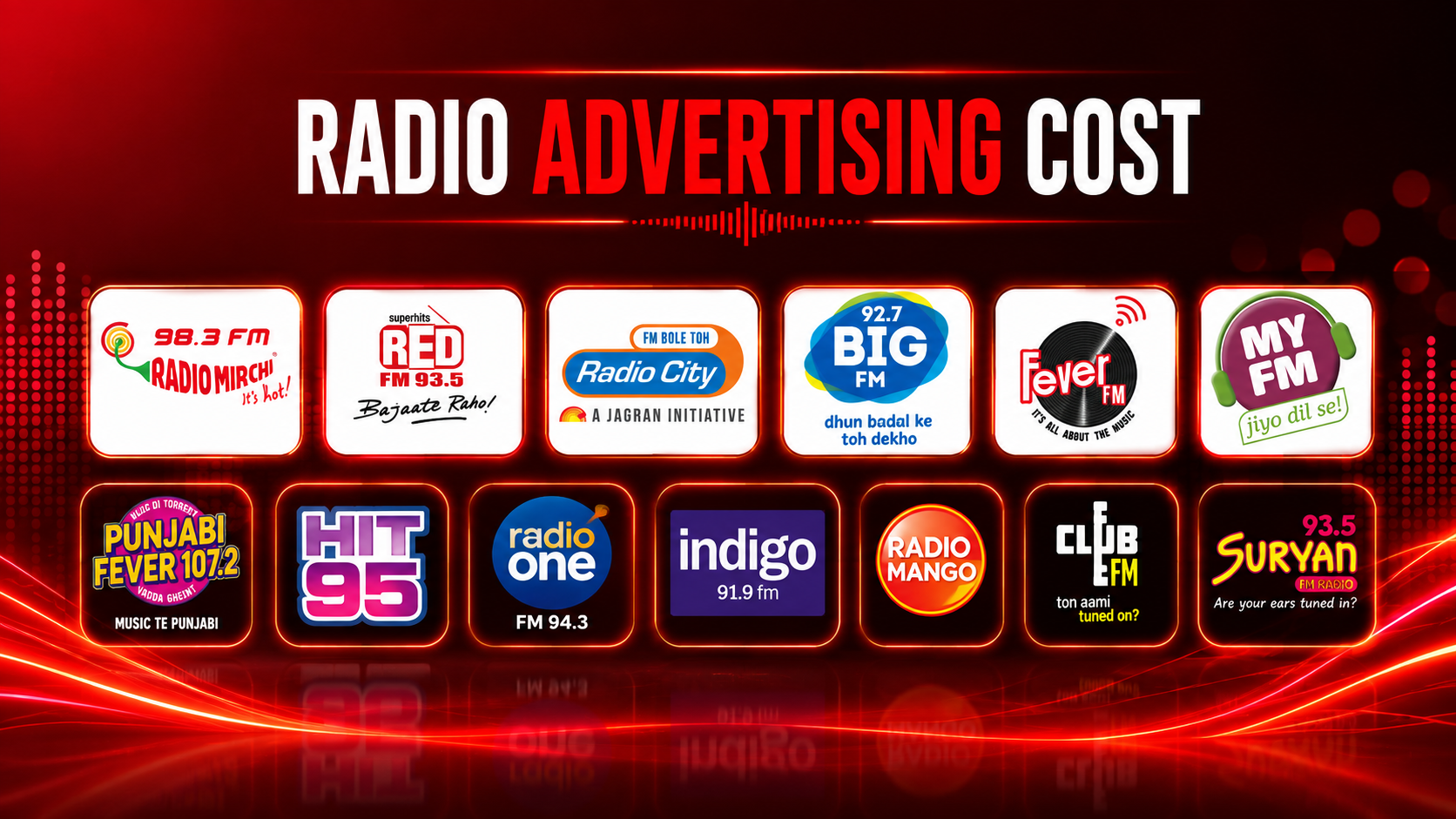
Radio Advertising Cost: Radio advertising cost in India is generally determined by the radio station, city, advertisement duration, time band and number of spots. Morning and evening drive-time periods can command higher rates because of stronger commuter listenership.
A radio campaign should therefore be budgeted according to both the cost per spot and the frequency required to create sufficient listener recall.
Cinema Advertising Cost: Cinema advertising cost in India depends on the cinema chain, city, theatre category, number of screens and campaign duration. Premium multiplexes and high-performing theatres in metropolitan markets can have higher rates than cinemas in smaller cities.
Both on-screen commercials and off-screen branding opportunities can be used, with the total campaign cost increasing according to the number of theatres and screens selected.
Newspaper Advertising Cost: Newspaper advertising cost in India generally depends on the publication, edition, advertisement size, colour, page position and day of publication. Front-page and other premium positions command higher rates than regular inside-page inventory.
Advertisers can also select city, regional or national editions depending on the geographic reach required.
Magazine Advertising Cost: Magazine advertising cost is generally calculated per insertion and depends on the publication, circulation, advertisement size and position. Full Page, Double Page Spread and premium cover positions have different pricing levels.
Special-interest and premium publications may have smaller audiences than mass publications but can provide access to more defined consumer segments.
OTT Advertising Cost: OTT advertising cost in India can be calculated according to impressions, CPM, audience targeting, content, advertising format and campaign scale. Rates vary according to the platform and the specificity of the audience being targeted.
OTT campaigns can therefore be planned differently from conventional television because advertisers may have greater flexibility in defining audience segments and campaign delivery.
Digital Advertising Cost: Digital advertising cost in India commonly follows CPC, CPM, CPV, CPL, CPA or campaign-based pricing models. The actual cost depends on the advertising platform, target audience, competition, geography, campaign objective and bidding environment.
Google Ads, social media advertising, display advertising and video advertising can consequently have very different costs even when the overall campaign budgets are similar.
The cost of media advertising in India should therefore be evaluated according to more than the initial rate. Advertisers should compare the total media investment, expected audience reach, frequency, geography, engagement opportunity and campaign objective before deciding which advertising medium offers the most appropriate value for their budget.
Cost of Hiring an Advertising Agency in India
The cost of hiring an advertising agency in India varies according to the agency's scope of work, campaign size, media budget, number of advertising channels, creative requirements and level of campaign management required. There is no single standard agency fee because advertisers may require anything from media planning and buying for one campaign to complete strategy, creative development, production and multi-media campaign execution.
An Advertising Agency in India may charge through a fixed project fee, monthly retainer, percentage of media spend, media planning and buying fee or a combination of these models. The final cost should therefore be evaluated according to the services included rather than comparing agency fees in isolation.
|
Advertising Agency Pricing Model |
Typical Pricing Structure |
Commonly Used For |
|
Percentage of Media Spend |
Percentage of total media budget |
Media planning & buying campaigns |
|
Fixed Project Fee |
Pre-agreed amount based on scope |
Individual campaigns and projects |
|
Monthly Retainer |
Fixed monthly agency fee |
Ongoing advertising support |
|
Media Planning Fee |
Based on planning scope |
Media strategy and planning |
|
Media Buying Fee |
Fee/commission linked to media buying |
Media negotiation and booking |
|
Creative Fee |
Project or deliverable based |
Campaign concepts and creatives |
|
Campaign Management Fee |
Based on campaign complexity |
Execution, coordination and monitoring |
|
Production Fee |
Based on actual requirements |
Printing, fabrication, video, audio and other production |
Percentage of Media Spend: Advertising agencies involved in media planning and buying may charge a percentage or commission linked to the overall media investment. The actual percentage can vary according to campaign size, media type, services included and commercial arrangement. Larger media budgets may also be negotiated differently from smaller campaigns.
Fixed Project Fee: For a defined advertising campaign, an agency may quote a fixed project fee. This approach is commonly used when the scope, deliverables, campaign duration and execution requirements can be clearly established before work begins.
Monthly Retainer: Businesses requiring continuous advertising support may work with an agency on a monthly retainer. The retainer can cover services such as strategy, planning, account management, creative coordination, campaign management and reporting. Media spend, production and other third-party costs may be charged separately.
Media Planning & Buying Fees: A Media Planning and Buying Agency in India can help advertisers identify appropriate media, compare rates, negotiate with media owners, prepare media plans and manage bookings. The fee may be included within the agency's overall commercial arrangement or charged separately depending on the campaign.
Creative Agency Fees: Creative development can be priced separately from media buying. The cost depends on whether the advertiser requires copywriting, graphic design, campaign concepts, adaptations, video commercials, radio spots, animation or multiple creative formats.
Production & Execution Charges: Campaigns involving outdoor advertising, airports, metro networks, airline media, activations and other physical advertising formats can involve printing, fabrication, mounting, installation, logistics and execution costs. These expenses should not automatically be assumed to be included in the advertising agency fee.
What Determines Advertising Agency Cost?
The Advertising Agency Cost in India is influenced by the size and complexity of the campaign. A single-city outdoor campaign will generally require a different level of planning and management from a national campaign combining television, radio, outdoor, airports, airlines, cinema and digital advertising.
The number of markets, media platforms, creative deliverables, campaign duration, production requirements, reporting needs and media budget can all affect the agency's scope of work and therefore its fees.
Advertising Agency Fee vs Media Cost
One of the most important distinctions for advertisers is the difference between agency fees and media costs.
If a company has an advertising budget of ₹25 lakh, it should establish whether the quoted amount represents only the media purchase or includes agency services, creative development, production and execution.
A complete campaign investment can be represented as:
Media Spend + Advertising Agency Fee + Creative Cost + Production & Execution + Applicable Taxes = Total Campaign Cost
This makes it easier to compare proposals from different agencies on a like-for-like basis.
Is Hiring an Advertising Agency Worth the Cost?
The value of an advertising agency should not be assessed only by finding the lowest agency fee. A capable agency can help advertisers compare media opportunities, negotiate advertising rates, allocate budgets across channels, coordinate production and manage campaign execution.
For brands investing substantial amounts in media, even a small improvement in media selection, negotiation or budget allocation can have a meaningful impact on the overall campaign.
Businesses should therefore evaluate an agency according to its media planning capability, rate transparency, media buying experience, execution support, reporting, campaign management and understanding of the required advertising platforms, alongside the agency fee.
The actual cost of hiring an advertising agency should ultimately be considered in relation to the size of the advertising investment, services required and value the agency provides in planning and managing the campaign.
Cost of Hiring a Digital Marketing Agency in India
The cost of hiring a digital marketing agency in India depends on the services required, business size, competition, target locations, campaign objectives and level of ongoing management. Unlike traditional advertising, where a large portion of the budget may be spent directly on media inventory, digital marketing costs can include agency fees, paid media budgets, content creation, SEO, social media management, creative development, analytics and marketing technology.
A business requiring only SEO or social media management may have a relatively limited monthly investment, while a company using SEO, Google Ads, social media marketing, performance marketing, content marketing and creative services together will require a substantially larger budget.
|
Digital Marketing Service |
Indicative Cost in India |
Common Pricing Basis |
|
Basic Digital Marketing Package |
₹25,000–₹50,000 |
Per Month |
|
Comprehensive Digital Marketing |
₹50,000–₹2 Lakh+ |
Per Month |
|
SEO Services |
₹25,000–₹1.5 Lakh+ |
Per Month |
|
Social Media Management |
₹20,000–₹1 Lakh+ |
Per Month |
|
Google Ads / PPC Management |
₹15,000–₹75,000+ |
Monthly Fee / % of Ad Spend |
|
Content Marketing |
₹20,000–₹1 Lakh+ |
Per Month / Project |
|
Performance Marketing Management |
₹25,000–₹1.5 Lakh+ |
Monthly Fee / % of Ad Spend |
|
Creative & Design Services |
₹10,000–₹1 Lakh+ |
Project / Monthly |
|
Enterprise Digital Marketing |
₹2 Lakh–₹10 Lakh+ |
Per Month |
These are broad indicative ranges. Actual digital marketing agency fees in India can be lower or considerably higher depending on the agency, scope, deliverables and advertising spend.
Monthly Retainer: A monthly retainer is one of the most common digital marketing agency pricing models. The business pays a fixed monthly fee for an agreed scope of services, which may include SEO, social media, content, paid campaign management, reporting and strategy. The advertising budget paid to platforms is generally separate unless specifically included in the proposal.
Project-Based Pricing: Businesses may hire a digital marketing agency for a specific requirement such as a website launch campaign, SEO audit, lead-generation campaign, social media strategy or digital campaign. In these cases, the agency can charge a fixed amount according to the defined scope and deliverables.
Percentage of Advertising Spend: Performance marketing and PPC agencies may charge a percentage of the advertiser's paid media budget. As advertising spend increases, the management requirement and agency fee structure may also change. Some agencies combine a minimum monthly management fee with a percentage of media spend.
SEO Agency Cost: The cost of hiring an SEO agency in India depends on website size, competition, number of target keywords, geographic markets, technical requirements and content requirements. Local SEO for a smaller business generally requires a different investment from national or enterprise SEO involving hundreds or thousands of pages.
Social Media Marketing Cost: Social media marketing agency costs depend on the number of platforms, posting frequency, creative requirements, video production, community management and paid advertising. Organic social media management and paid social media advertising should be treated as separate cost components when comparing quotations.
Google Ads & PPC Management Cost: Google Ads campaigns normally involve two distinct expenses: the amount paid directly toward advertising and the agency's campaign-management fee. The total investment can therefore be represented as Google Ads Spend + PPC Management Fee + Creative/Landing Page Cost, where applicable.
Content & Creative Cost: Digital marketing requires a continuous supply of landing pages, blogs, ad creatives, social media posts, videos, banners and other content. Some digital marketing agencies include a defined quantity of content within their monthly package, while others charge separately for content and creative production.
What Determines Digital Marketing Agency Cost?
The final Digital Marketing Agency Cost in India depends heavily on scope. Important factors include the number of services required, target locations, number of campaigns, competition, advertising budget, website size, content volume, creative requirements, reporting requirements and campaign objectives.
A local business targeting one city may require a substantially smaller investment than an e-commerce company or national brand running paid campaigns across India while simultaneously investing in SEO, content and social media.
Digital Marketing Agency Fee vs Advertising Spend
Businesses should clearly separate the agency management fee from the actual digital advertising budget.
For example, if a business allocates ₹5 lakh per month to Google Ads and social media advertising, that ₹5 lakh should not automatically be interpreted as the complete digital marketing cost. Agency management, creative production, landing pages, content and technology may be additional.
A more complete calculation is:
Digital Marketing Agency Fee + Paid Media Spend + SEO/Content + Creative Production + Technology/Tools + Applicable Taxes = Total Digital Marketing Investment
How Much Should You Budget for a Digital Marketing Agency?
There is no single budget suitable for every business. Small businesses may begin with focused services such as SEO, social media or paid search, whereas growing businesses may combine several channels. Larger brands may require dedicated teams, substantial paid-media budgets, continuous content production and advanced analytics.
Rather than choosing a Digital Marketing Agency in India solely according to the lowest monthly fee, businesses should compare the services included, team expertise, strategy, reporting, transparency, campaign management and expected level of work.
The right digital marketing budget should ultimately be based on the company's business objectives, competitive environment, customer acquisition goals and required scale, rather than selecting a standard package without considering the actual marketing requirement.
SEO Cost in India
The SEO cost in India depends on the size of the website, competition, target keywords, geographic coverage, current search visibility and the amount of technical, content and authority-building work required. SEO is generally an ongoing investment rather than a one-time advertising expense because improving organic search visibility requires continuous optimisation, content development, technical improvements and performance monitoring.
The cost of hiring an SEO agency in India can range from relatively affordable packages for small local businesses to several lakhs per month for highly competitive national, e-commerce or enterprise SEO campaigns.
|
SEO Service |
Indicative Cost in India |
Common Pricing Basis |
|
Local SEO |
₹15,000–₹40,000 |
Per Month |
|
Small Business SEO |
₹20,000–₹50,000 |
Per Month |
|
Standard SEO Services |
₹30,000–₹1 Lakh |
Per Month |
|
National SEO |
₹50,000–₹2 Lakh+ |
Per Month |
|
E-commerce SEO |
₹50,000–₹2.5 Lakh+ |
Per Month |
|
Enterprise SEO |
₹1.5 Lakh–₹5 Lakh+ |
Per Month |
|
SEO Audit |
₹25,000–₹1.5 Lakh+ |
Per Project |
|
Technical SEO |
₹30,000–₹2 Lakh+ |
Project / Monthly |
|
SEO Content Strategy |
₹25,000–₹1.5 Lakh+ |
Project / Monthly |
These are indicative planning ranges rather than fixed SEO agency rates. The actual quotation depends on the website and competitive requirements.
Local SEO Cost: Local SEO cost in India is generally lower than national SEO because the campaign focuses on visibility within a specific city, region or service area. Local SEO can include Google Business Profile optimisation, location pages, local keyword targeting, citations, content optimisation and local search visibility.
National SEO Cost: National campaigns compete for keywords across India and therefore usually require substantially more work. Keyword competition, content depth, website authority and the number of competing businesses can significantly influence the required SEO investment.
E-commerce SEO Cost: E-commerce SEO pricing depends heavily on website size and the number of product, category and supporting content pages requiring optimisation. Large e-commerce websites may also require technical SEO, structured data, internal-linking improvements, content development and continuous monitoring across thousands of URLs.
Enterprise SEO Cost: Enterprise SEO generally involves large websites, multiple product or service categories, highly competitive keywords and substantial technical requirements. The cost can be higher because campaigns may require SEO strategists, technical specialists, content teams, developers and detailed reporting.
SEO Audit Cost: An SEO audit is usually a project-based engagement that evaluates technical SEO, indexing, website architecture, on-page optimisation, content, internal linking, backlinks and other factors affecting organic search performance. The cost depends primarily on website size and the depth of analysis required.
Technical SEO Cost: Technical SEO can include crawlability, indexation, site architecture, Core Web Vitals, structured data, canonicalisation, redirects, duplicate-content management and other technical improvements. Complex websites generally require more technical SEO resources than smaller informational websites.
SEO Content Cost: Content is often a significant component of the overall SEO services cost. Landing pages, service pages, location pages, product/category content, guides and supporting articles may be required depending on the keyword strategy. Content costs may be included within the SEO retainer or quoted separately.
What Determines SEO Agency Cost?
The SEO Agency Cost in India is primarily influenced by competition and scope. A business targeting a handful of local keywords in one city has very different requirements from a company attempting to rank nationally for hundreds of competitive commercial keywords.
Website size, existing authority, technical condition, number of target keywords, content requirements, target locations, competitor strength and reporting requirements can all influence the final SEO pricing.
SEO Agency Fee vs Paid Advertising Cost
SEO and paid advertising use fundamentally different cost structures. With Google Ads or other paid media, a substantial part of the budget is spent directly on purchasing traffic or advertising inventory. SEO does not require advertisers to pay search engines for each organic click.
Instead, businesses invest in SEO strategy, technical optimisation, content, implementation and ongoing management.
A typical SEO investment can therefore be viewed as:
SEO Agency Fee + Content Cost + Technical/Development Cost + SEO Tools + Applicable Taxes = Total SEO Investment
Cost of Hiring an SEO Agency vs Freelancer
Businesses may choose between an SEO freelancer, specialist consultant, in-house team or SEO agency. A freelancer can have lower overheads and may be suitable for limited requirements, while an agency can provide access to multiple specialists covering technical SEO, content, strategy, analytics and implementation.
The decision should therefore not be based solely on the lowest monthly SEO cost. Businesses should compare the actual scope of work, expertise, deliverables, transparency, reporting and resources available for the campaign.
How Much Should a Business Spend on SEO?
There is no universal SEO budget. A local business operating in one market may require a relatively modest monthly investment, whereas a national brand competing in highly valuable search categories may require several lakhs per month.
Businesses should determine their SEO budget according to keyword competition, commercial value of organic traffic, website size, geographic reach and long-term growth objectives. The appropriate cost of SEO services in India is therefore the investment required to compete effectively in the search market relevant to the business rather than simply the cheapest SEO package available.
Social Media Marketing Cost in India
The social media marketing cost in India depends on the number of social media platforms managed, content volume, creative requirements, video production, posting frequency, community management, paid advertising and campaign objectives. Businesses may require only organic social media management or a combination of content creation, social media management, influencer marketing and paid social media advertising, resulting in significantly different monthly budgets.
The cost of hiring a social media marketing agency in India can also vary according to whether the agency handles only content and posting or provides complete strategy, creative production, paid campaign management, reporting and optimisation.
|
Social Media Marketing Service |
Indicative Cost in India |
Common Pricing Basis |
|
Basic Social Media Management |
₹15,000–₹30,000 |
Per Month |
|
Small Business Social Media Marketing |
₹20,000–₹50,000 |
Per Month |
|
Multi-Platform Social Media Management |
₹30,000–₹1 Lakh+ |
Per Month |
|
Social Media Advertising Management |
₹15,000–₹75,000+ |
Monthly Fee / % of Ad Spend |
|
Content & Creative Production |
₹15,000–₹1 Lakh+ |
Monthly / Project |
|
Reels & Short-Form Video Content |
₹20,000–₹1.5 Lakh+ |
Monthly / Project |
|
Influencer Marketing Management |
Campaign Based |
Project / Campaign |
|
Large Brand Social Media Management |
₹1 Lakh–₹5 Lakh+ |
Per Month |
These are broad indicative ranges. Actual social media agency costs in India depend on the platforms, number of deliverables, creative complexity, advertising budget and overall scope of work.
Social Media Management Cost: Social media management cost generally covers activities such as content planning, content calendars, posting, captions, scheduling, basic community management and performance reporting. Costs increase when a business requires multiple platforms, greater posting frequency or dedicated account management.
Social Media Content Creation Cost: Content production can represent a substantial portion of the overall social media budget. Static creatives, carousels, infographics, photography, reels, short-form videos, animation and professionally produced video content have different production requirements and costs.
A package offering a limited number of static posts will therefore cost significantly less than a strategy requiring frequent original videos, shoots and platform-specific creative production.
Paid Social Media Advertising Cost: Paid campaigns on platforms such as Meta and other social networks normally involve two separate expenses: the advertising budget paid to the platform and the agency fee for campaign management.
The advertising spend itself can vary from a few thousand rupees for a small local campaign to several lakhs or crores for large-scale performance or brand campaigns.
The total paid social investment can therefore be calculated as:
Social Media Ad Spend + Agency Management Fee + Creative Production + Landing Page/Technology Cost = Total Paid Social Media Cost
Instagram Marketing Cost: The cost of Instagram marketing in India depends on content frequency, reels and video requirements, influencer collaborations, community management and paid advertising. Businesses focused heavily on visual content may require a higher creative budget because continuous photography, design and video production can become a major part of the campaign.
Facebook Marketing Cost: Facebook marketing costs can include page management, content creation and paid advertising. For performance campaigns, the advertising budget depends on audience targeting, competition, campaign objective and bidding conditions, while management fees may be charged separately by the agency.
LinkedIn Marketing Cost: LinkedIn marketing is commonly used by B2B companies, professional services firms, recruiters and businesses targeting decision-makers. Content management and paid advertising can require different budgets, while paid campaigns may have a different cost structure from mass-market social platforms because of the professional audience being targeted.
Influencer Marketing Cost: Influencer marketing cost in India varies considerably according to the creator's audience size, engagement, niche, platform, content format, usage rights and campaign deliverables. A campaign involving micro-influencers may have a very different budget from one involving celebrities or large national creators.
Influencer fees, content production and agency campaign-management charges should therefore be evaluated separately when preparing the total budget.
What Determines Social Media Marketing Cost?
The final Social Media Marketing Cost in India is influenced by the number of platforms, number of monthly posts, reels and videos, content quality, photography requirements, community management, influencer involvement, paid media spend and reporting requirements.
A local business requiring basic content across one or two platforms will generally have a different cost structure from a national consumer brand publishing daily content, producing original videos, working with influencers and running continuous paid campaigns.
Organic Social Media Cost vs Paid Social Media Cost
Businesses should distinguish between organic social media marketing and paid social advertising.
Organic social media investment primarily covers strategy, content creation, publishing and community management. Paid social advertising requires an additional media budget to purchase impressions, clicks, video views, leads or conversions.
For a combined campaign:
Agency Fee + Organic Content & Management + Paid Media Spend + Creative Production + Influencer/Production Costs + Applicable Taxes = Total Social Media Marketing Investment
Cost of Hiring a Social Media Marketing Agency
The cost of hiring a social media marketing agency should be evaluated according to the actual services and deliverables included. Two agencies charging different monthly fees may provide very different levels of content production, strategy, video creation, community management and paid campaign support.
Businesses should compare the number and quality of deliverables, platforms covered, creative capabilities, paid media expertise, reporting, response management and campaign strategy rather than selecting an agency solely because it offers the lowest monthly package.
The appropriate social media marketing budget ultimately depends on whether the objective is brand awareness, audience engagement, lead generation, sales, community building or performance marketing, as each objective requires a different combination of content, media spend and agency resources.
Google Ads & PPC Advertising Cost in India
The Google Ads cost in India depends on the industry, target keywords, competition, location, campaign type, audience and bidding strategy. Unlike traditional media, Google Ads does not have a fixed advertising rate. Advertisers generally set a daily or monthly budget and compete for advertising inventory through an auction-based system.
The total PPC advertising cost in India should also not be confused with the amount paid only to Google. Businesses working with a PPC Agency or Digital Marketing Agency in India may additionally pay for campaign strategy, account setup, management, optimisation, creative development and landing-page support.
|
Google Ads / PPC Service |
Indicative Cost |
Common Pricing Basis |
|
Google Search Ads |
Variable |
CPC / Click |
|
Google Display Ads |
Variable |
CPC / CPM |
|
YouTube Advertising |
Variable |
CPV / CPM / Campaign |
|
Performance Max Campaigns |
Variable |
Campaign Budget |
|
Shopping Ads |
Variable |
CPC / Campaign |
|
Remarketing Campaigns |
Variable |
CPC / CPM |
|
Basic PPC Management |
₹15,000–₹30,000+ |
Per Month |
|
Professional PPC Management |
₹25,000–₹75,000+ |
Per Month / % of Spend |
|
Large PPC / Performance Campaigns |
₹75,000–₹2 Lakh+ |
Per Month / % of Spend |
These are indicative agency-management ranges rather than fixed Google advertising prices. Actual platform spend is determined by the advertiser's budget and auction conditions.
Google Search Ads Cost: Google Search Ads cost in India is commonly based on Cost Per Click (CPC). Advertisers bid to appear for relevant searches, but the actual CPC can vary significantly depending on keyword competition, commercial intent, location, ad quality and other auction factors.
Highly competitive keywords in sectors such as finance, insurance, real estate, education, legal services and B2B services can require substantially higher bids than less competitive searches.
Google Display Advertising Cost: Display advertising allows brands to reach audiences through visual advertisements across eligible websites, apps and other placements. Campaigns may be optimised around clicks, impressions, conversions or other objectives, depending on campaign configuration.
The cost therefore depends on audience targeting, placements, geography, bidding strategy and competition rather than a fixed display advertising rate.
YouTube Advertising Cost: YouTube advertising cost in India can vary according to the advertising format, audience targeting, campaign objective, video engagement and bidding model. Campaigns can be planned for brand awareness, video views, consideration, website traffic, leads or conversions.
Video production should be treated separately from the media budget when the advertiser requires new campaign creatives.
Performance Max Cost: Performance Max campaigns use a campaign budget across Google's available advertising inventory according to the campaign setup and objectives. The advertiser controls the overall budget, while campaign performance depends on factors including conversion data, creative assets, audience signals, competition and optimisation.
Google Shopping Ads Cost: E-commerce businesses can use Shopping campaigns to promote products through product-led advertising. Costs are influenced by product competition, bidding, margins, feed quality and conversion performance.
PPC Agency Cost in India
The PPC Agency Cost in India is normally separate from the advertising budget paid to Google or another advertising platform. Agencies may charge a fixed monthly management fee, a percentage of advertising spend or a hybrid combination of both.
For example, a company spending ₹5 lakh per month on paid advertising may have an additional management fee for campaign planning, optimisation, reporting and account management. The exact commercial structure varies according to the agency and campaign complexity.
Google Ads Management Fees
Google Ads management fees in India can depend on the number of campaigns, advertising spend, number of products or services, target locations, landing pages, conversion tracking requirements and level of optimisation required.
Management can include keyword research, campaign structure, audience targeting, bidding, negative keywords, ad copy, budget allocation, conversion tracking, testing, optimisation and performance reporting.
Larger advertising accounts with multiple campaigns, cities, products or conversion objectives generally require more management resources than a small local campaign.
Ad Spend vs PPC Management Fee
Businesses should clearly distinguish between Google Ads spend and agency management fees.
If a business has a monthly PPC budget of ₹3 lakh, for example, it should establish whether ₹3 lakh represents the amount being paid to the advertising platform or the complete campaign cost including agency services.
The overall PPC investment can be calculated as:
Advertising Spend + PPC Agency Fee + Creative Cost + Landing Page/Development Cost + Tracking/Technology + Applicable Taxes = Total PPC Advertising Cost
What Determines Google Ads Cost?
The final Google Advertising Cost in India can be influenced by keyword competition, industry, target geography, campaign objective, bidding strategy, audience, device, seasonality, landing-page experience and advertising quality.
The same monthly budget can therefore generate very different results for two businesses operating in different industries.
A local service business targeting one city may compete within a relatively narrow advertising market, while a financial services company targeting highly competitive searches nationally may require a substantially larger budget.
How Much Should a Business Spend on Google Ads?
There is no universal minimum Google Ads budget suitable for every business. The appropriate budget should be determined by the average cost of acquiring relevant traffic, conversion rate, customer value, competition and number of conversions required.
Smaller businesses may begin with focused campaigns around high-intent keywords and limited locations, while larger businesses can allocate significantly higher budgets across Search, Display, YouTube, Shopping, remarketing and Performance Max campaigns.
The objective should not simply be to achieve the lowest cost per click. Advertisers should evaluate cost per lead, cost per acquisition, conversion value and return on advertising spend to determine whether the campaign is commercially effective.
Cost of Hiring a PPC Agency
The cost of hiring a PPC agency should be assessed in relation to the advertising budget being managed and the level of expertise required. A lower management fee does not necessarily produce a lower overall customer acquisition cost if campaigns are poorly structured or optimised.
Businesses should therefore compare PPC agency fees, campaign strategy, tracking capabilities, optimisation process, reporting transparency and experience managing similar advertising budgets before selecting an agency.
For paid advertising, the most important figure is ultimately not the agency fee or CPC in isolation, but the total cost required to generate the desired business outcome.
Website Development Cost in India
The website development cost in India depends on the type of website, number of pages, design requirements, functionality, technology, integrations, content requirements and level of custom development involved. A basic business website can require a relatively modest investment, while an e-commerce platform, marketplace, booking portal or custom web application can require several lakhs or substantially more.
The cost of hiring a website development agency in India also varies according to whether the requirement involves a template-based website, custom UI/UX, WordPress development, e-commerce development or a completely custom platform. Businesses should therefore evaluate website costs according to functionality and long-term requirements rather than comparing only the initial development price.
|
Website Type |
Indicative Development Cost in India |
Common Pricing Basis |
|
Basic Business Website |
₹25,000–₹60,000 |
Per Project |
|
Professional Corporate Website |
₹50,000–₹1.5 Lakh |
Per Project |
|
Custom Business Website |
₹1 Lakh–₹3 Lakh+ |
Per Project |
|
WordPress Website |
₹30,000–₹1.5 Lakh+ |
Per Project |
|
E-commerce Website |
₹75,000–₹5 Lakh+ |
Per Project |
|
Custom E-commerce Platform |
₹3 Lakh–₹15 Lakh+ |
Per Project |
|
Landing Page |
₹10,000–₹40,000+ |
Per Page / Project |
|
Web Portal |
₹2 Lakh–₹10 Lakh+ |
Per Project |
|
Custom Web Application |
₹3 Lakh–₹25 Lakh+ |
Based on Scope |
|
Website Maintenance |
₹5,000–₹50,000+ |
Per Month |
These are broad indicative ranges. The actual website development price in India can vary considerably according to project scope, technology, agency expertise and development complexity.
Business Website Development Cost: The cost of developing a business website depends on the number of pages, design, content, forms, integrations and functionality required. A simple informational website with a limited number of pages will generally cost less than a corporate website containing multiple service categories, locations, resources, case studies and advanced functionality.
Custom Website Development Cost: Custom website development cost in India is generally higher because the website is designed and developed around specific business requirements rather than relying primarily on an existing template. Custom UI/UX, functionality, databases, APIs, user accounts and workflow requirements can significantly increase development time and cost.
WordPress Website Development Cost: WordPress websites can range from relatively simple template-based implementations to completely customised websites. The final WordPress website development cost depends on theme customisation, plugins, custom functionality, design requirements, number of pages and integrations.
E-commerce Website Development Cost: E-commerce website development cost in India depends on the number of products, payment gateway, shipping integrations, inventory management, product filters, customer accounts, checkout functionality and other commerce requirements.
A relatively small online store can be developed at a lower cost, while a large e-commerce platform requiring extensive custom functionality, integrations and automation can require a substantially larger investment.
Landing Page Development Cost: Businesses running Google Ads, social media or lead-generation campaigns may require dedicated landing pages. The cost depends on design, copy, forms, tracking, integrations, mobile optimisation and whether multiple landing-page variations are required for testing.
Web Portal & Web Application Cost: Portals and custom web applications generally require more extensive planning and development than standard websites. User authentication, dashboards, databases, payment systems, APIs, automation and custom workflows can significantly affect the final project cost.
Website Design Cost vs Website Development Cost
Website design cost and website development cost are related but not identical. Design primarily covers the visual interface, user experience, layouts and interaction design, while development converts these designs into a functional website.
For a custom project, businesses may therefore need to budget for both:
UI/UX & Website Design + Front-End Development + Back-End Development + Integrations + Testing + Deployment
Some website development agencies include all these components within a single project quotation, while others price them separately.
What Determines Website Development Cost?
The final Website Development Cost in India is influenced by the number of pages, custom design requirements, functionality, technology stack, CMS, e-commerce features, integrations, database requirements, mobile responsiveness and project complexity.
Content can also influence the budget. A website requiring professional copywriting, original photography, videos, illustrations or hundreds of SEO landing pages will have different requirements from a website where all content and creative assets are supplied by the client.
Cost of Hiring a Website Development Agency
The cost of hiring a website development agency in India can be higher than hiring an individual freelancer because an agency may provide a broader team covering strategy, UI/UX, development, testing, project management and ongoing support.
However, quotations should be compared according to the actual scope. A lower development quote may exclude content, SEO setup, testing, hosting, maintenance or integrations that are included in another agency's proposal.
Businesses should therefore request a clear breakdown of design, development, functionality, integrations, content, testing, deployment and post-launch support before comparing website development prices.
Additional Website Costs
The initial website development fee is not necessarily the complete cost of owning and operating a website. Businesses may also need to budget for domain registration, hosting, SSL, premium plugins, third-party software, maintenance, security, backups, content updates and ongoing technical support.
For websites generating leads or sales, additional investment may also be required for SEO, Google Ads, social media marketing, conversion optimisation and content development after launch.
A more complete calculation can therefore be represented as:
Website Design & Development + Content + Hosting & Technology + Integrations + Maintenance + Digital Marketing = Total Website Investment
How Much Should a Business Spend on Website Development?
The appropriate website development budget depends on the role the website plays in the business. A company requiring a basic online presence does not need the same investment as a business where the website is the primary source of leads, bookings or e-commerce revenue.
Instead of selecting the cheapest website development package, businesses should consider performance, scalability, user experience, SEO readiness, security, functionality and future expansion.
The right website development cost in India is therefore determined by what the website needs to accomplish for the business, not simply by the number of pages being developed.
Branding & Creative Agency Cost in India
The branding agency cost in India depends on the scope of branding required, business size, number of deliverables, research requirements and level of creative development involved. A startup requiring a logo and basic visual identity will have a very different budget from an established company undertaking a complete brand strategy, repositioning or corporate rebranding exercise.
Similarly, the cost of hiring a creative agency in India varies according to whether the requirement involves individual advertising creatives, campaign concepts, graphic design, video production or complete creative management across multiple advertising channels.
|
Branding & Creative Service |
Indicative Cost in India |
Common Pricing Basis |
|
Logo Design |
₹10,000–₹75,000+ |
Per Project |
|
Basic Brand Identity |
₹25,000–₹1 Lakh+ |
Per Project |
|
Complete Brand Identity |
₹75,000–₹3 Lakh+ |
Per Project |
|
Brand Strategy & Positioning |
₹1 Lakh–₹5 Lakh+ |
Per Project |
|
Corporate Rebranding |
₹2 Lakh–₹10 Lakh+ |
Per Project |
|
Advertising Creative Design |
₹5,000–₹50,000+ |
Per Creative / Project |
|
Social Media Creative Package |
₹15,000–₹1 Lakh+ |
Per Month |
|
Campaign Creative Development |
₹50,000–₹5 Lakh+ |
Per Campaign |
|
Creative Agency Retainer |
₹50,000–₹5 Lakh+ |
Per Month |
|
Video / Ad Film Production |
₹1 Lakh–₹25 Lakh+ |
Per Project |
These are broad indicative ranges rather than fixed creative agency rates. Complex national campaigns, celebrity-led advertising, high-end video production and large-scale rebranding projects can require substantially higher investments.
Branding Agency Cost: The cost of hiring a branding agency in India depends on whether the business requires only visual identity development or a complete branding exercise. Comprehensive branding can include market research, competitor analysis, brand positioning, naming, messaging, tone of voice, logo development, colour systems, typography, brand guidelines and applications across different consumer touchpoints.
Logo Design Cost: Logo design pricing can vary substantially depending on the level of research, number of concepts, revisions and whether the work is part of a broader brand identity programme. Businesses should therefore distinguish between purchasing a standalone logo and developing a complete visual identity system.
Brand Identity Cost: A complete brand identity can extend beyond the logo to include colours, typography, visual language, stationery, presentation templates, social media guidelines, packaging direction and detailed brand guidelines. The greater the number of applications and deliverables, the higher the overall branding investment can become.
Creative Agency Cost: The Creative Agency Cost in India depends on the amount and type of creative work required. An advertiser requiring a few static advertisements has a very different requirement from a national brand developing a campaign across television, outdoor, digital, print, radio and social media.
Creative agencies may charge per deliverable, per campaign, through a monthly retainer or as part of a broader advertising agency engagement.
Advertising Campaign Creative Cost: A campaign may require a central creative concept followed by adaptations for multiple media formats. For example, one campaign idea may need to be adapted for billboards, airport displays, metro panels, inflight magazines, newspapers, digital banners and social media.
The number of adaptations, languages, formats and sizes can therefore significantly affect the final advertising creative cost.
Graphic Design Cost: Graphic design cost in India depends on the complexity and number of deliverables. Individual designs such as advertisements, brochures, banners, presentations and social media creatives may be charged separately or included within a monthly creative package.
Video & Ad Film Production Cost: Video production can be one of the largest creative expenses in an advertising campaign. The budget depends on the concept, script, shoot duration, locations, equipment, actors, director, production crew, animation, editing, music and post-production.
A straightforward digital video and a large television commercial therefore cannot be compared using a single standard production rate.
Creative Adaptation Cost: Media campaigns often require an approved master creative to be adapted into multiple specifications. An outdoor billboard, magazine advertisement, airport digital screen, social media post and television graphic may all require different dimensions and technical formats.
For multi-media campaigns, adaptation costs should be considered when calculating the complete creative budget.
Branding Cost vs Advertising Cost
Branding and advertising perform different functions and should not automatically be treated as the same expense. Branding investment develops the identity, positioning and communication system of the business, while advertising expenditure pays to communicate that brand or campaign to an audience.
A company launching a new brand may therefore need to budget for both:
Brand Strategy & Identity + Campaign Creative + Media Buying + Production & Execution = Total Brand Launch Investment
An established brand with an existing identity may require only campaign creative and media expenditure.
What Determines Branding & Creative Agency Cost?
The final Branding and Creative Agency Cost in India depends on project complexity, research, number of concepts, number of deliverables, creative formats, revisions, languages, production requirements and campaign scale.
The level of agency involvement also matters. Developing a logo from an existing brief requires a different scope from researching a market, defining brand positioning, creating the identity and developing an integrated advertising campaign.
Cost of Hiring a Branding or Creative Agency
Businesses comparing branding agencies should look beyond the quoted project fee. The proposal should clearly define strategy, research, concepts, deliverables, revisions, brand guidelines, creative adaptations, production and usage requirements.
Similarly, advertisers hiring a creative agency should establish whether the quotation includes only creative concepts or also copywriting, design, adaptations, video production and ongoing campaign support.
The appropriate cost of hiring a branding agency or creative agency ultimately depends on the strategic and creative depth required. For brands where identity and communication directly influence customer perception, branding should be viewed as a long-term business investment rather than simply the cost of producing a logo or advertisement.
Advertising Cost by Campaign Budget in India
The advertising budget in India can vary from a few lakhs for a focused local campaign to several crores for national, multi-media advertising. The right budget depends on the campaign objective, target audience, geography, duration, required reach and the combination of advertising channels selected.
Instead of asking only “How much does advertising cost in India?”, businesses should also consider what different budget levels can realistically achieve. A ₹5 lakh campaign may work effectively when concentrated on selected media or locations, while ₹50 lakh or ₹1 crore provides greater scope for multi-city, multi-platform and higher-frequency campaigns.
The examples below are indicative planning scenarios. Actual media availability and advertising rates vary according to the selected platforms, locations and campaign period.
|
Advertising Budget |
Possible Campaign Approach |
Suitable Campaign Scale |
|
₹5 Lakh |
Focused single-media or local campaign |
Local / Targeted |
|
₹10 Lakh |
Strong single-media or limited media mix |
Local / City / Targeted |
|
₹25 Lakh |
Multi-location or selected multi-media campaign |
City / Regional |
|
₹50 Lakh |
Wider multi-media and multi-city campaign |
Regional / Multi-City |
|
₹1 Crore+ |
Integrated high-reach advertising campaign |
Multi-City / National |
₹5 Lakh Advertising Budget: A ₹5 lakh advertising budget is best used selectively rather than divided across too many media channels. Depending on current rates and inventory, the budget can be considered for selected outdoor locations, radio advertising, cinema screens, metro media, digital advertising, social media campaigns or individual premium media opportunities.
For airline and inflight advertising, a ₹5 lakh budget may accommodate selected lower-investment formats or limited-scale campaigns, although premium airline inventory can require a higher minimum investment.
For digital marketing, ₹5 lakh can alternatively be distributed between paid advertising, SEO, social media, content and agency management depending on the business objective.
The key at this budget level is concentration. Spreading ₹5 lakh across too many channels can reduce the frequency and impact achieved within each medium.
₹10 Lakh Advertising Budget: A ₹10 lakh advertising budget provides greater flexibility for premium placements, higher frequency or a combination of selected media.
For example, brands may consider outdoor advertising across selected high-value locations, a larger radio or cinema campaign, metro advertising, digital performance campaigns or airline/inflight opportunities. A premium inflight magazine placement may also fit within this budget depending on the publication and position selected.
A ₹10 lakh digital marketing budget can support a more substantial combination of paid search, paid social, SEO, content and creative development, although the allocation should depend on whether the primary objective is awareness, leads, sales or long-term organic growth.
₹25 Lakh Advertising Budget: With an advertising budget of ₹25 lakh, brands can begin considering broader media combinations rather than relying exclusively on a single advertising platform.
A campaign could combine outdoor advertising with radio, metro or digital media; use multiple premium outdoor locations; expand cinema coverage across several screens; or create a larger airline, airport or transit advertising programme.
For a performance-led strategy, ₹25 lakh can also support a substantial paid digital media campaign alongside agency management, creative development, landing pages and analytics.
At this level, the media plan should focus on how different channels complement each other rather than simply adding more advertising formats.
₹50 Lakh Advertising Budget: A ₹50 lakh advertising budget provides scope for larger multi-city or multi-media campaigns. Depending on the campaign objective, advertisers can evaluate combinations involving television, outdoor, airport, metro, airline, radio, cinema, OTT and digital advertising.
For example, a brand could use outdoor media to build physical-market visibility while digital advertising provides audience targeting and measurable response. Another campaign might combine airport or airline advertising with premium digital and print media to reach business and affluent travellers.
The allocation between media should be determined by target audience and campaign objectives rather than dividing the budget equally across platforms.
₹1 Crore Advertising Budget: A ₹1 crore advertising budget can support a substantial integrated campaign across multiple markets and media platforms. Brands can consider television, OTT, outdoor, airports, airlines, metro networks, radio, cinema and digital advertising according to the audience and geographic strategy.
However, a larger budget does not automatically require using every available medium. In many cases, concentrating ₹1 crore across three or four strategically selected channels can produce a stronger campaign than spreading the investment thinly across ten different media categories.
The campaign budget should also account for creative development, production, agency management and execution rather than allocating the entire amount to media buying.
Advertising Budgets Above ₹1 Crore: National brands, major product launches and large integrated campaigns can involve advertising investments substantially above ₹1 crore. These campaigns may combine national television, high-impact outdoor, multiple airports, airline media, OTT, digital performance campaigns, influencer marketing, radio and other media.
At this scale, media planning becomes particularly important because even relatively small differences in rates, audience selection or media allocation can represent several lakhs of rupees in campaign expenditure.
Media Budget vs Total Advertising Budget
Advertisers should distinguish between the media budget and total advertising budget. If a company approves ₹25 lakh for a campaign, it should establish whether the complete amount is intended for media or whether creative, production, agency fees and taxes must also be funded from the same budget.
A practical calculation is:
Total Advertising Budget = Media Spend + Agency Fee + Creative + Production + Execution + Technology/Logistics + Applicable Taxes
If these additional expenses are not considered during initial planning, the amount actually available for purchasing media can be considerably lower than the headline campaign budget.
How Should an Advertising Budget Be Allocated?
There is no universal percentage that should be allocated to television, outdoor, digital, radio or any other advertising medium. The appropriate allocation depends on campaign objective, target audience, geography, required reach, frequency, customer journey and measurement requirements.
A brand seeking national awareness may allocate a larger share towards television, OTT and outdoor media. A premium consumer brand may consider airports, airlines and inflight media. A local business may prioritise outdoor, radio, cinema and digital advertising, while a performance-focused company may allocate a greater share towards Google Ads, social media and other measurable digital channels.
The purpose of media planning is therefore not simply to spend the available budget, but to determine where each rupee of advertising investment can contribute most effectively to the campaign objective.
Advertising Cost by Business Size in India
The advertising cost for a business in India should be planned according to its size, growth stage, target market, competition, revenue objectives and geographic reach. A local business targeting customers within one city does not require the same advertising investment as a growing company expanding across multiple markets or a national brand seeking mass-market visibility.
Business size alone should not determine the advertising budget. Two companies of similar size can require very different investments depending on their industry, customer acquisition cost, competition and marketing objectives. The advertising budget should therefore be linked to the scale of the opportunity and the results the business wants to achieve.
|
Business Type |
Indicative Advertising Approach |
Media Commonly Considered |
|
Small & Local Businesses |
Focused geographic campaigns |
Digital, Social Media, Google Ads, Local OOH, Radio, Cinema |
|
Startups |
Awareness + Customer Acquisition |
Digital, Performance Marketing, Social Media, OOH, Influencer |
|
Growing / Mid-Sized Businesses |
Multi-channel campaigns |
Digital, OOH, Radio, Metro, Cinema, OTT |
|
Large Businesses |
Multi-city integrated campaigns |
TV, OOH, Digital, OTT, Airport, Metro, Radio |
|
National Brands |
High-reach integrated campaigns |
TV, OTT, OOH, Airport, Airline, Digital, Radio, Cinema |
Small Business Advertising Cost: The advertising cost for a small business in India should generally be concentrated on media that can efficiently reach customers within the business's actual service area. Google Ads, social media advertising, local SEO, selected outdoor locations, radio and cinema can be considered depending on the nature of the business.
A restaurant, local retailer, educational institute, clinic or professional service provider may benefit more from strong visibility within a defined catchment area than from purchasing expensive national media.
Small businesses should also account for the cost of maintaining their digital presence. Website development, SEO, social media management, creative development and paid advertising may form part of the overall marketing investment.
Startup Advertising Cost: A startup may need to balance brand-building and customer acquisition costs. Early-stage businesses often rely heavily on performance marketing because leads, app installations, registrations or sales can be measured more directly. However, startups entering competitive categories may also require brand advertising to establish credibility and awareness.
The advertising budget can therefore include Google Ads, social media advertising, influencer marketing, content, SEO and selected offline media. As the company expands, outdoor, metro, radio, cinema, OTT, airport or airline advertising may be introduced according to the target audience.
Startups should avoid allocating the entire budget to customer acquisition without considering the long-term cost of building brand visibility and organic demand.
Mid-Sized Business Advertising Cost: Growing and mid-sized businesses generally have greater flexibility to combine performance marketing with offline and brand-building media. Their campaigns may include digital advertising alongside outdoor, radio, metro, cinema, OTT or other targeted advertising opportunities.
A company expanding from one city into several markets, for example, may require separate media budgets for each location. Geographic expansion can therefore significantly increase the total advertising campaign cost even when the same advertising strategy is used.
At this stage, professional media planning becomes increasingly important because budgets can easily become fragmented across too many platforms.
Large Business Advertising Cost: Large businesses typically require more extensive media coverage, greater campaign frequency and consistent visibility across multiple consumer touchpoints. Advertising budgets can include television, OTT, outdoor, digital, radio, airports, metro networks, cinema and other media according to the campaign objective.
Large campaigns also tend to have higher creative and production requirements. Television commercials, video production, multiple language adaptations, outdoor creatives, digital assets and regional campaign variations can add substantially to the overall advertising investment.
For these businesses, the cost of advertising should therefore be evaluated as an integrated investment covering media, agency services, creative development, production, execution and measurement.
National Brand Advertising Cost: National advertising campaigns can require investments ranging from several lakhs to multiple crores depending on campaign duration, reach and media mix. Brands targeting consumers across India may use a combination of national television, OTT, digital advertising, outdoor media across major cities, airports, airline advertising, radio and cinema.
Regional language requirements can further increase creative and media costs because campaigns may need separate advertisements, voiceovers, artwork or media plans for different markets.
A national campaign should therefore be planned according to market priority rather than automatically allocating equal budgets to every city or region.
Advertising Budget for B2B vs B2C Businesses
Business model also influences advertising expenditure. B2C brands often require larger audience reach and higher campaign frequency, which can make television, outdoor, OTT, radio, cinema, social media and other mass-reach channels relevant.
B2B businesses may focus more heavily on search advertising, SEO, LinkedIn, content marketing, industry publications, business media and highly targeted campaigns because the potential customer base is narrower.
A smaller B2B advertising budget can sometimes reach a highly valuable audience more effectively than a substantially larger mass-media campaign.
Local vs Multi-City vs National Advertising Budget
Geographic coverage is one of the biggest factors affecting advertising cost in India. A campaign targeting one city can concentrate its budget across selected locations and audiences. Expanding the same campaign across five or ten cities increases the required media inventory, production, creative adaptations and campaign management.
Businesses should therefore determine whether they require:
Local Advertising: Focused on one city or catchment area.
Regional Advertising: Covers selected cities or states.
Multi-City Advertising: Uses media across several priority markets.
National Advertising: Targets consumers across India through national and regional media.
Selecting the appropriate geographic level can prevent businesses from paying for audience reach that does not contribute to their commercial objectives.
How Much Should a Business Spend on Advertising?
There is no universal advertising budget suitable for every company. Businesses should determine their investment based on revenue goals, customer acquisition economics, market competition, growth objectives, target geography and the role advertising plays in generating demand.
A company entering a new market may temporarily require a higher advertising investment to establish awareness, while an established brand may focus more heavily on maintaining visibility and market share.
The appropriate advertising budget for a business in India is therefore not simply the lowest affordable amount or a fixed percentage applied to every company. It should be the level of investment required to reach the right audience with sufficient frequency while remaining commercially sustainable.
Advertising Cost by Industry in India
The advertising cost in India can vary significantly from one industry to another because every sector has a different target audience, competitive environment, customer value and buying cycle. A real estate company selling premium residential projects, for example, may justify a much higher customer acquisition and advertising cost than an FMCG brand selling a low-value consumer product.
Industry also influences the choice of media. Real estate, automobile and luxury brands may invest heavily in outdoor, airport, airline and premium digital advertising, while FMCG brands may require television, OTT, outdoor and high-reach digital media. Education and financial services may allocate a larger share towards performance marketing, search advertising and lead generation.
|
Industry |
Advertising Media Commonly Used |
Typical Budget Focus |
|
Real Estate |
Outdoor, Digital, Google Ads, Metro, Airport, Print |
Leads + Project Awareness |
|
Automobile |
TV, OTT, Outdoor, Digital, Airport, Cinema |
Brand Awareness + Launches |
|
FMCG |
TV, OTT, Outdoor, Digital, Radio, Sampling |
Mass Reach + Product Trial |
|
Education |
Google Ads, Social Media, Outdoor, Metro, Radio |
Admissions + Lead Generation |
|
Banking & Finance |
TV, Digital, Airport, Airline, Outdoor, Print |
Trust + Customer Acquisition |
|
Technology |
Digital, OTT, Airport, Airline, Outdoor |
Awareness + Acquisition |
|
Travel & Hospitality |
Digital, Airline, Airport, OTT, Outdoor |
Bookings + Brand Awareness |
|
E-commerce |
Digital, TV, OTT, Outdoor, Influencer Marketing |
Traffic + Sales |
|
Healthcare |
Digital, Outdoor, Radio, Print, Local Media |
Awareness + Leads |
|
Jewellery & Luxury |
Print, Airport, Airline, Outdoor, Digital |
Premium Audience + Brand Image |
Real Estate Advertising Cost: Real estate advertising cost in India depends heavily on project value, location, target audience and sales cycle. Developers may use a combination of outdoor advertising, Google Ads, social media, newspapers, metro advertising, airport media and other premium advertising platforms.
A residential project targeting buyers within one city can concentrate its advertising budget locally, while a luxury development targeting NRIs, investors and affluent buyers may use airports, airline advertising, inflight magazines and premium digital media.
For real estate advertisers, the cost should ultimately be evaluated against qualified leads, site visits, bookings and project sales rather than media rates alone.
Automobile Advertising Cost: Automobile brands generally require a combination of mass awareness and local dealer-level marketing. Television, OTT, outdoor, digital advertising, cinema, airports and premium transit media can be used for vehicle launches and brand campaigns.
Advertising costs can increase substantially during a national product launch because the campaign may require television commercials, high-impact outdoor media, video production, influencer collaborations, digital campaigns and dealer-level advertising simultaneously.
FMCG Advertising Cost: FMCG advertising campaigns often require substantial reach and frequency because brands compete for consumer attention across large markets. Television, OTT, outdoor, digital, radio and retail media can therefore represent major components of the advertising budget.
Product sampling and experiential activations can add another cost layer. In categories where trial influences purchase, brands may allocate part of the campaign budget specifically to putting samples directly into consumers' hands through airline, mall, event or other sampling opportunities.
Education Advertising Cost: Education advertising can range from local campaigns for schools and coaching institutes to national campaigns for universities, edtech companies and higher-education institutions.
Google Ads, social media advertising, outdoor media, metro advertising, radio and digital lead-generation campaigns are commonly considered. Advertising demand can also become more concentrated around admission periods, which can affect competition and digital advertising costs.
The effectiveness of an education campaign should be measured against enquiries, applications and admissions, not merely impressions or clicks.
Banking & Financial Services Advertising Cost: Banks, fintech companies, insurance providers, credit-card companies and other financial brands can use television, digital, outdoor, airports, airlines, print and premium media to reach consumers.
Because financial products often have significant customer lifetime value, advertisers may be willing to invest more to acquire qualified customers. However, the campaign budget should distinguish between broad brand-building expenditure and measurable customer-acquisition activity.
Technology Advertising Cost: Technology companies can have very different advertising requirements depending on whether they sell consumer electronics, software, SaaS products, mobile applications or enterprise technology.
Consumer technology brands may use outdoor, airports, airline media, OTT and digital advertising for launches and awareness. B2B technology companies may allocate more budget towards search, LinkedIn, content, industry media and other targeted channels.
The appropriate advertising cost therefore depends heavily on whether the objective is mass-market awareness or targeted customer acquisition.
Travel & Hospitality Advertising Cost: Airlines, hotels, tourism boards, travel companies and hospitality brands often need to reach consumers during both travel planning and the actual journey.
Digital advertising, search, OTT, airports, airline media, inflight magazines and outdoor advertising can therefore work together within the same campaign.
Seasonality can have a major impact on the advertising budget, particularly around holidays, summer travel, festive periods and destination-specific travel seasons.
E-commerce Advertising Cost: E-commerce businesses can invest heavily in measurable digital channels such as Google Ads, social media advertising, performance marketing, affiliate marketing and influencer campaigns. Larger brands may complement these channels with television, OTT and outdoor advertising to increase brand awareness and direct demand.
For e-commerce businesses, advertising expenditure should be evaluated against metrics such as customer acquisition cost, conversion rate, average order value, repeat purchases and return on advertising spend.
Healthcare Advertising Cost: Healthcare advertising can include hospitals, diagnostic centres, clinics, healthcare platforms and other service providers. Digital advertising, local SEO, outdoor, radio, print and location-focused campaigns can be used depending on the audience and geographic catchment.
For hospitals and clinics, geographic targeting can be particularly important because paying for broad national reach may provide little value when most patients are expected to come from a defined city or region.
Jewellery & Luxury Advertising Cost: Jewellery, fashion, watches, luxury automobiles, premium real estate and other luxury categories generally place greater emphasis on the quality of the audience and advertising environment rather than simply achieving the lowest cost per impression.
Premium outdoor locations, airports, airline advertising, inflight magazines, luxury publications, digital media and selected high-end environments can therefore form part of the media plan.
A higher advertising rate may be commercially justified when the medium provides access to a more relevant affluent, business or premium consumer audience.
Why Advertising Costs Differ by Industry
The same advertising medium can produce very different commercial value for different industries. A ₹5 lakh campaign generating a small number of qualified customers may be highly successful for luxury real estate but economically unsustainable for a low-margin consumer product.
Industry-specific advertising budgets should therefore consider average transaction value, gross margin, customer lifetime value, sales cycle, competition, geographic market and acceptable customer acquisition cost.
The objective is not necessarily to identify which industry spends the most on advertising. Businesses should determine how much they can economically invest to reach, influence and acquire the customers that matter to their industry.
Advertising Cost by City in India
The advertising cost in India varies significantly by city because media demand, population, consumer spending, traffic, commercial activity and available advertising inventory differ across markets. Advertising in premium locations in Delhi or Mumbai can require a substantially higher investment than using a similar format in a smaller city, while digital advertising costs can also vary according to geographic competition and audience demand.
For businesses planning multi-city campaigns, location should therefore be treated as an important component of the advertising budget. The same billboard size, radio duration, cinema format or digital campaign can have different costs depending on the city and specific location selected.
|
City |
Major Advertising Opportunities |
Key Cost Drivers |
|
Delhi |
Outdoor, Metro, Airport, TV, Radio, Cinema, Digital |
Premium locations, traffic, reach, high media demand |
|
Mumbai |
Outdoor, Airport, Local Transit, TV, Radio, Cinema, Digital |
Premium inventory, high demand, audience value |
|
Bengaluru |
Outdoor, Airport, Metro, Digital, Radio, Cinema |
Technology audience, business districts, traffic |
|
Gurgaon |
Outdoor, Metro, Digital, Radio, Cinema |
Corporate audience, premium roads, commercial hubs |
|
Noida |
Outdoor, Metro, Digital, Cinema, Radio |
Corporate hubs, residential markets, commuter traffic |
|
Hyderabad |
Outdoor, Airport, Metro, Digital, Radio, Cinema |
IT corridors, business districts, airport traffic |
|
Chennai |
Outdoor, Airport, Metro, Radio, Cinema, Digital |
Regional audience, commercial areas, transit |
|
Kolkata |
Outdoor, Airport, Metro, Radio, Cinema, Digital |
Location, traffic, regional media consumption |
|
Pune |
Outdoor, Digital, Radio, Cinema, Transit |
IT, education, automotive and young audiences |
|
Ahmedabad |
Outdoor, Airport, Radio, Cinema, Digital |
Business audience, location and traffic |
Advertising Cost in Delhi: Advertising cost in Delhi depends heavily on the media and location selected. Delhi provides access to outdoor advertising, Delhi Metro, railway stations, airport media, television, radio, cinema, print and digital advertising.
Within outdoor advertising alone, costs can vary considerably between premium commercial areas, arterial roads, business districts and secondary locations. High-visibility areas such as central commercial zones generally command higher rates because of traffic volume and advertiser demand.
Delhi Metro advertising costs can similarly differ according to the station, media format and commuter footfall. Major interchange and high-traffic stations can require a higher investment than lower-footfall locations.
Advertising Cost in Mumbai: Advertising cost in Mumbai can be comparatively high for premium outdoor, airport, cinema and other high-demand media inventory. Mumbai's large consumer market, concentration of businesses and premium commercial areas create strong advertiser demand.
A campaign targeting selected neighbourhoods can be planned differently from a city-wide campaign. Advertisers should therefore distinguish between the cost of achieving presence in a few premium locations and the investment required to create broader coverage across Mumbai.
Advertising Cost in Bengaluru: Advertising cost in Bengaluru is influenced by the city's technology sector, corporate population, business districts and high commuter movement. Outdoor advertising, airport media, metro advertising, radio, cinema and digital campaigns can be particularly relevant depending on the target audience.
Advertising around technology corridors and major business districts can command premium rates because of the concentration of corporate professionals and high-value consumers.
Advertising Cost in Gurgaon: Advertising cost in Gurgaon can vary substantially according to location. Premium roads, corporate districts, office corridors, malls and high-income residential areas provide valuable audiences for outdoor and digital advertising.
Gurgaon also provides opportunities through metro and transit media, cinema, radio and digital platforms. Brands targeting corporate professionals, business decision-makers and affluent consumers may choose to concentrate a larger proportion of their advertising budget in premium Gurgaon locations.
Advertising Cost in Noida: Advertising cost in Noida depends on the sector, road, metro station and audience catchment selected. Noida's mix of corporate offices, technology companies, residential sectors, educational institutions and commercial developments creates opportunities across outdoor, metro, cinema, radio and digital media.
Premium commercial and high-traffic corridors generally require higher advertising investments than secondary sectors. Noida can also be combined with Delhi, Greater Noida and Ghaziabad when planning broader Delhi NCR campaigns.
Advertising Cost in Hyderabad: Advertising cost in Hyderabad is influenced by the city's major business districts, technology corridors, airport traffic, metro network and expanding consumer market. Outdoor, airport, metro, radio, cinema and digital advertising can all form part of a Hyderabad media plan.
Campaign costs can differ significantly between premium technology and commercial corridors and less prominent locations.
Advertising Cost in Chennai: Advertising cost in Chennai depends on media type, target geography and regional audience requirements. Outdoor advertising, Chennai Airport, metro, radio, cinema, television and digital media can be used for both local and national brands.
Regional-language creative and media requirements should also be considered when planning campaigns specifically for the Chennai and Tamil Nadu markets.
Advertising Cost in Kolkata: Advertising cost in Kolkata varies according to location, advertising format and required audience reach. Outdoor media, metro advertising, airport media, radio, cinema, print and digital campaigns can be considered depending on the campaign objective.
Premium commercial locations and major commuter corridors can command higher advertising rates than lower-demand inventory.
Advertising Cost in Pune: Advertising cost in Pune is influenced by the city's technology, automobile, education, residential and corporate markets. Outdoor advertising, radio, cinema, digital campaigns and transit media can provide different ways to reach these audiences.
Brands targeting students and young professionals may use a different media mix from companies targeting corporate executives or automobile buyers.
Advertising Cost in Ahmedabad: Advertising cost in Ahmedabad depends on location, media format, traffic and audience profile. Outdoor advertising, airport media, radio, cinema and digital campaigns can be used to reach business owners, professionals, families and other consumer segments.
Campaigns focused on premium commercial districts can require higher investments than campaigns using broader or secondary locations.
Tier 2 & Tier 3 City Advertising Cost: Advertising in Tier 2 and Tier 3 cities can sometimes provide lower media rates than major metropolitan markets, but lower cost should not be the only reason for selecting these markets. Cities should be chosen according to actual business opportunity, distribution, customer demand and expansion strategy.
Regional outdoor, radio, cinema, print and digital media can allow advertisers to build strong local visibility without requiring the same budget as a nationwide campaign.
Delhi NCR Advertising Cost: Brands targeting Delhi NCR should not treat the region as a single uniform advertising market. Delhi, Gurgaon, Noida, Ghaziabad and Faridabad have different commercial centres, commuter patterns, audience profiles and media rates.
A Delhi NCR campaign can therefore be planned market by market, with larger investments allocated to locations most relevant to the target audience rather than purchasing equal media coverage across the entire region.
Why Advertising Rates Differ Between Cities
The difference in advertising rates across Indian cities is driven by several factors, including population, purchasing power, traffic, media availability, audience profile, commercial importance and advertiser demand.
Even within the same city, two advertising locations can have dramatically different prices. A premium billboard on a major arterial road cannot be evaluated using the same rate as an outdoor site on a lower-traffic road simply because both are billboards.
Advertisers should therefore evaluate city + exact location + audience + media format + reach + campaign duration together when comparing advertising costs.
For multi-city campaigns, the most efficient strategy is not necessarily to allocate the same budget to every market. Advertising investment should be weighted according to market potential, business priority, audience concentration and expected campaign value.
Factors Affecting Advertising Cost in India
The advertising cost in India is influenced by several factors beyond the basic rate of a media platform. Two businesses using the same advertising medium can have very different campaign budgets depending on the location, audience, reach, advertising format, duration, frequency and execution requirements.
Understanding these factors is important when comparing advertising rates in India, evaluating agency quotations or preparing a realistic media budget.
Advertising Medium: The type of advertising medium selected has a major impact on cost. Television, outdoor, airport, airline, metro, radio, cinema, print, OTT and digital advertising all follow different pricing models. Even within the same medium, individual advertising options can have significantly different rates.
For example, airline advertising can be priced per passenger, aircraft, advertising unit or month, while television advertising can be priced according to spot duration, channel and time band. Advertisers should therefore compare the complete campaign investment rather than individual unit prices.
Target Audience: Media that provides access to a specialised or commercially valuable audience can command higher advertising rates. Airport and airline advertising, for example, can provide access to business travellers, corporate professionals and frequent flyers, while business publications and certain digital platforms can provide highly targeted professional audiences.
The value of the audience should therefore be considered alongside the size of the audience.
Location: Location is one of the strongest cost factors for outdoor, airport, metro, railway, cinema and other location-based advertising. Premium commercial districts, high-traffic roads, major airports and high-footfall metro stations generally command higher rates than secondary locations.
Even two advertising sites located within the same city can have substantially different costs because of traffic, visibility, audience profile and advertiser demand.
Audience Reach: Advertising opportunities capable of reaching larger audiences generally require greater investment. National television, major OTT platforms, high-traffic airports and large-scale outdoor networks can provide extensive reach but may require significantly larger campaign budgets.
However, higher reach does not automatically mean better value. Advertisers should determine how much of the audience is relevant to their target market.
Campaign Frequency: Frequency refers to how often consumers are exposed to an advertisement. Increasing frequency normally increases campaign cost because additional television spots, radio spots, digital impressions or media units must be purchased.
A campaign reaching 10 lakh people once has a different communication impact from one repeatedly reaching a smaller audience. Both reach and frequency should therefore be considered when determining the advertising budget.
Campaign Duration: The length of the campaign directly influences the overall cost. Outdoor, airport, metro and airline media may be purchased for one month or several months, while digital, radio and television campaigns can be planned for shorter or longer periods depending on the objective.
Longer campaigns increase total expenditure but can also create repeated exposure and stronger brand recall.
Advertising Format: Larger, more prominent or interactive advertising formats generally cost more. A premium magazine cover position costs more than a standard full-page advertisement, while a large digital billboard can cost more than a smaller static display.
Similarly, television sponsorships, premium airport displays, full station branding and high-impact digital formats can require considerably larger budgets than standard inventory.
Premium Positioning: Position within a media property can significantly affect the advertising rate. Examples include front-page newspaper advertisements, magazine covers, prime airport locations, premium metro stations and high-visibility outdoor sites.
Advertisers pay a premium because these positions can provide greater visibility, prominence or audience exposure.
Media Size: Physical advertising formats are often influenced by size. Larger billboards, LED screens, backlit panels and other displays generally require higher media and production investments than smaller units.
Size can also affect printing, fabrication, transportation and installation costs.
Prime Time and Time Band: Television and radio advertising rates can change according to when the advertisement is aired. Prime-time television programmes and high-listenership radio periods can command higher rates because more people are likely to be watching or listening.
Advertisers seeking to reduce costs can sometimes use a broader mix of prime and non-prime inventory rather than concentrating the entire campaign in the most expensive time bands.
Number of Locations or Markets: Expanding a campaign from one city to multiple cities increases the number of media units and the amount of campaign management required.
A Delhi-only outdoor campaign, for example, has a different cost structure from a campaign covering Delhi, Mumbai, Bengaluru, Hyderabad and Kolkata. National campaigns may also require regional creative adaptations and language variations.
Campaign Volume: The number of media units purchased directly affects total cost. This can include the number of billboards, television spots, radio spots, cinema screens, aircraft, boarding passes, product samples, digital impressions or magazine insertions.
Higher campaign volumes may sometimes provide opportunities for negotiated commercial terms, depending on the media owner and inventory.
Season and Advertising Demand: Advertising demand can increase during festive seasons, major sporting events, shopping periods, travel seasons and other high-demand periods. Premium inventory may become limited during these periods, which can influence both availability and pricing.
Campaigns planned around Diwali, major cricket tournaments or significant product-launch periods, for example, may face different commercial conditions from campaigns running during lower-demand periods.
Creative Requirements: Creative costs depend on the number and complexity of advertising assets required. A campaign using only one static outdoor creative may have relatively limited creative requirements, while an integrated campaign may require television commercials, videos, radio spots, outdoor artwork, digital banners and social media creatives.
Multiple languages and regional adaptations can further increase creative costs.
Production Requirements: Physical media can involve printing, fabrication and material costs in addition to media rental. Outdoor advertising, metro panels, airport branding, trolley advertising and promotional activations can all require separate production budgets.
Advertisers should confirm whether the quoted media rate includes production or whether it will be charged separately.
Installation and Execution: Installation, mounting, logistics and campaign execution can add to the final advertising cost. These expenses are particularly relevant for outdoor, transit, airport and activation campaigns.
Multi-city campaigns can have higher execution costs because materials and teams may need to be coordinated across several markets.
Agency Services: The cost of hiring an advertising agency can influence the complete campaign budget. Depending on the commercial arrangement, advertisers may pay for media planning, media buying, creative services, campaign management, production coordination and reporting.
Similarly, a digital marketing agency may charge separately for SEO, social media management, PPC management, content and other services.
Rate Negotiation: The published or initial media rate may not always represent the final commercial rate. Campaign volume, duration, inventory, season and media-owner negotiations can influence the final price.
This is why advertisers should distinguish between a rate card price and the actual negotiated campaign cost.
Taxes and Additional Charges: Applicable taxes and other statutory or third-party charges should be included when calculating the final campaign budget. A quotation shown before taxes will not represent the final payable amount.
The complete cost should therefore be calculated as:
Media Cost + Agency Fee + Creative + Production + Installation & Execution + Technology/Logistics + Applicable Taxes = Total Advertising Cost
The most effective way to evaluate advertising costs in India is therefore not to search only for the lowest rate. Advertisers should consider what they receive for the investment in terms of relevant audience, reach, frequency, location, visibility and campaign impact.
Rate Card vs Actual Advertising Cost
The advertising rate card is the published or standard price assigned to an advertising opportunity, but it does not always represent the final amount an advertiser will pay. The actual advertising cost in India can vary according to campaign volume, duration, season, inventory availability, media selection, negotiation and the additional services required to execute the campaign.
Understanding the difference between the rate card, negotiated media rate and final campaign cost is particularly important when comparing quotations from media owners, advertising agencies and media buying agencies.
Rate Card Price: A rate card provides the standard listed price for an advertising format. Depending on the medium, this may be expressed as a cost per television spot, radio spot, outdoor site, magazine insertion, airport media unit, metro panel, cinema screen, passenger, aircraft or another advertising unit.
Rate cards provide a useful starting point for media planning, but advertisers should not automatically treat them as the final payable price.
Negotiated Advertising Rate: The actual media rate can sometimes be negotiated based on campaign size, number of units, duration, season, inventory availability and relationship with the media owner. A larger campaign involving multiple locations or a longer duration may receive different commercial terms from a small one-time booking.
The level of negotiation also varies by medium. Some advertising inventory may offer considerable commercial flexibility, while premium or limited inventory may have much less scope for negotiation.
Agency Media Rate: An experienced Media Buying Agency in India may work with multiple media owners and advertising platforms. Depending on the campaign and commercial arrangement, an agency may be able to negotiate media rates, package multiple advertising units, or identify alternative inventory that provides better value within the available budget.
However, advertisers should evaluate the complete proposal rather than assuming that the lowest quoted media rate automatically represents the best media plan.
Volume Discounts: Campaign volume can influence advertising pricing. Buying multiple outdoor sites, television spots, radio spots, cinema screens, magazine insertions or other media units may provide different commercial terms from purchasing a single unit.
For example, a brand booking an inflight magazine for several consecutive issues may receive a different commercial proposal from an advertiser purchasing only one insertion.
Campaign Duration: Longer advertising campaigns can sometimes qualify for different rates or package pricing. A three-month outdoor campaign, for example, may have different commercial terms from a one-month booking.
However, advertisers should calculate the total campaign investment carefully. A lower monthly rate over a longer commitment can still result in a larger overall advertising spend.
Seasonal Pricing & Demand: Advertising rates can be influenced by demand. Festive periods, major sporting events, product-launch seasons, travel peaks and other high-demand periods can affect both inventory availability and commercial terms.
Premium advertising inventory may have less scope for negotiation when several advertisers are competing for the same locations, programmes, screens or advertising positions.
Premium Inventory: Some advertising opportunities command premium rates because inventory is limited. Magazine covers, high-traffic airport locations, premium outdoor sites, major metro stations, prime television programming and other high-visibility positions may be priced substantially above standard inventory.
In these cases, paying a higher rate may be justified when the advertising position provides significantly greater visibility or access to a more valuable audience.
Media Cost vs Production Cost: A negotiated media rate may cover only the advertising inventory. Printing, fabrication, mounting, installation, creative development, video production or other execution requirements may be additional.
For example:
Outdoor Rate = Media Rental Only
while the actual investment may be:
Outdoor Media Rental + Printing + Mounting + Installation + Applicable Taxes
Advertisers should therefore establish exactly what is included before comparing two outdoor advertising quotations.
Agency Fee vs Media Rate: The advertising agency fee should also be distinguished from the media rate. Depending on the commercial arrangement, an agency may charge separately for media planning, buying, campaign management, creative development or production.
A lower media quotation accompanied by substantial additional charges may ultimately cost more than a proposal with a slightly higher media rate but more services included.
From Rate Card to Final Advertising Cost
The actual amount payable for an advertising campaign can be understood through the following pricing flow:
Rate Card Price → Negotiated / Offer Rate → Final Media Cost → Creative & Production → Installation / Execution → Agency Fee → Applicable Taxes → Total Campaign Cost
For example, suppose a media opportunity has a rate card price of ₹10 lakh. After negotiations, the agreed media cost may be ₹8 lakh. If production and execution cost ₹1 lakh and other campaign-related services cost ₹50,000, the campaign investment before applicable taxes becomes ₹9.5 lakh.
This is why comparing only the published rate card can sometimes provide an incomplete picture of the actual advertising expenditure.
How to Compare Advertising Quotations
Advertisers comparing proposals from different media owners or an Advertising Agency in India should check whether each quotation is based on the same scope. The comparison should consider the exact media property, location, advertising format, quantity, campaign duration, negotiated media rate, production, installation, agency services and applicable taxes.
A quotation of ₹8 lakh and another quotation of ₹9 lakh cannot be meaningfully compared until it is clear what each price includes.
The objective should therefore be to identify the best overall media value, rather than simply selecting the largest discount from an advertising rate card.
How to Calculate Advertising Cost in India
Calculating the advertising cost in India requires more than multiplying a media rate by the number of advertising units. The total campaign investment can include media buying, agency fees, creative development, production, printing, installation, campaign execution, technology and applicable taxes.
The method used to calculate advertising cost also changes by medium. Television may be calculated by spot duration and frequency, outdoor advertising by site and campaign period, inflight magazines by insertion and position, cinema by screen and duration, while digital advertising can be evaluated using impressions, clicks, leads or conversions.
A basic calculation for the overall campaign is:
Total Advertising Cost = Media Cost + Agency Fee + Creative Cost + Production Cost + Execution Cost + Technology/Logistics + Applicable Taxes
Media Cost Calculation: Media cost represents the amount required to purchase advertising inventory. The calculation depends on how that particular medium is sold.
For outdoor advertising, a simple calculation may be:
Number of Advertising Sites × Rate per Site × Campaign Duration = Outdoor Media Cost
If five outdoor sites cost ₹1 lakh each per month and the campaign runs for two months, the basic media investment would be ₹10 lakh before production, installation, agency fees and applicable taxes.
Television Advertising Cost Calculation: Television advertising is commonly planned according to the advertisement duration, number of spots, channel and time band.
A simplified calculation can be:
Cost per Spot × Number of Spots = Television Media Cost
If the quoted rate is based on a 10-second commercial, a longer commercial may require proportionately more advertising time, subject to the channel's commercial terms.
The final television campaign cost can also vary considerably depending on whether spots run during prime time, non-prime time, specific programmes or major events.
Radio Advertising Cost Calculation: Radio advertising can similarly be calculated according to the spot duration and number of times the advertisement is aired.
Rate per Spot × Number of Spots × Number of Stations/Cities = Radio Media Cost
However, time bands are important. Morning and evening drive-time inventory can have different rates from other periods.
Inflight Magazine Advertising Cost Calculation: Inflight magazine advertising is usually calculated per insertion and position.
Rate per Insertion × Number of Issues = Inflight Magazine Media Cost
Premium positions such as the Inside Front Cover, Inside Back Cover, Back Cover and Double Page Spread generally cost more than a standard Full Page advertisement.
For example, Hello 6E advertising rates can differ substantially between a standard Full Page and premium cover positions, making the selected position an important part of the overall campaign calculation.
Airline Advertising Cost Calculation: Airline advertising can use several pricing models depending on the format. Some options may be calculated according to passenger volume, while others may be priced according to units, aircraft or campaign duration.
A passenger-based campaign can broadly be calculated as:
Rate per Passenger × Number of Passengers = Airline Advertising Media Cost
For aircraft-level or unit-based inventory, the appropriate aircraft or media-unit rate should be used instead.
Airport Advertising Cost Calculation: Airport advertising is commonly calculated according to the number of media units and campaign duration.
Number of Airport Media Units × Rate per Unit × Campaign Duration = Airport Media Cost
The airport, terminal and exact location can have a major impact on the rate. A premium digital display in a high-traffic terminal cannot be directly compared with a smaller static unit based only on the number of advertising units.
Metro Advertising Cost Calculation: Metro advertising costs can be calculated according to the selected media units, stations and campaign period.
Number of Media Units × Rate per Unit × Campaign Duration = Metro Advertising Cost
Campaigns involving several stations, train advertising or full station branding may require a customised calculation based on the inventory selected.
Cinema Advertising Cost Calculation: Cinema campaigns can be planned according to the number of screens, campaign duration and applicable screen rate.
A simplified calculation can be:
Number of Screens × Rate per Screen × Campaign Duration = Cinema Advertising Cost
Cinema chain, city, theatre category and advertising format can influence the final rate.
Digital Advertising Cost Calculation: Digital advertising requires different calculations because campaigns may be purchased according to impressions, clicks, video views, leads or conversions.
For CPM-based advertising:
Total Impressions ÷ 1,000 × CPM = Media Cost
For CPC campaigns:
Number of Clicks × Average CPC = Media Cost
For CPL campaigns:
Number of Leads × Cost per Lead = Campaign Cost
For acquisition-focused campaigns:
Number of Customers Acquired × Cost per Acquisition = Acquisition Cost
These calculations allow advertisers to connect advertising expenditure with measurable campaign outcomes.
Agency Cost Calculation: The cost of hiring an advertising agency can be added according to the agreed commercial arrangement. If the agency charges a fixed project or monthly fee, the amount can be added directly to the campaign budget.
Where an agency fee is linked to media spend, the calculation can broadly be represented as:
Media Spend × Agreed Agency Fee Percentage = Agency Fee
The exact agency pricing model should always be confirmed before calculating the final campaign investment.
Production & Execution Cost Calculation: Physical advertising campaigns may require printing, fabrication, mounting, installation and logistics. These costs should be calculated separately when they are not included in the media quotation.
For example:
Media Rental + Printing + Mounting + Installation = Executed Media Cost
This is particularly important when comparing outdoor, metro, airport, airline and other physical advertising formats.
Cost Per Thousand Impressions (CPM)
CPM is useful for understanding how much an advertiser pays to generate 1,000 advertising impressions.
The calculation is:
CPM = Total Advertising Cost ÷ Total Impressions × 1,000
For example, if a campaign costs ₹5 lakh and generates 50 lakh impressions:
₹5,00,000 ÷ 50,00,000 × 1,000 = ₹100 CPM
CPM can help compare audience-delivery efficiency, although it should not be used as the only measure of advertising value.
Cost Per Reach
Advertisers can also evaluate the amount spent relative to the number of unique people reached.
Cost Per Person Reached = Campaign Cost ÷ Estimated Unique Reach
This can be particularly useful when comparing media plans with very different audience sizes.
Cost Per Lead and Cost Per Acquisition
For lead-generation campaigns:
Cost Per Lead (CPL) = Advertising Spend ÷ Number of Leads Generated
For sales or customer-acquisition campaigns:
Cost Per Acquisition (CPA) = Advertising Spend ÷ Number of Customers Acquired
These metrics are particularly important for performance marketing because they connect advertising expenditure directly with business outcomes.
Advertising Cost vs Advertising Value
A lower advertising rate does not necessarily mean a better campaign. One media option may cost ₹2 lakh and reach a broad but less relevant audience, while another may cost ₹5 lakh but provide stronger access to the advertiser's actual target customers.
Advertisers should therefore calculate both cost and expected value by considering reach, frequency, audience quality, location, engagement and campaign objectives.
The purpose of calculating advertising cost is ultimately not simply to determine how much a campaign costs, but to understand what the advertising budget is expected to deliver for the investment.
How Much Should a Business Spend on Advertising in India?
Determining how much a business should spend on advertising depends on its revenue, growth objectives, industry, competition, target market, customer acquisition economics and stage of development. There is no single advertising budget that is appropriate for every business in India.
A company entering a new market, launching a product or aggressively pursuing market share may need to invest a larger proportion of its resources in advertising than an established company focused primarily on maintaining awareness. Similarly, businesses operating in highly competitive industries may require greater advertising frequency and visibility to remain competitive.
Advertising Budget Based on Business Objectives: The first step in determining an advertising budget is identifying what the campaign needs to achieve. Brand awareness, product launches, lead generation, sales, store visits, app downloads and market expansion require different media strategies and investment levels.
A brand-awareness campaign may require substantial reach through television, OTT, outdoor, radio or other mass media, while a lead-generation campaign may allocate more of the budget towards Google Ads, social media and performance marketing.
Advertising Budget Based on Revenue: Some businesses use a percentage of revenue as an initial framework for setting their advertising and marketing budget. However, a fixed percentage should not be treated as a universal rule because businesses with the same revenue can have very different margins, growth ambitions and competitive environments.
A rapidly growing business may deliberately invest more heavily in marketing, while an established business with strong organic demand may require a lower proportional investment.
The revenue-based approach should therefore be used as a planning reference rather than a fixed formula.
Advertising Budget Based on Customer Acquisition Cost: Businesses focused on measurable customer acquisition can work backwards from the number of customers required and the amount they can economically spend to acquire each customer.
A simplified calculation is:
Target Number of New Customers × Acceptable Customer Acquisition Cost = Acquisition Marketing Budget
If a business wants to acquire 1,000 customers and can sustainably spend ₹2,000 to acquire each customer, the potential acquisition budget would be ₹20 lakh.
This approach is particularly useful for digital marketing, e-commerce, financial services, education and other businesses where leads or customer acquisitions can be tracked.
Advertising Budget Based on Market Size: Businesses should also consider the size of the market they intend to reach. A local campaign targeting consumers within a few kilometres requires a very different investment from a campaign covering Delhi NCR, multiple metropolitan cities or the entire country.
Expanding geographic coverage generally increases the number of advertising locations, media units, impressions and creative adaptations required.
Advertising Budget Based on Competition: Competitive intensity can significantly influence advertising expenditure. Businesses operating in categories where competitors continuously advertise through television, outdoor, digital or other media may require higher frequency simply to achieve sufficient visibility.
Digital advertising competition can also influence CPC and other auction-based costs, while high advertiser demand can affect the pricing and availability of premium offline media.
Advertising Budget for Brand Awareness: Brand-building campaigns generally require sufficient reach and frequency over time. Television, OTT, outdoor, metro, airport, airline, radio, cinema and digital video can all contribute depending on the target audience.
The budget should therefore account for both how many relevant consumers can be reached and how frequently they will encounter the brand.
Advertising Budget for Lead Generation: Lead-generation campaigns should be planned around the number of qualified enquiries required rather than impressions alone.
A basic planning model is:
Required Leads × Target Cost Per Lead = Lead Generation Budget
If a company requires 2,000 qualified leads and has an acceptable CPL of ₹1,000, the planned advertising investment would be approximately ₹20 lakh, subject to actual campaign performance.
Advertising Budget for Product Launches: New product launches often require higher short-term advertising intensity because the campaign must create awareness within a relatively limited period.
A product-launch budget may include creative development, television or OTT, outdoor advertising, digital campaigns, influencer marketing, radio, cinema, sampling and retail or experiential activities depending on the category.
Production and creative costs should be planned separately from the media budget when calculating the complete launch investment.
Advertising Budget for Market Expansion: Businesses entering a new city or region should avoid automatically duplicating their existing advertising budget. Media rates, competition, consumer behaviour and available advertising inventory can differ significantly between markets.
A market-expansion budget should therefore be based on the commercial importance of each new market and the media required to establish sufficient visibility.
Advertising Budget for Seasonal Campaigns: Festive periods, sales events, admission seasons, travel seasons and major sporting events can require temporary increases in advertising expenditure. Media demand may also be higher during these periods.
Brands planning campaigns around Diwali, festive shopping, summer travel, school admissions or major cricket tournaments should therefore budget sufficiently early for both media availability and potentially stronger competition.
Media Budget vs Marketing Budget
Businesses should distinguish between their media budget, advertising budget and overall marketing budget.
A media budget primarily covers the purchase of advertising inventory. An advertising budget may additionally include agency fees, creative and production. A broader marketing budget can include SEO, content marketing, social media management, website development, marketing technology, events and other activities beyond paid media.
A simplified structure can be viewed as:
Marketing Budget = Advertising & Media + Agency Services + Digital Marketing + Creative & Content + Technology + Other Marketing Activities
This distinction becomes particularly important when comparing the cost of hiring an advertising agency or digital marketing agency, because agency fees do not necessarily include the media investment itself.
How to Allocate an Advertising Budget
Advertising budgets should not automatically be divided equally across available channels. A business spending ₹50 lakh does not necessarily need to allocate ₹10 lakh each to television, outdoor, digital, radio and cinema.
Instead, the allocation should reflect the role each medium plays within the campaign.
A high-reach medium may be used to generate awareness, another channel may provide repeated exposure, while digital advertising can capture demand and generate measurable leads or sales.
The objective is to create a complementary media mix rather than simply purchasing as many different advertising formats as possible.
When Should a Business Increase Its Advertising Budget?
An increase in advertising expenditure can be considered when campaigns are generating commercially sustainable results, the business has capacity to serve additional customers, new markets are being entered, or greater reach is required to achieve growth objectives.
Increasing the budget without understanding campaign performance, however, can simply increase inefficient expenditure.
Businesses should evaluate reach, frequency, leads, conversions, customer acquisition cost, sales and return on advertising spend wherever these metrics can be reliably measured.
Setting the Right Advertising Budget
The right advertising budget in India should ultimately balance growth opportunity with commercial sustainability. Rather than beginning with an arbitrary amount, businesses should define their objective, audience, geographic market and expected outcome before determining the media investment required.
For some businesses, a focused ₹5 lakh campaign may be sufficient. Others may require ₹50 lakh, ₹1 crore or substantially more to achieve meaningful reach across their target markets.
The key question is therefore not simply “How much should we spend on advertising?” but “How much investment is required to reach the right audience with sufficient impact to achieve the business objective?”
How to Compare Advertising Costs Across Different Media
Comparing advertising costs in India requires more than looking at which medium has the lowest rate. Television, outdoor, airline, airport, metro, radio, cinema, print, OTT and digital advertising deliver audiences in different ways, so their prices cannot be compared on a simple rupee-to-rupee basis.
A ₹5 lakh outdoor campaign, ₹5 lakh digital campaign and ₹5 lakh inflight advertising campaign may have the same budget but deliver very different reach, frequency, audience profile, geographic coverage, engagement and brand impact. The right comparison should therefore focus on the value delivered against the campaign objective.
|
Comparison Factor |
What Advertisers Should Evaluate |
|
Total Campaign Cost |
Complete investment, not only unit rate |
|
Reach |
Number of people potentially reached |
|
Frequency |
Number of exposures to the audience |
|
Audience Quality |
Relevance of the audience to the brand |
|
Geographic Coverage |
Local, regional, multi-city or national |
|
Visibility |
Size, prominence and advertising environment |
|
Engagement |
Opportunity for consumers to notice or interact |
|
Campaign Duration |
Length of exposure |
|
Targeting |
Ability to reach specific audience segments |
|
Measurement |
Ability to track campaign delivery and outcomes |
|
Production Cost |
Additional creative and execution requirements |
|
Business Objective |
Awareness, leads, sales, launches or engagement |
Compare Total Campaign Cost: Advertisers should first compare the complete campaign investment rather than individual advertising rates. A media option with a low unit rate may require hundreds or thousands of units to achieve meaningful reach, while another format with a higher unit rate may provide substantial audience exposure through fewer placements.
The comparison should therefore include media cost, production, creative, execution and agency-related charges where applicable.
Compare Audience Reach: Reach represents the number of people who may be exposed to an advertising campaign. Mass media such as television, OTT and large outdoor networks can provide substantial reach, while airport, airline, inflight magazine and specialised digital advertising may provide access to more defined audiences.
Advertisers should determine whether they require the largest possible audience or the most relevant possible audience.
Compare Frequency: Advertising effectiveness often depends on repeated exposure. Outdoor advertising, metro media and radio can provide strong frequency because people may encounter the campaign repeatedly during their daily routines.
An advertising medium delivering fewer unique people but repeated exposure can therefore serve a different purpose from a medium providing very high reach but lower frequency.
Compare Audience Quality: Audience relevance can sometimes justify a higher advertising cost. Airport and airline advertising may cost more than some mass-market formats but can provide access to business travellers, corporate professionals, frequent flyers and premium consumers.
Similarly, B2B digital platforms may have higher audience-acquisition costs but allow businesses to focus on decision-makers relevant to their products or services.
The cheapest CPM is therefore not necessarily the most valuable CPM.
Compare Geographic Coverage: A local business should not pay for national reach if most customers come from one city. Conversely, a national brand may find a highly localised advertising format insufficient for its campaign objectives.
Advertisers should determine whether they require local, city-wide, regional, multi-city or national advertising coverage before comparing costs.
Compare Advertising Environment: The environment in which consumers see an advertisement can influence its communication value. An advertisement displayed inside an airport, aircraft cabin or premium business publication creates a different context from a roadside billboard or mobile display advertisement.
The media environment should therefore be considered when advertising objectives include premium positioning, trust or brand perception.
Compare Engagement and Dwell Time: Some media provide consumers with more time to engage with advertising than others. Inflight magazines, airport waiting areas, cinema screens and certain transit environments can provide relatively long dwell periods, while outdoor advertising is typically designed for faster visual communication.
A medium with fewer impressions may still be valuable when the audience has greater opportunity to notice or engage with the message.
Compare Targeting Capability: Digital advertising can provide detailed targeting based on search intent, interests, behaviour, geography and other available audience signals. Offline advertising typically provides broader targeting based on location, media environment and audience profile.
Neither approach is universally better. The appropriate level of targeting depends on the campaign objective and size of the potential customer base.
Compare Measurement: Digital campaigns can generally provide detailed metrics such as impressions, clicks, leads, conversions and acquisition costs. Offline advertising may rely more heavily on audience estimates, passenger traffic, circulation, footfall, viewership, listenership or campaign-specific studies.
Advertisers should avoid assuming that a medium is ineffective simply because it is measured differently. Measurement should reflect the role that each medium plays within the campaign.
CPM – Cost Per Thousand Impressions
CPM can be useful when comparing media primarily on audience delivery.
CPM = Total Media Cost ÷ Total Impressions × 1,000
For example, a campaign costing ₹10 lakh and delivering an estimated 1 crore impressions would have an estimated CPM of ₹100.
However, CPM alone does not measure audience relevance, attention, frequency or business outcomes.
Cost Per Reach
Cost per reach can help determine how much is being spent to reach each unique consumer.
Cost Per Person Reached = Total Campaign Cost ÷ Estimated Unique Reach
This is particularly useful when comparing two campaigns that generate similar impression volumes, but very different unique audience reach.
Cost Per Lead
For lead-generation campaigns, Cost Per Lead (CPL) can be more meaningful than CPM.
CPL = Advertising Spend ÷ Number of Leads Generated
A campaign with a higher CPM can still be more commercially effective if it generates substantially more qualified leads.
Cost Per Acquisition
For campaigns where sales or customer acquisition can be tracked:
CPA = Advertising Spend ÷ Number of Customers Acquired
This allows advertisers to determine whether the cost of acquiring customers is commercially sustainable.
Cost Per Advertising Location
For outdoor, airport, metro and other location-based advertising, brands can calculate:
Cost Per Location = Total Media Cost ÷ Number of Advertising Locations
However, two locations should not be treated as equal simply because their rates are similar. Traffic, visibility, audience profile and positioning can create substantial differences in value.
Cost Per Passenger
Passenger-based measurement can be useful for airline, airport and transit advertising.
Where reliable passenger exposure data is available:
Cost Per Passenger = Campaign Cost ÷ Estimated Passenger Audience
This can help advertisers understand the investment required to reach travellers across different environments.
Cost Per Screen
Cinema and certain DOOH campaigns can be evaluated according to the number of screens purchased.
Cost Per Screen = Campaign Cost ÷ Number of Screens
The quality of the screens, cinema locations, audience attendance and campaign duration should also be considered.
Cost Per Insertion
Print and inflight magazine advertising are commonly evaluated per insertion.
Cost Per Insertion = Advertising Rate × Number of Issues
Premium positions such as the Inside Front Cover, Inside Back Cover, Back Cover and Double Page Spread generally require a higher investment than standard Full Page positions.
Cost Per Spot
Television and radio advertising commonly use spot-based pricing.
Cost Per Spot × Number of Spots = Basic Media Cost
Advertisers should additionally evaluate programme, time band, audience and frequency because two spots carrying the same price may not necessarily deliver the same audience value.
Which Advertising Cost Metric Should You Use?
There is no single metric that works for every advertising medium. CPM can help evaluate reach efficiency, CPL and CPA are useful for performance campaigns, while location-based, passenger-based, insertion-based and spot-based calculations are more appropriate for specific offline media.
The strongest media comparison therefore combines cost metrics with audience relevance, reach, frequency, geography and campaign objectives.
A lower advertising rate is valuable only when the medium helps the advertiser reach the right audience effectively. The purpose of an advertising cost comparison should therefore be to identify the media that provides the strongest value for the campaign budget, rather than simply finding the cheapest advertising option.
Which Advertising Medium Is Most Cost-Effective in India?
The most cost-effective advertising medium in India depends on the campaign objective, target audience, geography, required reach, frequency and available advertising budget. There is no single advertising platform that provides the best value for every business.
A medium with a lower advertising rate may generate inexpensive reach but provide limited relevance to the target audience. Another medium may have a substantially higher cost but provide access to a more valuable consumer segment. Advertisers should therefore evaluate cost-effectiveness in relation to the campaign objective, rather than selecting media purely according to price.
|
Campaign Objective |
Advertising Media to Consider |
Primary Advantage |
|
Mass Brand Awareness |
TV, OTT, Outdoor, Digital |
Large-scale reach |
|
Premium Audience |
Airport, Airline, Inflight Magazine |
Premium traveller audience |
|
Local Market Visibility |
Outdoor, Radio, Cinema, Digital |
Geographic concentration |
|
Commuter Reach |
Metro, Outdoor, Transit |
Repeated daily exposure |
|
Product Launch |
TV, OTT, Outdoor, Digital, Influencer |
Rapid awareness building |
|
Product Sampling |
Airline, Airport, Mall & Experiential Activations |
Direct product interaction |
|
Lead Generation |
Google Ads, Social Media, Digital |
Measurable response |
|
Customer Acquisition |
Search, Performance Marketing, Social Media |
Conversion-focused |
|
B2B Advertising |
Search, LinkedIn, Digital, Business Media |
Targeted professional audience |
|
Premium Brand Building |
Airport, Airline, Inflight, Premium OOH |
High-value environment |
|
High Frequency |
Radio, Outdoor, Metro, Digital |
Repeated exposure |
|
Regional Campaign |
Outdoor, Radio, Cinema, Digital |
Market-specific reach |
|
National Campaign |
TV, OTT, Digital, OOH |
Broad geographic coverage |
Television Advertising: Television can be cost-effective for brands requiring large-scale reach and rapid awareness. The cost per individual exposure can become competitive when a campaign reaches millions of viewers, although the overall campaign budget can be substantial.
TV is particularly relevant for FMCG, automobile, consumer electronics, financial services, e-commerce and other brands targeting broad consumer markets.
Outdoor Advertising: Outdoor advertising can be cost-effective for continuous geographic visibility. A billboard or unipole located on a high-traffic route can generate repeated exposure throughout the campaign period without advertisers paying separately for every individual view.
Outdoor is particularly useful for real estate, automobile, retail, education, consumer brands and businesses targeting defined geographic markets.
Metro Advertising: Metro advertising can provide strong value when the objective is reaching urban commuters repeatedly. Daily passenger movement allows brands to build frequency through station and train advertising.
The cost-effectiveness depends heavily on station selection. A carefully selected group of relevant stations can sometimes provide better value than purchasing a larger number of locations without considering the target audience.
Airport Advertising: Airport advertising generally requires a higher investment than many local media formats, but it can provide access to business travellers, corporate professionals, tourists and affluent consumers within a premium environment.
For luxury, finance, technology, automobile, real estate, hospitality and premium consumer brands, the audience profile can make the higher advertising cost commercially relevant.
Airline Advertising: Airline advertising can be cost-effective when brands specifically want to reach travellers during the passenger journey. Boarding passes, inflight media, product sampling, meal-related branding and other airline advertising opportunities provide different levels of interaction.
Instead of comparing airline advertising with mass media solely by reach, advertisers should consider the passenger profile, advertising environment and level of engagement.
Inflight Magazine Advertising: Inflight magazines can provide value for brands seeking longer-form communication with a premium traveller audience. Unlike short-duration advertising formats, magazines allow advertisers to communicate detailed brand or product messages during passenger dwell time.
Premium positions such as the Inside Front Cover, Inside Back Cover and Back Cover cost more than standard pages, but can provide greater prominence.
Radio Advertising: Radio can be a cost-effective medium for generating high advertising frequency within selected cities. Multiple spots can be scheduled throughout the day, allowing brands to reinforce their message repeatedly.
Radio can be particularly useful for retail, real estate, automobile dealerships, education, entertainment, local services and event-based campaigns.
Cinema Advertising: Cinema advertising can provide strong audiovisual impact within a highly attentive environment. Brands can select specific cities, theatres and screens rather than purchasing nationwide coverage.
Cinema can therefore be useful for brands seeking local or regional audience concentration combined with high-impact video communication.
OTT Advertising: OTT platforms combine video advertising with digital audience targeting. They can be useful for brands that want the storytelling capabilities of video while retaining greater flexibility in audience selection than conventional mass television.
The cost-effectiveness of OTT should be evaluated according to CPM, audience targeting, completed views, reach and campaign objectives.
Google Ads: Search advertising can be highly cost-effective when the objective is to capture consumers who are already searching for a relevant product or service. However, highly competitive keywords can have expensive CPCs.
The correct measure is therefore not simply the cost per click, but whether those clicks generate commercially viable leads or customers.
Social Media Advertising: Social media can provide flexible budgets, detailed targeting and multiple creative formats. It can work for awareness, engagement, leads, e-commerce sales and remarketing.
Its cost-effectiveness should be evaluated through metrics appropriate to the objective, including CPM, CPC, CPL, CPA and return on advertising spend.
SEO: SEO differs from paid advertising because businesses do not purchase individual organic impressions or clicks. The investment goes into technical optimisation, content, authority development and ongoing SEO management.
SEO can become cost-effective over the longer term when strong organic rankings continue generating relevant traffic without paying separately for every click. However, results generally require time and sustained investment.
Low-Cost Advertising vs Cost-Effective Advertising
The cheapest advertising medium in India is not necessarily the most cost-effective.
Suppose one campaign costs ₹2 lakh and generates substantial reach among people who are unlikely to purchase the product, while another costs ₹5 lakh but reaches a smaller, highly relevant audience. The ₹5 lakh campaign may provide greater commercial value despite its higher initial cost.
Advertisers should therefore distinguish between:
Low Cost = Smaller Initial Investment
and
Cost-Effective = Stronger Value Relative to the Campaign Objective
When Does Paying a Higher Advertising Rate Make Sense?
A higher advertising rate can make commercial sense when it provides a significantly better location, audience, visibility, reach, engagement or brand environment.
Premium airport media, major outdoor locations, high-footfall metro stations, prime television inventory and premium inflight magazine positions can cost considerably more than standard inventory. The additional investment may be justified when these placements provide substantially stronger access to the advertiser's target audience.
The decision should therefore be based on the incremental value obtained from the premium placement, not simply the difference in price.
Choosing the Most Cost-Effective Media Mix
In many campaigns, the most cost-effective solution is not a single advertising medium but a combination of complementary channels.
For example, Outdoor + Digital can combine physical-market visibility with measurable online response. TV + Digital can combine mass awareness with audience retargeting. Airport + Airline + Inflight Media can provide repeated exposure throughout the traveller journey. Metro + Outdoor + Radio can create high-frequency visibility among urban commuters.
An experienced Advertising Agency in India or Media Planning Agency can compare advertising rates, audience delivery, campaign objectives and available budgets before developing the media mix.
The most cost-effective advertising strategy is ultimately the one that delivers the right audience, sufficient reach and frequency, and the required business outcome at a commercially sustainable total cost.
How to Reduce Advertising Cost Without Compromising Campaign Quality
Reducing advertising cost in India does not necessarily mean choosing the cheapest media available. Effective cost optimisation involves improving how the advertising budget is allocated, selecting the right locations and audiences, negotiating media rates, controlling production expenses and eliminating expenditure that does not contribute meaningfully to the campaign objective.
A well-planned ₹10 lakh campaign can sometimes deliver better value than a poorly allocated ₹25 lakh campaign. The objective should therefore be to reduce waste rather than simply reduce advertising spend.
Define the Campaign Objective Before Buying Media: Advertising budgets are often wasted when brands begin selecting media before clearly defining what the campaign needs to achieve. Brand awareness, lead generation, product launches, store visits, customer acquisition and premium positioning require different media strategies.
Clearly defining the objective makes it easier to eliminate advertising channels that do not contribute directly to the campaign.
Focus on the Right Target Audience: Reaching more people is not always better. A campaign that reaches 50 lakh highly relevant consumers can potentially provide more value than one generating 2 crore impressions among a broad but poorly matched audience.
Brands should therefore evaluate media according to audience relevance as well as reach. This is particularly important when comparing mass media with premium environments such as airports, airlines and inflight magazines.
Prioritise High-Value Locations: Outdoor, metro, airport and transit campaigns do not necessarily require purchasing the maximum possible number of advertising locations.
Selecting fewer but strategically stronger locations can sometimes provide better visibility than spreading the same budget across many lower-impact sites. Traffic, audience profile, visibility, dwell time and proximity to the target market should guide location selection.
Avoid Spreading the Budget Across Too Many Media Channels: Using television, outdoor, radio, cinema, digital, metro and other channels simultaneously may appear comprehensive, but a limited budget can become ineffective when divided across too many platforms.
For smaller and mid-sized campaigns, concentrating investment across a few complementary media channels can create stronger reach and frequency.
For example, Outdoor + Digital, Metro + Radio, or Airport + Airline + Inflight Media may provide more coherent audience coverage than using several unrelated channels with insufficient investment in each.
Optimise Reach and Frequency: Advertising frequency should be sufficient to build recall, but excessive repetition among the same audience can result in unnecessary expenditure.
Media planning should balance unique reach and repeated exposure according to the campaign objective. Digital campaigns can use frequency controls where available, while offline campaigns can manage frequency through location selection, number of units and campaign duration.
Compare Multiple Media Options: Advertisers should compare alternative formats before confirming a booking. If a premium advertising option exceeds the available budget, another format within the same environment may provide useful exposure at a lower cost.
For example, advertisers considering premium airport media may compare static and digital formats, while inflight magazine advertisers can evaluate a standard Full Page against premium cover positions.
The objective is not automatically to select the cheapest format but to identify the best cost-to-value relationship.
Negotiate Media Rates: Published advertising rate cards should be treated as a starting point where commercial negotiation is available. Campaign duration, booking volume, number of locations and available inventory can influence the final media rate.
A Media Buying Agency in India can help advertisers compare available inventory and negotiate commercial terms with media owners.
The advertiser should, however, compare the final media cost rather than focusing only on the percentage discount from the rate card.
Use Campaign Volume Strategically: Larger bookings can sometimes provide more favourable commercial terms. Instead of making several small independent purchases, advertisers can evaluate whether consolidating locations, insertions, spots or campaign periods creates better media economics.
Volume should only be increased when the additional inventory contributes meaningfully to reach or frequency. Buying more media simply to obtain a lower unit rate can increase the total campaign cost without improving results proportionately.
Plan Campaigns Early: Last-minute advertising bookings can limit inventory choices, particularly for premium outdoor locations, airport media, inflight magazine positions and other limited advertising opportunities.
Early planning gives advertisers more time to compare inventory, negotiate rates, prepare creatives and avoid expensive production or execution changes close to the campaign launch.
Review Campaign Duration: Longer campaigns can improve frequency and may sometimes receive different commercial terms, but advertisers should not automatically book additional months simply because the monthly rate becomes lower.
The relevant comparison is:
Total Campaign Cost vs Additional Value from the Longer Duration
A three-month campaign at a lower monthly rate can still cost substantially more than a one-month campaign.
Control Creative Production Costs: Creative and production expenses can become significant when campaigns use multiple media formats. A television commercial, radio spot, outdoor artwork, airport display and social media campaign all require different creative specifications.
Developing a strong master campaign concept that can be adapted across multiple media can help control creative costs while maintaining consistency.
Plan Creative Adaptations in Advance: Multi-city and national campaigns may require multiple sizes, formats and languages. Planning these requirements before production can reduce repeated design work and last-minute adaptation charges.
Advertisers should identify all required formats before finalising the primary campaign creative.
Control Printing and Installation Costs: For outdoor, metro, airport and other physical advertising formats, advertisers should compare not only the media rental but also printing, fabrication, mounting, installation and removal costs.
A media option with a lower rental rate can become more expensive when execution costs are included.
The relevant comparison should therefore be based on the executed media cost, not media rental alone.
Use Digital Advertising to Support Offline Media: Offline and digital advertising do not have to compete for the same budget. Digital campaigns can reinforce offline exposure and capture consumers who subsequently search for the brand or visit its website.
For example, a brand running outdoor or metro advertising in selected locations can use geographically targeted digital campaigns within the same markets instead of buying additional physical inventory everywhere.
This can create a more integrated campaign without requiring a proportionate increase in offline media expenditure.
Optimise PPC Campaigns Continuously: Google Ads and other performance campaigns require ongoing optimisation. Negative keywords, audience refinement, bidding, landing pages, conversion tracking and budget allocation can all influence advertising efficiency.
The objective should not simply be to reduce CPC. A higher-cost keyword that generates qualified customers can be more valuable than cheaper traffic that does not convert.
Invest in SEO for Long-Term Organic Visibility: Paid advertising stops generating traffic when the media budget stops. SEO can complement paid campaigns by building organic search visibility over time.
SEO requires ongoing investment, but strong organic rankings can reduce dependence on continuously purchasing every website visit through paid advertising.
A balanced SEO + PPC strategy can therefore be considered where both immediate demand capture and long-term search visibility are important.
Measure Campaign Performance: Advertising budgets should be reviewed against the metrics appropriate to each medium. These may include reach, impressions, frequency, website traffic, enquiries, leads, conversions, sales, CPL, CPA and ROAS.
Not every offline campaign can be measured with the same precision as digital advertising, but available audience, traffic, footfall and campaign-delivery information should still be considered when evaluating performance.
Avoid Choosing an Agency Only on the Lowest Fee: The lowest advertising agency cost or digital marketing agency fee does not necessarily result in the lowest total campaign cost.
Media selection, negotiation, planning, optimisation and execution can have a much larger financial impact than a relatively small difference in agency fees. For example, poor allocation of a ₹50 lakh media budget can cost considerably more than the amount saved by selecting an agency solely because its management fee is lower.
Businesses should therefore evaluate agency fee + media value + planning capability + execution quality + transparency together.
Advertising Cost Optimisation
The purpose of advertising cost optimisation is not to make every component cheaper. Premium media can justify premium pricing when it provides stronger locations, audiences, visibility or engagement.
A practical approach is:
Remove Unnecessary Media → Prioritise Relevant Audiences → Select Strong Locations → Negotiate Rates → Control Production → Optimise Frequency → Measure Performance → Reallocate Budget
The most effective way to reduce advertising and marketing costs in India is therefore to minimise wasted expenditure while protecting the media, audiences and campaign activities that contribute most strongly to the business objective.
How to Choose an Advertising Agency Based on Cost
Choosing an Advertising Agency in India should not be based only on which agency offers the lowest fee or the largest discount on a media rate card. The actual value of an advertising agency depends on its ability to plan the right media mix, negotiate competitive rates, manage the campaign efficiently and ensure that the advertising budget is invested in media relevant to the target audience.
The cost of hiring an advertising agency should therefore be evaluated together with media pricing, planning capabilities, transparency, execution support and the overall scope of services included in the proposal.
Compare the Complete Campaign Cost: When comparing advertising agencies, businesses should evaluate the total campaign investment rather than the agency fee alone. One agency may quote a lower management fee but higher media or execution costs, while another may charge a higher agency fee but provide stronger media negotiations, planning and campaign management.
The comparison should therefore consider:
Media Cost + Agency Fee + Creative + Production + Execution + Applicable Taxes = Total Campaign Cost
This provides a more accurate basis for evaluating competing agency proposals.
Check Media Rate Transparency: A professional Media Buying Agency in India should clearly explain the advertising inventory being purchased, the applicable rate, campaign duration, quantity and additional costs.
Advertisers should understand whether the quotation represents a rate card price, negotiated rate or packaged campaign rate. Printing, production, installation and other execution costs should also be clearly identified where applicable.
Evaluate Media Planning Capability: An agency should be able to explain why particular advertising media have been recommended. Selecting television, outdoor, airport, airline, metro, radio, cinema or digital media should be based on the target audience and campaign objective rather than simply on available inventory.
A strong Media Planning Agency in India should evaluate audience, geography, reach, frequency, budget and campaign objectives before recommending the media mix.
Compare Agency Fee Models: Advertising agencies can use different pricing structures, including percentage of media spend, fixed project fees, monthly retainers, media buying commissions and campaign-management fees.
A percentage-based fee may be appropriate for a large media campaign, while a fixed project fee may be easier to evaluate for a defined campaign. Retainers can be suitable for businesses requiring continuous advertising support.
The advertiser should understand what services are included within the agency fee before comparing the price.
Check What Is Included in the Quotation: Two advertising agency quotations that appear similar can include very different services. Advertisers should establish whether the proposal includes media planning, media buying, creative adaptation, production coordination, installation, campaign monitoring and reporting.
Services excluded from the initial quotation can substantially increase the final advertising cost.
Evaluate Media Buying & Negotiation: Media negotiation can have a significant impact on larger advertising budgets. Differences in the negotiated cost of outdoor sites, television inventory, radio spots, airport media or other advertising opportunities can potentially outweigh relatively small differences in agency fees.
Advertisers should therefore evaluate the agency's experience working with the required media rather than focusing solely on its management charges.
Consider Multi-Media Capabilities: Businesses planning integrated campaigns can benefit from an agency capable of comparing multiple advertising channels. An agency working across airline, airport, outdoor, metro, television, radio, cinema, print, OTT and digital media can evaluate how different channels fit within the same campaign budget.
This can help prevent the media plan from becoming biased towards a single advertising platform simply because that is the agency's primary area of expertise.
Check Geographic Coverage: Multi-city campaigns require additional planning and execution. Businesses advertising across Delhi, Mumbai, Bengaluru, Hyderabad, Chennai, Kolkata or other markets should evaluate whether the agency can coordinate media buying and campaign execution across the required locations.
For national campaigns, the agency should also be capable of managing regional media requirements, creative adaptations and local execution.
Evaluate Creative & Production Capabilities: Creative and production requirements can influence both campaign quality and overall cost. Advertisers should establish whether the agency can manage creative adaptations, printing, fabrication, video production, radio production and other campaign materials when required.
A coordinated approach can reduce execution delays and avoid unnecessary duplication between creative, media and production vendors.
Review Campaign Monitoring & Reporting: The agency's responsibility should not necessarily end when the advertising inventory is booked. Depending on the campaign, advertisers may require proof of execution, campaign monitoring, digital performance reporting and other delivery information.
The required reporting should be established before the campaign begins so that the advertiser understands how execution and performance will be evaluated.
Compare Relevant Media Experience: An agency with relevant experience can better understand pricing structures, inventory and execution requirements within a particular advertising medium.
For example, airline and airport advertising require different planning from television or digital advertising, while outdoor and metro campaigns involve location-specific inventory and execution.
Relevant media experience can therefore be an important consideration when evaluating the cost of hiring an advertising agency in India.
Avoid Selecting an Agency Only on the Lowest Cost: A lower agency fee can appear attractive but may provide limited value if the campaign suffers from weak media selection, poor negotiation, execution problems or inadequate optimisation.
Similarly, a higher agency fee does not automatically guarantee better results. Advertisers should evaluate whether the additional cost is supported by stronger planning, media access, expertise, execution and service.
Advertising Agency Cost vs Value
The correct comparison is not simply:
Which advertising agency charges the lowest fee?
A more useful question is:
Which agency can provide the strongest combination of media cost, planning, execution and campaign value within the available budget?
For a ₹5 lakh campaign, agency costs need to remain proportionate to the available media budget. For a ₹50 lakh or ₹1 crore campaign, media planning, negotiation and execution become increasingly important because even relatively small improvements in budget allocation can represent substantial financial value.
Businesses should therefore compare an Advertising Agency in India based on total campaign cost, media transparency, planning capability, buying expertise, execution support and reporting, rather than judging the agency solely by its quoted fee.
How The Media Spaces Plans Advertising Budgets
The Media Spaces follows a structured approach to advertising budget planning, media planning and media buying so that campaign investment is aligned with the advertiser’s audience, geography, objectives and available budget. Rather than beginning with a particular advertising medium, the planning process starts by understanding what the campaign needs to achieve and then identifying the media options that can deliver the required reach and frequency.
The objective is to develop a media plan in which advertising cost, audience quality, media selection, campaign scale and execution requirements are considered together.
Campaign Brief: Advertising budget planning begins with the campaign brief. This includes understanding the brand, product or service, campaign objective, target market, preferred campaign period and available advertising budget.
The objective may be brand awareness, product launch, lead generation, customer acquisition, store visits, market expansion, product sampling or premium brand positioning. Defining the objective helps determine which advertising channels should be evaluated.
Target Audience: The next step is identifying the audience the campaign needs to reach. Depending on the advertiser, this may include mass consumers, corporate professionals, business travellers, commuters, students, affluent consumers, families, decision-makers or specific demographic and geographic segments.
Audience selection influences the media strategy. For example, airport, airline and inflight advertising may be considered for premium traveller audiences, while metro and outdoor advertising can provide repeated exposure among urban commuters.
Geographic Market: The campaign geography is defined according to the advertiser's business requirements. Campaigns can be planned for a single location, city, Delhi NCR, multiple cities, selected states or across India.
For multi-city campaigns, the advertising budget does not necessarily need to be divided equally between markets. Greater investment can be allocated to locations with higher business potential, stronger target-audience concentration or greater strategic importance.
Advertising Budget: Once the campaign objective, audience and geography are understood, the available budget is evaluated against realistic media opportunities.
A ₹5 lakh campaign requires a different planning approach from a ₹25 lakh, ₹50 lakh or ₹1 crore campaign. Smaller budgets may need to be concentrated on fewer media channels, while larger budgets can provide greater scope for multi-media and multi-city advertising.
The objective is to avoid spreading the available advertising budget so widely that no individual medium receives sufficient investment to create meaningful impact.
Media Selection: Relevant advertising channels are shortlisted according to the campaign requirements. Depending on the audience and objective, the media mix can include airline advertising, airport advertising, inflight magazines, outdoor and DOOH, metro advertising, television, radio, cinema, print, OTT and digital advertising.
Digital marketing requirements can additionally include Google Ads, social media advertising, SEO, content marketing and performance marketing.
Media are selected according to their role within the campaign rather than simply according to the lowest available advertising rate.
Media Rate Comparison: Once suitable media options have been identified, their costs are compared. This includes examining the applicable advertising rate, media unit, quantity, duration, location and additional execution requirements.
For example, an outdoor campaign may require comparison of individual sites and monthly rentals, while an inflight magazine campaign may require comparison of Full Page, Double Page Spread and premium cover positions.
The comparison focuses on what each option provides for the investment rather than rate alone.
Reach & Frequency Planning: Advertising budgets are evaluated against the expected reach and frequency of the selected media. Some channels are useful for generating large-scale reach, while others provide repeated exposure or access to specialised audiences.
A media plan may therefore combine channels with different roles. Outdoor advertising can provide continuous physical visibility, for example, while digital advertising can provide targeted reach and measurable response.
Media Mix & Budget Allocation: After comparing the available media, the budget is distributed across the channels considered most relevant to the campaign.
The allocation does not need to be equal. A campaign may place the majority of the budget into one primary medium and use other channels for support.
For example:
Outdoor + Digital can combine physical visibility with targeted online communication.
Airport + Airline + Inflight Media can provide multiple advertising touchpoints throughout the traveller journey.
Metro + Outdoor + Radio can provide repeated exposure among urban commuters.
TV + OTT + Digital can combine mass reach, video communication and audience targeting.
The appropriate combination depends on the campaign rather than following a fixed media formula.
Media Negotiation: After the media plan is shortlisted, commercial terms can be evaluated with the relevant media owners. Campaign duration, quantity, inventory availability and booking volume may influence the final negotiated advertising rates.
The focus is on the final media cost and value of the inventory, rather than simply obtaining the largest percentage discount from a published rate card.
Creative & Production Planning: Media buying is only one component of the total campaign investment. The plan also considers creative development, printing, fabrication, mounting, video or audio production and other execution requirements where applicable.
Planning these costs helps advertisers understand how much of the approved budget will actually remain available for media buying.
Campaign Booking & Execution: Once the media plan, rates and inventory are approved, the selected advertising opportunities can be booked and the execution process coordinated.
Depending on the medium, this can involve artwork specifications, creative submission, printing, production, installation, scheduling and coordination with media owners.
Campaign Monitoring & Reporting: Campaign execution can be monitored according to the advertising medium and available reporting mechanism. Physical media may require execution confirmation and campaign monitoring, while digital advertising can provide metrics such as impressions, clicks, leads and conversions.
Reporting requirements should be established according to the campaign objective and the type of media being used.
Advertising Budget Planning Process
The complete planning process can therefore be represented as:
Campaign Brief → Target Audience → Geography → Advertising Budget → Media Selection → Rate Comparison → Reach & Frequency → Media Mix → Negotiation → Creative & Production → Booking → Execution → Reporting
As an Advertising Agency and Media Planning Agency in India, The Media Spaces can help advertisers evaluate different media opportunities within a single campaign rather than considering every advertising platform independently.
The purpose of advertising budget planning is ultimately to ensure that the available investment is allocated towards the media, markets and audiences most relevant to the campaign objective, while maintaining transparency around media rates, production requirements and the total campaign cost.
Advertising Cost Guides by The Media Spaces
The Advertising Cost Guides by The Media Spaces provide detailed pricing information for individual advertising media, platforms, agencies and marketing services in India. While this pillar provides an overall understanding of advertising costs in India, media rates, agency fees and marketing budgets, individual cost guides go deeper into the rates, formats, pricing models and factors affecting the cost of a specific advertising opportunity.
These guides can help advertisers move from broad budget planning to more detailed media evaluation before requesting a customised advertising plan.
Airline Advertising Cost Guides: Airline advertising costs vary according to the airline, passenger volume, advertising format, number of aircraft or units and campaign duration. Dedicated airline cost guides provide detailed information on available advertising options and indicative pricing.
The IndiGo Advertising Cost Guide covers IndiGo inflight and airline advertising rates, including passenger and aircraft-based advertising opportunities along with Hello 6E Magazine Advertising. It provides detailed pricing for formats such as Full Page, Double Page Spread, Inside Front Cover, Inside Back Cover and Back Cover advertising.
Similar cost guides can help advertisers compare advertising opportunities across other airlines before deciding which airline or inflight media fits their campaign budget.
Inflight Magazine Advertising Cost Guides: Inflight magazine pricing varies according to the publication, airline reach, advertisement size, advertising position and number of insertions.
Dedicated guides can cover publications such as Hello 6E, Namaste.ai, SpiceRoute and Rising Star, including standard Full Page advertising and premium positions such as Double Page Spread, Inside Front Cover, Inside Back Cover and Back Cover.
These guides are useful for brands comparing the cost of reaching airline passengers through editorial environments rather than other inflight advertising formats.
Airport Advertising Cost Guides: Airport Advertising Cost Guides can provide detailed information on advertising rates at individual airports, terminals and media locations.
The cost structure can be examined across digital screens, LED displays, static advertising, backlit panels, baggage areas, arrival and departure zones, airport trolleys and other available formats.
Individual airport guides can cover major markets such as Delhi, Mumbai, Bengaluru, Hyderabad, Chennai, Kolkata, Ahmedabad, Jaipur, Lucknow, Goa, Kochi and other airports across India.
Airport Trolley Advertising Cost Guides: Airport trolley advertising follows a different pricing model from larger terminal media and therefore deserves dedicated cost coverage.
Individual guides can explain the cost per trolley, minimum quantity, campaign duration, printing, mounting and total campaign investment, allowing advertisers to estimate the cost of different trolley quantities before booking.
Outdoor Advertising Cost Guides: Outdoor advertising costs vary significantly according to city, road, traffic, media size and visibility. Dedicated cost guides can provide more detailed pricing for billboards, hoardings, unipoles, OOH and DOOH advertising.
Location-specific guides can also help advertisers compare outdoor advertising costs across Delhi, Gurgaon, Noida, Ghaziabad, Faridabad and other major Indian cities.
Metro Advertising Cost Guides: Metro advertising costs depend on the network, station, format, passenger footfall and campaign duration. Dedicated guides can cover Delhi Metro Advertising Cost, Noida Metro Advertising Cost, Gurgaon Rapid Metro Advertising Cost and individual high-value metro stations.
These guides can provide detailed rates for available formats such as backlit panels, digital LED screens, train advertising, promotional kiosks, experiential activations and full station branding.
Railway Station Advertising Cost Guides: Railway advertising costs can vary according to station traffic, location within the station, media format and campaign duration.
Individual cost guides can provide pricing for major railway stations and explain the difference between static media, digital displays, platform advertising and entry/exit advertising.
Television Advertising Cost Guides: Television advertising has one of the widest variations in media pricing because rates depend on the channel, format, programme, time band and advertisement duration.
Dedicated TV advertising cost guides can cover individual channels and formats including FCT, L-Band, Aston Band and other television advertising opportunities, helping advertisers compare channel-level rates rather than relying only on broad TV advertising estimates.
Radio Advertising Cost Guides: Radio advertising cost guides can provide station-wise and city-wise rates based on advertisement duration, time band and campaign frequency.
Individual guides can cover major radio networks and help advertisers calculate the investment required according to the number of spots, cities, stations and campaign duration.
Cinema Advertising Cost Guides: Cinema advertising cost varies according to the cinema chain, city, theatre, screen and campaign period. Dedicated cost guides can cover major cinema networks such as PVR INOX and Cinepolis, along with city-wise cinema advertising rates.
These guides can also distinguish between on-screen advertising and available off-screen branding opportunities.
OTT Advertising Cost Guides: OTT cost guides can provide platform-specific information about advertising budgets, pricing models, audience targeting and available advertising formats.
As OTT advertising is commonly purchased according to impressions, audience and campaign requirements, individual platform guides can provide more useful budget guidance than a single general OTT advertising rate.
Advertising Agency Cost Guide: A dedicated Advertising Agency Cost Guide can explain the cost of hiring an advertising agency in India, including media planning fees, media buying charges, monthly retainers, project fees, creative costs and campaign-management fees.
This guide can also help businesses understand the difference between agency fees, media spend and total advertising campaign cost.
Digital Marketing Agency Cost Guide: A dedicated Digital Marketing Agency Cost Guide can provide detailed information on monthly retainers, service packages, performance marketing fees and the cost of hiring a digital marketing agency in India.
It can also explain how agency fees differ from the advertising budgets paid directly to Google, Meta and other digital platforms.
SEO Cost Guide: The SEO Cost Guide can provide deeper coverage of SEO pricing for local businesses, national campaigns, e-commerce websites and enterprise websites, including the factors that determine monthly SEO agency costs.
Social Media Marketing Cost Guide: A dedicated guide can cover social media marketing costs, agency fees, content creation, reels and video production, community management, influencer marketing and paid social media advertising.
Google Ads & PPC Cost Guide: The Google Ads cost guide can explain CPC, campaign budgets, management fees and the difference between Google advertising spend and PPC agency charges.
Website Development Cost Guide: A dedicated website development guide can provide detailed pricing for business websites, WordPress websites, e-commerce development, landing pages, portals and custom web applications, along with the cost of hiring a website development agency in India.
Branding & Creative Agency Cost Guide: This guide can cover the cost of hiring a branding or creative agency, including brand strategy, logo design, corporate identity, advertising creatives, campaign development and video production.
Building a Complete Advertising Cost Resource
The individual guides should work together with this pillar rather than duplicate it. The pillar answers the broader questions around advertising cost, agency fees, marketing budgets and media comparison, while each supporting guide answers detailed pricing questions for a particular advertising medium or service.
The structure can therefore grow as:
Advertising & Marketing Cost Guide → Media Cost Category → Individual Media/Platform Cost Guide
and
Advertising & Marketing Cost Guide → Agency/Marketing Service Cost → Individual Service Cost Guide
This creates a central resource where businesses can begin with a broad understanding of advertising costs in India and then move to detailed cost information for the particular media, platform, agency service or marketing activity they are considering.
FAQ's
What is the average advertising cost in India?
There is no fixed average advertising cost in India because campaigns can range from small local promotions to national campaigns involving television, outdoor, digital, airport, airline and other media. The average cost depends primarily on the medium, geography, campaign duration, audience and required reach.
How much does it cost to advertise a business in India?
The cost to advertise a business in India depends on whether the business is targeting a local, regional or national audience. Small businesses may begin with focused digital or local media campaigns, while larger businesses can invest several lakhs or crores across multiple advertising channels.
How much does a media buying agency charge in India?
A media buying agency in India may charge a fixed fee, a percentage of media spend, a campaign-management fee or use another commercial arrangement depending on the campaign. Advertisers should establish whether media planning, negotiation, booking, execution and reporting are included in the quoted fee.
What is the cost of hiring a media planning agency in India?
The cost of hiring a media planning agency in India depends on campaign complexity, number of media channels, markets, advertising budget and services required. Media planning may be included within a broader media buying arrangement or charged separately.
How much does outdoor advertising cost in India?
Outdoor advertising costs in India vary significantly according to the city, road, media format, size, traffic and visibility. Premium billboards, hoardings, unipoles and DOOH screens in high-traffic commercial locations generally cost more than advertising inventory in secondary locations.
How much does airport advertising cost in India?
Airport advertising cost in India depends on the airport, terminal, advertising location, media format, size and campaign duration. Premium digital screens and high-visibility locations can require substantially larger budgets than smaller static formats.
How much does airline advertising cost in India?
Airline advertising costs depend on the airline, passenger volume, advertising format, number of aircraft or units and campaign duration. Available opportunities can include inflight media, passenger touchpoints, product sampling and inflight magazine advertising.
How much does inflight magazine advertising cost?
Inflight magazine advertising rates vary according to the airline publication, advertisement size and position. A standard Full Page generally costs less than premium positions such as a Double Page Spread, Inside Front Cover, Inside Back Cover or Back Cover.
How much does metro advertising cost in India?
Metro advertising cost in India depends on the metro network, station, passenger footfall, advertising format and campaign duration. High-footfall interchange stations and premium digital formats can command higher rates than standard inventory.
How much does TV advertising cost in India?
TV advertising cost in India varies according to the television channel, programme, time band, advertisement duration, audience and number of spots purchased. Prime-time and high-viewership inventory generally commands higher rates.
How much does radio advertising cost in India?
Radio advertising cost in India depends on the station, city, advertisement duration, time band and number of spots. Campaigns using multiple cities or high-listenership time bands generally require larger budgets.
How much does cinema advertising cost in India?
Cinema advertising costs depend on the cinema chain, city, theatre, number of screens, advertising format and campaign duration. Advertisers can plan campaigns across selected screens or multiple cities depending on their audience and budget.
How much does digital advertising cost in India?
Digital advertising cost in India is flexible and depends on the platform, audience, competition, campaign objective and bidding model. Digital campaigns may be charged according to impressions, clicks, views, leads or conversions.
Is agency fee included in the advertising cost?
Not always. An advertising quotation may represent only the media cost, while agency fees, creative development, production, printing, installation and taxes may be additional. Advertisers should request a clear cost breakdown before approving a campaign.
Does a higher advertising budget guarantee better results?
No. A higher budget can provide greater reach, frequency or media coverage, but results depend on media selection, audience targeting, creative quality, campaign execution and budget allocation. A smaller, well-planned campaign can sometimes provide better value than a larger, poorly allocated campaign.
Is advertising cheaper for a longer campaign?
A longer campaign may sometimes receive more favourable commercial terms or a lower effective monthly rate. However, the total advertising cost will generally increase with campaign duration. Advertisers should compare the overall investment with the additional reach and frequency obtained.
Which is better: advertising agency or direct media buying?
Direct media buying may work for straightforward campaigns involving a limited number of media properties. An advertising or media buying agency can be useful for campaigns requiring media comparison, planning, negotiation, multi-city coordination and execution across multiple platforms. The better option depends on campaign complexity and internal resources.
What should I ask an advertising agency before getting a quotation?
Advertisers should clearly communicate their campaign objective, target audience, locations, campaign duration, preferred media and approximate budget. They should also confirm whether the quotation includes media, agency fees, creative, production, installation, execution and applicable taxes.
Can an advertising campaign be planned according to a fixed budget?
Yes. A campaign can be developed around a predefined budget such as ₹5 lakh, ₹10 lakh, ₹25 lakh, ₹50 lakh or ₹1 crore+. The media mix, number of locations, duration and expected reach can then be adjusted according to the available investment.
What is the minimum budget required for advertising in India?
There is no universal minimum advertising budget in India. Digital and highly local campaigns can start with relatively small investments, while television, airport, airline and premium outdoor campaigns may require substantially higher minimum commitments. The appropriate starting budget depends on the selected medium and campaign objective.
Which advertising medium gives the best ROI?
There is no single medium that always provides the best advertising ROI. Performance channels can offer direct measurement, while television, outdoor, airport, airline, metro and other brand media may contribute to awareness and demand in different ways. ROI should be evaluated according to the objective assigned to each advertising channel.
What is the difference between advertising cost and marketing cost?
Advertising cost primarily relates to paid promotion and the expenses required to create and execute advertising campaigns. Marketing cost is broader and can additionally include SEO, content marketing, social media management, website development, CRM, research, events, technology and other marketing activities.
Are production and printing included in media rates?
Not necessarily. Outdoor, airport, metro, airline and other physical advertising formats may require separate printing, fabrication, mounting and installation charges. Advertisers should confirm whether these expenses are included in the quoted media rate.
Does GST apply to advertising costs in India?
Applicable taxes can be additional to quoted advertising, agency, production and marketing-service rates. Advertisers should therefore confirm whether a quotation is inclusive or exclusive of applicable taxes before calculating the final payable campaign amount.
Get Advertising Cost & Media Plan for Your Campaign
Advertising costs can vary substantially depending on the media platform, location, audience, campaign duration, advertising format and available inventory. Published or indicative rates are useful for initial budget planning, but the final campaign cost should be calculated according to the specific requirements of the advertiser.
The Media Spaces helps businesses evaluate advertising opportunities across Outdoor & DOOH, Airport, Airline, Inflight Magazine, Metro, Television, Radio, Cinema, OTT, Print and Digital Media. Campaign planning can cover a single city, multiple markets or pan-India advertising depending on the required audience and budget.
Whether the available advertising budget is ₹5 lakh, ₹10 lakh, ₹25 lakh, ₹50 lakh, ₹1 crore or more, the media plan should focus on selecting appropriate advertising platforms rather than simply distributing the budget across as many channels as possible.
For a customised advertising proposal, businesses can share their target audience, campaign locations, preferred advertising media, campaign duration and approximate budget. Based on these requirements, suitable media options, indicative advertising rates and campaign opportunities can be evaluated.
Plan Your Advertising Campaign with The Media Spaces
The Media Spaces provides media planning, media buying and advertising campaign execution across India, helping brands compare media opportunities and understand the complete campaign investment before booking.
Share your campaign requirements to receive advertising options, rates and a customised media plan based on your budget and target market.
Email: enquiry@themediaspaces.com