
Delhi Metro
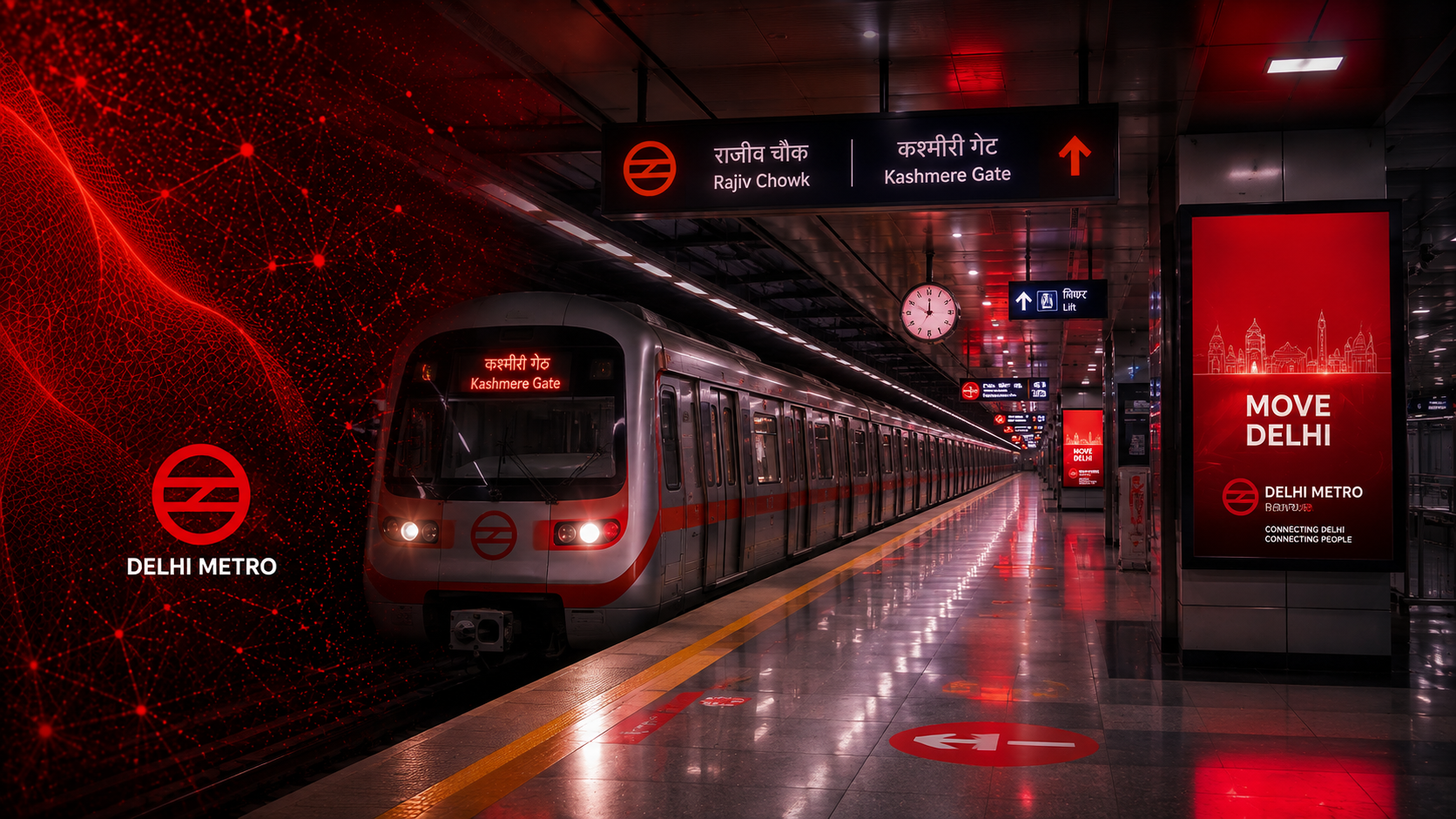
Compare Delhi Metro Advertising Cost across metro stations, lines, and advertising formats to find the right options for your campaign budget. Explore indicative costs for Station Panels, Digital Screens, Activation Spaces, Inside-Train Advertising, Train Wraps, and Complete Station Branding. Compare station-wise rates, media pricing, and campaign budget requirements to plan an effective Delhi Metro Advertising campaign.
Key Insights
Delhi Metro Advertising Cost in Delhi – Complete Cost & Budget Guide
Delhi Metro is one of India's largest urban transit networks, giving advertisers access to commuters across stations, platforms, concourses and metro trains throughout Delhi NCR. Delhi Metro Advertising Cost can start from approximately ₹24,000 per month for selected station panels and extend to ₹75 lakh or more for complete station branding and domination, depending on the station, advertising format, media size, campaign duration and inventory selected.
There is no single standard advertising rate applicable across the Delhi Metro network. Station static and backlit panels, digital screens, promotional spaces, platform branding, inside-train media, exterior train branding and complete station domination are different advertising products and follow different pricing structures.
Station selection also has a significant impact on cost. A static panel at a regular station can require a relatively small investment, while premium station media and activation spaces can cost several lakhs per month. Train advertising follows another pricing structure, with inside-train costs differing according to the metro line and exterior or full-train branding requiring substantially larger campaign budgets.
Delhi Metro Advertising Cost at a Glance
|
Delhi Metro Advertising Format |
Indicative Cost Range |
|
Station Static / Backlit Advertising |
₹24,000 – ₹5,00,000+ per unit/month depending on station, size and inventory |
|
Station Digital Screens |
₹1.50 lakh – ₹4 lakh+ depending on station, screen and campaign period |
|
Promotional / Activation Space |
₹2.5 lakh – ₹8 lakh+ per station/month |
|
Inside Train Advertising |
₹65,000 – ₹95,000 per coach/month onwards depending on Metro line |
|
Exterior Train Branding |
₹14.5 lakh – ₹35 lakh+ per train/month |
|
Full Train Branding |
₹15.5 lakh – ₹35 lakh+ per train/month depending on branding configuration |
|
Platform / Concourse Branding |
₹24,000 per panel/month onwards; larger packages can run into several lakhs |
|
Complete Station Branding / Domination |
₹75 lakh onwards depending on station and inventory |
|
Printing, Fabrication & Mounting |
Additional and highly format-dependent |
Inside-train advertising costs also vary according to the Delhi Metro line. Based on the available cost inputs, Green, Pink and Magenta Line advertising starts from approximately ₹65,000 per coach per month, while Red and Violet Line advertising starts from approximately ₹80,000 per coach per month. The Blue and Yellow Lines are higher at approximately ₹95,000 per coach per month onwards.
|
Delhi Metro Line |
Inside Train Advertising Cost |
|
Green Line |
₹65,000 per coach/month onwards |
|
Pink Line |
₹65,000 per coach/month onwards |
|
Magenta Line |
₹65,000 per coach/month onwards |
|
Red Line |
₹80,000 per coach/month onwards |
|
Violet Line |
₹80,000 per coach/month onwards |
|
Blue Line |
₹95,000 per coach/month onwards |
|
Yellow Line |
₹95,000 per coach/month onwards |
The total cost of a full-train interior campaign depends on the number of coaches being branded. For example, branding six coaches at ₹65,000 per coach would represent approximately ₹3.90 lakh per month, while six coaches at ₹95,000 per coach would represent approximately ₹5.70 lakh per month, before applicable production, printing, mounting and taxes.
This difference illustrates why Delhi Metro Advertising Cost should not be represented by one average rate. A ₹24,000 platform panel, a ₹5 lakh premium station display, an ₹8 lakh activation, a ₹35 lakh train-branding campaign and a ₹75 lakh station domination are fundamentally different advertising opportunities.
The actual campaign cost should therefore be calculated according to the station or Metro line, advertising format, number and size of media units, number of coaches or trains, campaign duration and applicable execution costs.
How Delhi Metro Advertising Cost Is Calculated
Delhi Metro Advertising Cost is calculated differently for station media, inside-train advertising, train branding and promotional spaces. Unlike media where one standard rate can be multiplied across the campaign, Delhi Metro inventory may be priced per panel, per square foot, per screen, per coach, per train or per station per month.
For station panels priced according to advertising area, the basic calculation is:
Media Size in Sq. Ft. × Rate per Sq. Ft. × Number of Panels × Campaign Duration = Media Cost
For example, selected Magenta Line platform glass panels are priced at approximately ₹800 per sq. ft. per month.
A 10 × 3 ft panel provides 30 sq. ft. of advertising area: 30 sq. ft. × ₹800 = ₹24,000 per panel/month
A 16 × 3 ft panel provides 48 sq. ft.: 48 sq. ft. × ₹800 = ₹38,400 per panel/month
If an advertiser selects 10 panels of 10 × 3 ft for one month: ₹24,000 × 10 panels = ₹2.40 lakh
Selected Blue Line backlit inventory uses a higher rate of approximately ₹1,200 per sq. ft. per month. At this rate, an 8 × 4 ft panel costs approximately ₹38,400 per month, while a 10 × 5 ft panel costs approximately ₹60,000 per month.
This means that even when two advertisers purchase static station media, their cost can be different because of the applicable station inventory, panel dimensions and rate per square foot.
Digital screens follow a different pricing structure. Depending on the station and available screen package, station digital advertising can cost approximately ₹1.50 lakh to ₹4 lakh+. The advertiser therefore needs to compare the number of screens, station, campaign period and applicable display package rather than applying the static-panel rate to digital inventory.
Promotional and activation spaces are generally priced according to the station and selected space. Indicative costs can range from approximately ₹2.5 lakh to ₹8 lakh+ per station per month.
For example, an activation space costing ₹3 lakh per month and booked for two months would represent: ₹3 lakh × 2 months = ₹6 lakh media cost
Inside-train advertising is calculated primarily according to the Metro line, number of coaches and campaign duration.
The basic calculation is: Cost per Coach × Number of Coaches × Campaign Months = Inside Train Media Cost
If six coaches are selected on the Green, Pink or Magenta Line at approximately ₹65,000 per coach: ₹65,000 × 6 = ₹3.90 lakh per month
For the Red or Violet Line at approximately ₹80,000 per coach: ₹80,000 × 6 = ₹4.80 lakh per month
For the Blue or Yellow Line at approximately ₹95,000 per coach: ₹95,000 × 6 = ₹5.70 lakh per month
A three-month six-coach campaign at ₹95,000 per coach would therefore represent approximately: ₹95,000 × 6 × 3 = ₹17.10 lakh
before separately applicable production and execution costs.
Exterior and full-train branding are calculated at the train level rather than simply at the individual coach-panel level. Indicative exterior train branding costs approximately ₹14.5 lakh to ₹35 lakh+ per train per month, while full train branding can cost approximately ₹15.5 lakh to ₹35 lakh+ per train per month, depending on the branding configuration and selected train inventory.
Complete station branding follows another pricing structure because multiple advertising assets within a station can be combined into one integrated branding package. Such campaigns can start from approximately ₹75 lakh onwards, depending on the station and inventory included.
The practical calculation of Delhi Metro Advertising Cost can therefore be understood as:
Media Rate × Number of Advertising Units × Campaign Duration + Production / Printing / Fabrication / Mounting + Applicable Taxes
The exact meaning of “advertising unit” changes according to the format. It can mean one panel, one digital-screen package, one activation space, one coach, one complete train or one station-branding package. This is why Delhi Metro quotations should always identify the exact inventory being purchased before two campaign costs are compared.
Delhi Metro Station Advertising Cost
Delhi Metro Station Advertising Cost varies significantly according to the station, advertising format, media dimensions and exact location of the advertising asset within the station. Brands can advertise through static and backlit panels, platform glass panels, concourse media, digital screens, entry and exit media, promotional spaces and complete station branding.
Individual station advertising can start from approximately ₹24,000 per panel per month, while premium static or backlit inventory can reach ₹5 lakh+ per unit per month. Digital screen packages can range from approximately ₹1.50 lakh to ₹4 lakh+, promotional and activation spaces from approximately ₹2.5 lakh to ₹8 lakh+ per month, and complete station branding can start from approximately ₹75 lakh onwards.
|
Station Advertising Format |
Indicative Cost |
|
Platform Glass Panel |
₹24,000 – ₹38,400+ per panel/month |
|
Static / Backlit Media |
₹38,400 – ₹5 lakh+ per unit/month |
|
Digital Screens |
₹1.50 lakh – ₹4 lakh+ |
|
Promotional / Activation Space |
₹2.5 lakh – ₹8 lakh+ per month |
|
Platform / Concourse Packages |
₹24,000 per panel/month onwards |
|
Complete Station Branding |
₹75 lakh onwards |
Static and Backlit Station Advertising: Static and backlit panels are among the most flexible options because advertisers can select individual media units instead of branding an entire station.
The available Blue Line inventory from Mayur Vihar towards Noida Electronic City provides examples based on approximately ₹1,200 per sq. ft. per month.
At this rate:
8 × 4 ft panel = ₹38,400 per month
10 × 5 ft panel = ₹60,000 per month
The total investment depends on how many panels are selected. For example, ten 10 × 5 ft panels would represent approximately ₹6 lakh per month in media cost.
Premium station inventory can cost considerably more, with selected static and backlit advertising opportunities reaching approximately ₹5 lakh+ per unit per month depending on the station, location and asset.
Platform Glass Panel Advertising: Platform glass panels provide advertising visibility directly within passenger waiting and boarding areas.
The available Magenta Line inventory covers stations from Janakpuri West to Botanical Garden and Pink Line inventory covers stations from Majlis Park to Shiv Vihar, uses approximately ₹800 per sq. ft. per month for selected glass-panel media.
A standard 10 × 3 ft panel costs approximately ₹24,000 per month, while a 16 × 3 ft panel costs approximately ₹38,400 per month.
This allows advertisers to scale a campaign by increasing the number of panels rather than necessarily moving to a more expensive advertising format.
For example:
|
Number of 10 × 3 ft Panels |
Approx. Monthly Media Cost |
|
5 Panels |
₹1.20 lakh |
|
10 Panels |
₹2.40 lakh |
|
20 Panels |
₹4.80 lakh |
|
50 Panels |
₹12 lakh |
Concourse Advertising Cost: Concourse advertising reaches commuters as they move between entry gates, platforms, interchange areas and station exits.
The supplied Magenta Line inventory includes 8 × 4 ft concourse panels at Hauz Khas. At approximately ₹800 per sq. ft. per month, a 32 sq. ft. panel costs around ₹25,600 per month.
A campaign using 20 such panels would therefore represent approximately: ₹25,600 × 20 = ₹5.12 lakh per month
The actual cost at other stations can differ according to the dimensions and commercial rate applicable to the available concourse inventory.
Digital Screen Advertising Cost: Digital screens are priced differently from static panels and can cost approximately ₹1.50 lakh to ₹4 lakh+, depending on the station, screen inventory and campaign period.
Advertisers should check what the quoted digital package includes because a digital quotation may represent an individual screen, a group of screens or a station-level package. Comparing only the headline price without comparing the number and location of screens can therefore be misleading.
Promotional and Activation Space Cost: Promotional spaces allow brands to conduct physical activations, product displays, demonstrations, lead-generation activities and consumer engagement within selected Delhi Metro stations.
Indicative Delhi Metro activation costs range from approximately ₹2.5 lakh to ₹8 lakh+ per station per month.
Premium stations can command substantially higher activation rates than regular stations. Consequently, an ₹8 lakh budget could be concentrated on one premium activation location or distributed across multiple lower-priced station opportunities.
Fabrication, stall construction, manpower, electricity, logistics and other execution requirements can be additional to the quoted media-space cost.
Complete Station Branding Cost: Complete station branding represents a substantially larger investment because the campaign can combine multiple advertising assets to create a dominant brand presence within a selected station.
Depending on the station and inventory included, complete Delhi Metro station branding can start from approximately ₹75 lakh onwards.
The package can potentially include a combination of available platform, concourse, entry/exit, static, digital and other station media rather than one isolated advertising unit.
This is why the term station advertising cost can represent anything from approximately ₹24,000 for an individual platform panel to ₹75 lakh+ for integrated station branding.
The correct comparison should therefore be made at the inventory level:
Station + Media Format + Asset Location + Media Size + Number of Units + Campaign Duration = Delhi Metro Station Advertising Cost
Delhi Metro Advertising Cost by Station
Delhi Metro Advertising Cost varies significantly from one station to another. The rate depends not only on commuter traffic and station importance but also on the advertising format, panel dimensions, location inside the station and commercial rate applicable to that particular inventory.
For station advertising panels, indicative monthly rates can start from approximately ₹35,000 at selected stations and reach ₹1 lakh onwards at Rajiv Chowk. On several Metro corridors, panel advertising is calculated according to the total display area using a per-square-foot monthly rate.
Station Advertising Panel Cost
|
Delhi Metro Station |
Indicative Advertising Panel Cost |
|
Rajiv Chowk |
₹1,00,000 onwards |
|
New Delhi |
₹45,000 onwards |
|
Chandni Chowk |
₹45,000 onwards |
|
Vishwavidyalaya |
₹45,000 onwards |
|
Botanical Garden |
₹40,000 onwards |
|
GTB Nagar |
₹35,000 onwards |
|
Hauz Khas |
₹35,000 onwards |
These are indicative starting costs for station advertising panels. The final cost depends on the dimensions, exact location and number of advertising panels selected.
Station Advertising Cost by Metro Line
For several Delhi Metro corridors, static station advertising is calculated according to the advertising area.
|
Delhi Metro Line |
Indicative Station Panel Rate |
|
Red Line |
₹900 per sq. ft./month |
|
Green Line |
₹900 per sq. ft./month |
|
Magenta Line |
₹900 per sq. ft./month |
|
Pink Line |
₹900 per sq. ft./month |
|
Blue Line |
₹1,000 per sq. ft./month |
|
Violet Line |
₹1,000 per sq. ft./month |
|
Yellow Line |
₹1,000 – ₹5,000 per sq. ft./month depending on station |
A 10 × 4 ft advertising panel provides 40 sq. ft. of display area. At ₹900 per sq. ft., the media cost would be approximately ₹36,000 per month. At ₹1,000 per sq. ft., the same panel would cost approximately ₹40,000 per month.
The Yellow Line shows a much wider variation because rates differ substantially between stations.
Yellow Line Station Advertising Cost
|
Yellow Line Station / Category |
Indicative Rate |
|
Rajiv Chowk |
Around ₹5,000 per sq. ft./month |
|
New Delhi |
Around ₹2,100 per sq. ft./month |
|
Chandni Chowk |
Around ₹2,100 per sq. ft./month |
|
Chawri Bazar |
Around ₹2,100 per sq. ft./month |
|
Vishwavidyalaya |
Around ₹2,100 per sq. ft./month |
|
Millennium City Centre Gurugram |
Around ₹1,300 per sq. ft./month |
|
Guru Dronacharya |
Around ₹1,000 per sq. ft./month |
|
IFFCO Chowk |
Around ₹1,000 per sq. ft./month |
|
Sikanderpur |
Around ₹1,000 per sq. ft./month |
|
MG Road |
Around ₹1,000 per sq. ft./month |
|
Other Yellow Line Stations |
Around ₹1,800 per sq. ft./month |
The difference becomes substantial when the rates are applied to the same advertising-panel size.
For a 10 × 4 ft panel of 40 sq. ft., the indicative monthly media cost would be approximately:
|
Station / Rate Category |
Calculation |
Approx. Monthly Cost |
|
Rajiv Chowk |
40 × ₹5,000 |
₹2,00,000 |
|
New Delhi / Chandni Chowk / Chawri Bazar / Vishwavidyalaya |
40 × ₹2,100 |
₹84,000 |
|
Other Yellow Line Stations |
40 × ₹1,800 |
₹72,000 |
|
Millennium City Centre Gurugram |
40 × ₹1,300 |
₹52,000 |
|
Guru Dronacharya / IFFCO Chowk / Sikanderpur / MG Road |
40 × ₹1,000 |
₹40,000 |
|
Blue / Violet Line Benchmark |
40 × ₹1,000 |
₹40,000 |
|
Red / Green / Magenta / Pink Line Benchmark |
40 × ₹900 |
₹36,000 |
This shows why the station itself can have a much greater impact on Delhi Metro Advertising Cost than the physical size of the panel. A 40 sq. ft. advertising panel could cost approximately ₹36,000 per month on selected ₹900-per-sq.-ft. inventory but around ₹2 lakh per month at Rajiv Chowk at the indicative ₹5,000-per-sq.-ft. rate.
For advertisers working with a fixed budget, this creates a clear planning choice. The budget required for a small number of panels at a premium station can potentially purchase substantially more advertising area across lower-priced stations.
The appropriate comparison is therefore not simply Rajiv Chowk vs New Delhi vs Hauz Khas. Advertisers should compare the cost per sq. ft., panel dimensions, number of units, station relevance and total monthly investment before selecting the station network.
Premium vs Regular Metro Station Advertising Cost
The difference between premium and regular stations can significantly change the Delhi Metro Advertising Cost even when the advertising format and panel dimensions remain the same. Station advertising rates can range from approximately ₹900 per sq. ft. per month on selected Metro lines to around ₹5,000 per sq. ft. per month at Rajiv Chowk.
This means advertisers need to decide whether their budget should be concentrated at a smaller number of premium stations or distributed across a larger network of comparatively lower-cost stations.
For example, consider the cost of the same 40 sq. ft. advertising panel:
|
Station / Station Category |
Indicative Rate |
Approx. Cost for 40 Sq. Ft./Month |
|
Rajiv Chowk |
₹5,000/sq. ft. |
₹2,00,000 |
|
New Delhi / Chandni Chowk / Chawri Bazar / Vishwavidyalaya |
₹2,100/sq. ft. |
₹84,000 |
|
Other Yellow Line Stations |
₹1,800/sq. ft. |
₹72,000 |
|
Millennium City Centre Gurugram |
₹1,300/sq. ft. |
₹52,000 |
|
Blue & Violet Line |
₹1,000/sq. ft. |
₹40,000 |
|
Guru Dronacharya / IFFCO Chowk / Sikanderpur / MG Road |
₹1,000/sq. ft. |
₹40,000 |
|
Red, Green, Magenta & Pink Line |
₹900/sq. ft. |
₹36,000 |
At these indicative rates, the same 40 sq. ft. advertising area at Rajiv Chowk can cost more than five times the equivalent area on selected Red, Green, Magenta or Pink Line inventory.
The difference becomes more important when several panels are purchased. Ten 40 sq. ft. panels at ₹900 per sq. ft. would represent approximately ₹3.60 lakh per month, while ten equivalent panels at ₹5,000 per sq. ft. would represent approximately ₹20 lakh per month.
What a ₹10 Lakh Monthly Budget Can Buy
Using the same indicative rates, a ₹10 lakh monthly media budget could theoretically purchase very different amounts of advertising area:
|
Station / Rate Category |
Approx. Advertising Area Within ₹10 Lakh |
|
Rajiv Chowk at ₹5,000/sq. ft. |
200 sq. ft. |
|
₹2,100/sq. ft. Premium Station Inventory |
476 sq. ft. |
|
Other Yellow Line at ₹1,800/sq. ft. |
555 sq. ft. |
|
Millennium City Centre at ₹1,300/sq. ft. |
769 sq. ft. |
|
₹1,000/sq. ft. Inventory |
1,000 sq. ft. |
|
₹900/sq. ft. Inventory |
1,111 sq. ft. |
The advertiser is therefore not simply choosing between an expensive and inexpensive station. The decision is between concentrated visibility at selected premium locations and substantially greater advertising area across a wider station network.
Premium stations can be appropriate when the campaign specifically requires a high-value interchange, central business location or particular commuter catchment. Regular station inventory can be more suitable when the objective is to increase geographic coverage and maintain presence across several parts of Delhi NCR.
A balanced campaign can combine both approaches. Premium stations such as Rajiv Chowk, New Delhi or other strategically important locations can provide concentrated presence, while comparatively lower-cost stations can extend the campaign across additional corridors.
For this reason, the lowest Delhi Metro Advertising Cost per sq. ft. should not automatically determine the media plan. The more useful comparison is the station relevance, advertising area available, number of panels, geographic coverage and total monthly investment that the campaign budget can purchase.
Delhi Metro Inside Train Advertising Cost
Inside-train advertising gives brands visibility throughout a commuter's journey and moves across the entire route of the selected Metro line. Delhi Metro inside train advertising cost ranges from approximately ₹65,000 to ₹95,000 per coach per month, depending on the line.
The train configuration is important when calculating the total cost. Pink, Magenta, Green, Red and Violet Line trains have 6 coaches, while Blue and Yellow Line trains have 8 coaches. Therefore, the full-train interior cost should be calculated according to the actual number of coaches operating on the selected line.
|
Delhi Metro Line |
Coaches per Train |
Cost per Coach/Month |
Full Train Interior Cost/Month |
|
Pink Line |
6 |
₹65,000 |
₹3.90 lakh |
|
Magenta Line |
6 |
₹65,000 |
₹3.90 lakh |
|
Green Line |
6 |
₹65,000 |
₹3.90 lakh |
|
Red Line |
6 |
₹80,000 |
₹4.80 lakh |
|
Violet Line |
6 |
₹80,000 |
₹4.80 lakh |
|
Blue Line |
8 |
₹95,000 |
₹7.60 lakh |
|
Yellow Line |
8 |
₹95,000 |
₹7.60 lakh |
A complete interior campaign on a Pink, Magenta or Green Line train would therefore cost approximately ₹3.90 lakh per month at the indicative rate of ₹65,000 per coach.
For the Red and Violet Lines, the cost increases to approximately ₹4.80 lakh per train per month, based on six coaches at ₹80,000 each.
The Blue and Yellow Lines have eight-coach trains and a higher indicative rate of ₹95,000 per coach. A complete train interior campaign therefore costs approximately:
₹95,000 × 8 coaches = ₹7.60 lakh per train per month
Campaign duration has a direct impact on the total investment.
|
Metro Line Group |
1 Month |
3 Months |
6 Months |
|
Pink, Magenta & Green |
₹3.90 lakh |
₹11.70 lakh |
₹23.40 lakh |
|
Red & Violet |
₹4.80 lakh |
₹14.40 lakh |
₹28.80 lakh |
|
Blue & Yellow |
₹7.60 lakh |
₹22.80 lakh |
₹45.60 lakh |
The difference between the line groups becomes substantial for longer campaigns. A three-month full-train interior campaign costs approximately ₹11.70 lakh on the Pink, Magenta or Green Line, compared with approximately ₹22.80 lakh on the Blue or Yellow Line.
Inside-train advertising can use multiple approved interior surfaces within the coaches, giving the advertiser repeated visibility while passengers travel. Unlike station advertising, the campaign is not tied to one fixed station; the branded train operates along its assigned Metro corridor.
For this reason, the lowest per-coach rate should not automatically determine the line selection. A campaign targeting commuters travelling along the Blue or Yellow Line may justify the higher Delhi Metro Advertising Cost, while campaigns focused on markets connected by the Pink, Magenta, Green, Red or Violet Lines should select the corresponding train inventory.
The quoted media cost should also be separated from applicable printing, production, mounting, installation and removal costs. These execution expenses depend on the approved inside-train branding surfaces and quantity of material required.
The total inside-train campaign investment can therefore be calculated as:
Cost per Coach × Actual Number of Coaches × Campaign Duration + Printing & Execution Cost + Applicable Taxes
This provides a more accurate calculation than applying a generic six-coach or eight-coach assumption across the entire Delhi Metro network.
Delhi Metro Train Wrap Advertising Cost
Train wrap advertising turns the complete exterior of a Delhi Metro train into a moving advertising medium. Delhi Metro train wrap advertising cost ranges from approximately ₹14.5 lakh to ₹35 lakh+ per train per month, depending on the Metro line, train configuration, extent of branding, available inventory and campaign duration.
For broader full train branding, the indicative cost ranges from approximately ₹15.5 lakh to ₹35 lakh+ per train per month.
Unlike inside-train advertising, train wrap advertising is calculated at the complete-train level rather than simply multiplying an interior per-coach rate.
|
Train Advertising Format |
Indicative Cost / Train / Month |
|
Inside Train – Pink, Magenta & Green |
₹3.90 lakh |
|
Inside Train – Red & Violet |
₹4.80 lakh |
|
Inside Train – Blue & Yellow |
₹7.60 lakh |
|
Exterior Train Branding / Wrap |
₹14.5 lakh – ₹35 lakh+ |
|
Full Train Branding |
₹15.5 lakh – ₹35 lakh+ |
The difference in investment reflects the extent of branding. Inside-train advertising places the brand within the passenger environment, while exterior train branding creates a large moving visual presence as the train travels through stations and along applicable sections of the Metro corridor.
At the lower indicative exterior branding cost of ₹14.5 lakh per train per month, campaign investment would be approximately:
|
Campaign Duration |
Approx. Media Cost |
|
1 Month |
₹14.5 lakh |
|
3 Months |
₹43.5 lakh |
|
6 Months |
₹87 lakh |
At ₹25 lakh per train per month, the same campaign would require approximately ₹25 lakh for one month, ₹75 lakh for three months and ₹1.50 crore for six months.
At the upper indicative level of ₹35 lakh per train per month, a three-month campaign could reach approximately: ₹35 lakh × 3 months = ₹1.05 crore per train
The number of trains selected can therefore change the campaign budget substantially. If three trains are branded at an average media rate of ₹20 lakh per train per month: ₹20 lakh × 3 trains = ₹60 lakh per month
For a three-month campaign: ₹60 lakh × 3 months = ₹1.80 crore
Full train branding follows the same principle but can involve a broader branding configuration. At approximately ₹15.5 lakh to ₹35 lakh+ per train per month, the media investment for a three-month campaign can range from approximately ₹46.5 lakh to ₹1.05 crore+ per train.
The quoted train media rate should not automatically be treated as the complete executed campaign cost. Exterior branding requires significantly more production material than station panels or inside-train media, and printing, fabrication, application, mounting and removal charges can be additional.
The complete calculation should therefore consider:
Train Media Cost × Number of Trains × Campaign Duration + Printing / Production + Application / Removal + Applicable Taxes
The decision between inside-train advertising and train wrap advertising should ultimately depend on the campaign objective. Inside-train advertising provides a lower-cost entry into moving Metro media and creates repeated visibility within the passenger environment, while exterior and full train branding require a substantially larger Delhi Metro Advertising Cost but create a much larger moving brand presence across the selected Metro corridor.
Delhi Metro Advertising Budget Guide
The budget required for a Delhi Metro campaign depends on whether the objective is to advertise at selected stations, build visibility across multiple stations, advertise inside trains or use large-format train and station branding. Smaller budgets are generally better suited to individual station panels, while larger investments provide access to digital media, multiple stations, complete train interiors, train wraps and integrated station branding.
₹1–3 Lakh Delhi Metro Advertising Budget: A budget of ₹1–3 lakh per month is suitable for a focused station advertising campaign.
At approximately ₹900 per sq. ft., ₹3 lakh can purchase around 333 sq. ft. of advertising area, while at ₹1,000 per sq. ft., it can purchase approximately 300 sq. ft.
The same budget will provide substantially less advertising area at premium Yellow Line stations where the applicable rate is higher.
This budget can therefore be used for selected panels at one important station or distributed across several lower-cost station locations.
₹3–5 Lakh Delhi Metro Advertising Budget: A ₹3–5 lakh monthly budget provides considerably more flexibility.
Apart from building a larger station-panel network, this budget reaches the approximate cost of a complete inside-train campaign on selected six-coach trains.
A full Pink, Magenta or Green Line train interior costs approximately ₹3.90 lakh per month, while a Red or Violet Line train costs approximately ₹4.80 lakh per month.
The advertiser can therefore choose between a station-focused campaign and corridor-level inside-train advertising within broadly the same budget range.
₹5–10 Lakh Delhi Metro Advertising Budget: At ₹5–10 lakh per month, advertisers can build a larger multi-station campaign or consider complete inside-train advertising on the Blue or Yellow Line.
An eight-coach Blue or Yellow Line train interior costs approximately ₹7.60 lakh per month.
Alternatively, ₹10 lakh could purchase approximately 1,111 sq. ft. of station media at ₹900 per sq. ft., 1,000 sq. ft. at ₹1,000 per sq. ft., or approximately 200 sq. ft. at Rajiv Chowk's indicative ₹5,000 per sq. ft. rate.
This illustrates how the same budget can create either wider station coverage or a concentrated premium-station presence.
₹10–25 Lakh Delhi Metro Advertising Budget: A ₹10–25 lakh monthly budget allows advertisers to combine multiple Delhi Metro advertising formats.
The campaign could include premium and regular station panels, digital inventory and inside-train advertising, or move into exterior train branding.
With exterior train branding starting from approximately ₹14.5 lakh per train per month, this is the budget level at which a complete moving exterior campaign becomes feasible.
The budget can also be divided between station and train media rather than being invested entirely in one format.
₹25–50 Lakh Delhi Metro Advertising Budget: A ₹25–50 lakh monthly investment can support large-scale Delhi Metro campaigns.
Depending on the applicable rate, this budget can cover one premium exterior or full-train branding campaign, multiple inside-train campaigns or an extensive network of station advertising assets.
For example, ₹30 lakh could theoretically cover several complete train interiors across selected lines or be allocated between premium station inventory and broader lower-cost station coverage.
At this level, the campaign should be planned according to corridor and station priorities rather than simply maximising the number of advertising units.
₹50 Lakh+ Delhi Metro Advertising Budget: Budgets above ₹50 lakh allow brands to consider large multi-format Delhi Metro campaigns combining station and train media.
The investment can be distributed across premium stations, high-volume station-panel networks, digital screens, activations, inside-train branding and exterior train wraps.
Complete station branding becomes relevant at the higher end of this budget category, with indicative investment starting from approximately ₹75 lakh onwards, depending on the selected station and inventory.
Budget Does Not Directly Equal Coverage: The same ₹10 lakh budget can create completely different campaigns.
It could purchase a large amount of advertising area across stations priced at ₹900–₹1,000 per sq. ft., a much smaller premium presence at Rajiv Chowk, a complete Blue or Yellow Line train interior, or a combination of station and digital inventory. The appropriate budget allocation should therefore follow:
Target Locations → Required Format → Station or Metro Line → Campaign Duration → Available Budget
This approach ensures that Delhi Metro Advertising Cost is used to purchase relevant commuter coverage rather than simply the maximum quantity of available media.
What Determines Delhi Metro Advertising Cost?
The final Delhi Metro Advertising Cost is influenced by several variables beyond the advertising format itself. Two campaigns using similar-sized panels or the same number of coaches can have significantly different costs depending on where the media is located, which Metro line is selected and how extensively the campaign is executed.
Metro Station: Station selection is one of the biggest pricing factors. Premium and strategically important stations generally command higher rates than other stations.
For example, station-panel pricing can be around ₹5,000 per sq. ft. per month at Rajiv Chowk, compared with approximately ₹900 per sq. ft. on selected Red, Green, Magenta and Pink Line inventory.
Even within the Yellow Line, rates vary substantially between stations rather than following one common line-wide price.
Location of Media Inside the Station: Two advertising assets at the same Metro station can have different commercial values.
Media positioned at platforms, concourses, interchange areas, entry and exit zones or other commuter movement points can follow different rates. The advertiser should therefore check the exact location of the media asset instead of comparing only the station name.
Size of the Advertising Panel: For inventory priced per square foot, panel dimensions directly determine the monthly media cost.
A 30 sq. ft. panel at ₹1,000 per sq. ft. costs approximately ₹30,000 per month, while a 50 sq. ft. panel at the same rate costs ₹50,000 per month.
Larger advertising surfaces therefore increase the investment even when the station and applicable rate remain unchanged.
Number of Advertising Units: A quotation for one panel should not be confused with the cost of a station-wide campaign.
If one panel costs ₹40,000 per month, 10 equivalent panels would represent approximately ₹4 lakh per month and 25 panels approximately ₹10 lakh per month.
The number of available and selected units can therefore have a greater impact on the total campaign budget than the individual panel rate.
Static vs Digital Inventory: Static panels and digital screens follow different pricing structures.
Static media can be calculated according to dimensions and per-square-foot rates, whereas digital inventory can be sold according to the screen or available station package. The number of screens, their locations and the applicable display arrangement should therefore be checked when comparing digital quotations.
Metro Line for Inside-Train Advertising: The selected Metro line directly affects inside-train advertising costs.
Pink, Magenta and Green Line inventory is approximately ₹65,000 per coach per month, Red and Violet approximately ₹80,000, and Blue and Yellow approximately ₹95,000.
Train configuration adds another variable. Pink, Magenta, Green, Red and Violet Line trains have six coaches, while Blue and Yellow Line trains have eight coaches. This results in full-train interior costs ranging from approximately ₹3.90 lakh to ₹7.60 lakh per month.
Extent of Train Branding: Inside-train advertising, exterior wrapping and full-train branding should not be treated as equivalent inventory.
Inside-train advertising starts at the coach level, while exterior and full-train branding can require approximately ₹14.5 lakh to ₹35 lakh+ per train per month.
The more extensive the approved train-branding configuration, the larger the media and production requirement.
Campaign Duration: Most rates in this guide are expressed on a monthly basis. Extending the campaign therefore increases the total media investment.
A ₹4 lakh monthly media plan represents approximately ₹12 lakh over three months and ₹24 lakh over six months, before additional execution costs.
Campaign duration should therefore be fixed before comparing final quotations.
Production and Execution Requirements: The media rate is not always the final executed campaign cost.
Depending on the format, advertisers may also need to budget for printing, fabrication, mounting, installation, removal and other execution requirements. These expenses are particularly relevant for large-format station branding, activations and train wraps.
The actual campaign investment is therefore better understood as:
Media Cost + Production / Printing + Fabrication / Mounting + Other Applicable Execution Charges + Taxes
This is why two Delhi Metro campaigns with the same media budget can ultimately have different payable amounts. The final Delhi Metro Advertising Cost should be calculated only after the exact station, asset, dimensions, quantity, Metro line, train configuration and campaign duration have been finalised.
Additional Costs Beyond Delhi Metro Advertising Rates
The quoted Delhi Metro Advertising Cost generally represents the media space being purchased. The final campaign investment can be higher because physical Metro advertising requires creative production, printing, fabrication, mounting and installation depending on the selected format.
For station advertising panels, the additional cost is primarily determined by the total printable area. A campaign using five panels requires considerably less production material than a campaign covering 50 or 100 panels, even when the media rate per panel remains unchanged.
For example, a 10 × 4 ft panel has 40 sq. ft. of printable area. A campaign using 20 such panels requires: 40 sq. ft. × 20 panels = 800 sq. ft. of printed material
Printing and mounting would therefore be calculated on approximately 800 sq. ft., separately from the station media cost.
Backlit displays may require different print material and production specifications from conventional static panels. Platform glass panels, concourse displays and other station assets also need to be produced according to their approved dimensions.
Digital screen campaigns generally do not require physical printing or mounting. The creative needs to be supplied in the required digital specifications, making production requirements different from static station advertising.
Activation campaigns can involve a wider range of additional expenses. Apart from the station activation-space cost of approximately ₹2.5 lakh to ₹8 lakh+ per month, advertisers may need to budget for kiosk or stall fabrication, branding material, product displays, manpower, transportation, installation and other execution requirements according to the activation concept.
Inside-train advertising also requires production material for every selected coach. A six-coach train needs branding material across six coaches, while Blue and Yellow Line campaigns require material for eight coaches. The total production and mounting cost therefore depends on the approved interior surfaces and the number of trains selected.
Exterior train wraps have substantially larger execution requirements. The media rate of approximately ₹14.5 lakh to ₹35 lakh+ per train per month should therefore be separated from the cost of producing, applying and subsequently removing the train-wrap material.
Complete station branding has the largest production requirement because multiple station assets can be included in the campaign. Printing, fabrication and installation should therefore be calculated only after the final station inventory and branding area have been confirmed.
The complete campaign budget can be understood as:
Delhi Metro Media Cost + Printing / Production + Fabrication + Mounting / Installation + Removal, where applicable + Applicable Taxes
Not every campaign incurs every additional cost. A digital-screen campaign, for example, does not require the same physical production as a train wrap, while an activation can require fabrication and manpower that a conventional station-panel campaign does not.
For this reason, advertisers should distinguish between the media rate and the final executed Delhi Metro Advertising Cost when comparing campaign quotations.
How Delhi Metro Advertising Is Booked
Booking Delhi Metro advertising starts with identifying the target locations, advertising format, campaign duration and available budget. Since Delhi Metro Advertising Cost varies considerably by station, Metro line and media format, the final booking should be based on available inventory rather than a general network-wide rate.
For station advertising, the first step is to shortlist the required Metro stations and choose the media format, such as static or backlit panels, digital screens, platform or concourse panels, activation spaces or station branding. Available media units, their dimensions, locations and applicable rates are then checked for the required campaign period.
For inside-train advertising, the advertiser selects the Metro line and number of trains required. The cost is calculated according to the applicable per-coach rate and train configuration. Pink, Magenta, Green, Red and Violet Line trains have six coaches, while Blue and Yellow Line trains have eight coaches.
Train wrap and full-train branding campaigns require confirmation of the available train inventory, approved branding configuration and campaign tenure before the final cost can be determined.
Once the inventory is available, a media plan is prepared showing the station or Metro line, advertising format, media dimensions or number of coaches, quantity, campaign duration and applicable media cost. Printing, fabrication, mounting and other execution expenses are added separately where required.
After the media plan is approved and inventory is confirmed, creatives are prepared according to the specifications of the selected media assets. Static panels and train branding require print-ready artwork, while digital screens require creatives in the prescribed digital format. Activation campaigns may additionally require kiosk or display design and fabrication.
The campaign is then installed or scheduled across the confirmed stations or trains for the agreed campaign period. Because Delhi Metro inventory is subject to availability, final rates and media locations should be confirmed before creative production and campaign execution.
Role of a Delhi Metro Advertising Agency
A Delhi Metro Advertising Agency helps advertisers plan and execute campaigns across Metro stations and trains by identifying suitable media inventory according to the target locations, campaign objective and available budget.
The planning process can include station advertising panels, backlit displays, digital screens, platform and concourse media, activation spaces, inside-train advertising, train wraps and complete station branding. Since each format follows a different pricing structure, the agency compares available options before preparing the final media plan.
For station campaigns, the agency can compare individual stations based on the required advertising format and applicable rates. This is particularly important because station panel costs can vary from around ₹900 per sq. ft. on selected Metro lines to approximately ₹5,000 per sq. ft. at Rajiv Chowk, while individual advertising panels can start from approximately ₹35,000–₹45,000 at several stations and ₹1 lakh onwards at Rajiv Chowk.
For inside-train campaigns, a Delhi Metro Advertising Agency in Delhi can help select the appropriate Metro line and calculate the cost according to the actual train configuration. Pink, Magenta and Green Line interiors cost approximately ₹3.90 lakh per complete six-coach train per month, Red and Violet approximately ₹4.80 lakh, and Blue and Yellow approximately ₹7.60 lakh per eight-coach train per month.
The agency also coordinates inventory availability, media specifications, creative adaptation, printing, fabrication, mounting and campaign execution where required. For large campaigns involving multiple stations, trains or advertising formats, these requirements can be consolidated into one media plan rather than being managed separately.
The role of a Delhi Metro Advertising Agency is therefore to convert the available campaign budget into the appropriate combination of stations, advertising assets, Metro lines and campaign duration, while keeping the media and execution costs clearly identified.
Get Delhi Metro Advertising Plan
Delhi Metro advertising rates vary according to the station, Metro line, advertising format, media size, number of units and campaign duration. The costs mentioned in this guide provide a practical benchmark for budget planning, while the final Delhi Metro Advertising Cost depends on the actual media inventory available for the required campaign period.
As a Delhi Metro Advertising Agency, The Media Spaces helps brands plan campaigns across station advertising panels, backlit displays, digital screens, platform and concourse media, activation spaces, inside-train advertising, train wraps and complete station branding. Campaigns can be planned for individual stations, selected Metro corridors or across multiple lines according to the target locations and available budget.
Share your preferred Metro stations or lines, advertising format, campaign duration and approximate budget to receive current media availability, applicable rates and a customised Delhi Metro advertising plan.
Get a Delhi Metro Advertising Plan customised to your campaign objective and budget.
Email us at enquiry@themediaspaces.com
Frequently Asked Questions (FAQ's)
-
How much does Delhi Metro advertising cost?
Delhi Metro Advertising Cost can start from approximately ₹24,000 per month for selected station panels and can exceed ₹75 lakh for complete station branding. The final cost depends on the Metro station, advertising format, panel size, number of units, Metro line and campaign duration.
-
What is the cost of advertising at Rajiv Chowk Metro Station?
Station advertising panels at Rajiv Chowk can start from approximately ₹1 lakh onwards. Selected panel inventory can be around ₹5,000 per sq. ft. per month, while promotional or activation space can cost approximately ₹8 lakh per month. The actual rate depends on the media asset selected.
-
What is the Delhi Metro advertising rate per square foot?
Indicative station advertising rates vary by Metro line and station. Selected Red, Green, Magenta and Pink Line inventory is approximately ₹900 per sq. ft. per month, while Blue and Violet Line inventory is approximately ₹1,000 per sq. ft. Yellow Line rates vary more significantly, ranging from around ₹1,000 to ₹5,000 per sq. ft. per month, depending on the station.
-
How much does advertising inside a Delhi Metro train cost?
Inside-train advertising costs approximately ₹65,000–₹95,000 per coach per month depending on the Metro line. A complete train interior costs approximately ₹3.90 lakh per month on the Pink, Magenta and Green Lines, ₹4.80 lakh on the Red and Violet Lines, and ₹7.60 lakh on the Blue and Yellow Lines.
-
How much does Delhi Metro train wrap advertising cost?
Delhi Metro train wrap advertising cost ranges from approximately ₹14.5 lakh to ₹35 lakh+ per train per month, depending on the Metro line, train inventory, branding configuration and campaign duration. Printing, application and removal charges can be additional.
-
How much does full Delhi Metro train branding cost?
Full train branding can cost approximately ₹15.5 lakh to ₹35 lakh+ per train per month. The final investment depends on the approved branding configuration, Metro line and campaign tenure.
-
How much do Delhi Metro digital screens cost?
Digital screen advertising can cost approximately ₹1.50 lakh to ₹4 lakh+, depending on the Metro station, number of screens, screen locations and available digital package.
-
How much does a Delhi Metro activation cost?
Promotional or activation spaces generally cost approximately ₹2.5 lakh to ₹8 lakh+ per station per month. Premium stations can command higher rates than regular station locations. Fabrication, stall branding, manpower and other activation expenses may be additional.
-
How much does complete Delhi Metro station branding cost?
Complete station branding or station domination can start from approximately ₹75 lakh onwards, depending on the station and advertising inventory included in the branding package.
-
Which Delhi Metro lines have the lowest station advertising rates?
Based on the indicative rates used in this guide, selected Red, Green, Magenta and Pink Line station inventory starts at approximately ₹900 per sq. ft. per month, compared with around ₹1,000 per sq. ft. for selected Blue and Violet Line inventory. Actual rates should still be checked for the individual station and media asset.
-
Which Delhi Metro stations are more expensive for advertising?
Premium stations can have substantially higher advertising rates. Rajiv Chowk, for example, can reach approximately ₹5,000 per sq. ft. per month for selected panel inventory, while New Delhi, Chandni Chowk, Chawri Bazar and Vishwavidyalaya can be around ₹2,100 per sq. ft. for selected inventory.
-
Is printing included in Delhi Metro Advertising Cost?
Not necessarily. Printing, fabrication, mounting, installation and removal can be additional to the media cost depending on the advertising format. Digital campaigns generally do not require physical printing, while station panels, inside-train branding and train wraps require production and execution.
-
What is the minimum budget for Delhi Metro advertising?
There is no single mandatory minimum budget for every campaign. Selected station panels can provide entry points from approximately ₹24,000–₹45,000 per month, while a broader station campaign may require several lakhs. Inside-train, train-wrap and complete station-branding campaigns require substantially larger budgets.
-
Can I advertise at only one Delhi Metro station?
Yes, subject to available inventory. Advertisers can select one station and specific advertising assets rather than necessarily purchasing media across the entire Delhi Metro network.
-
Can I choose specific Metro stations for my campaign?
Yes. Stations can be shortlisted according to target locations, available media formats and campaign budget. Advertisers can also combine premium stations with comparatively lower-cost stations to balance visibility and coverage.
-
Can a Delhi Metro Advertising Agency handle the complete campaign?
Yes. A Delhi Metro Advertising Agency can assist with station and media selection, inventory availability, cost planning, creative specifications, printing, mounting and campaign execution. A Delhi Metro Advertising Agency in Delhi can also coordinate campaigns involving multiple stations, Metro lines and train advertising formats.