
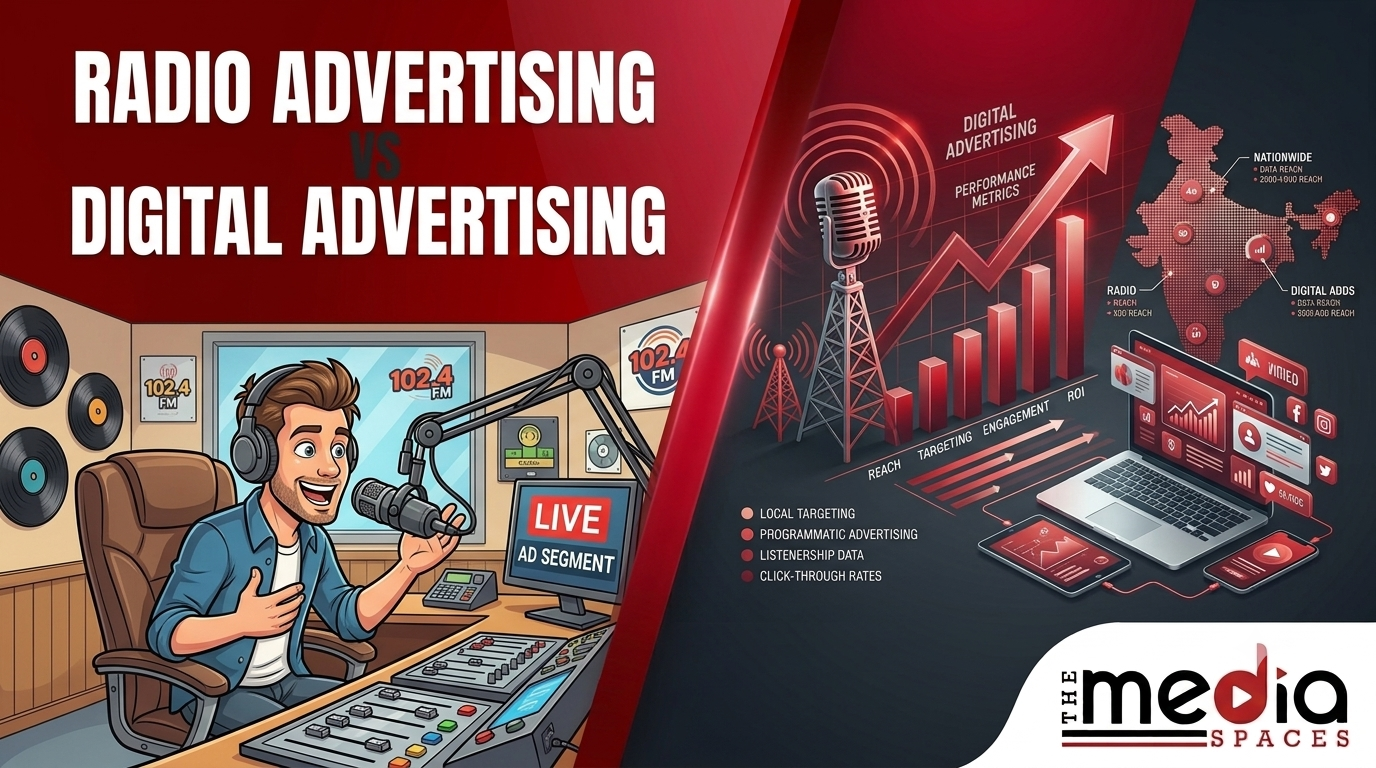
Radio Advertising vs Digital Advertising: Which Gives Better ROI?
Selecting the best advertising channel is one of the most crucial choices for any company. As consumers spend their time on many platforms, marketers usually wonder whether to put their money into Radio Advertising or Digital Advertising. The answer is contingent on your company's goals as well as your budget, audience target and desired results.
Digital platforms offer advanced marketing and tracking; radio advertising continues to be among the most reliable and cost-effective ways to reach thousands of people across India. From local businesses to global companies, radio remains an effective tool for increasing awareness and encouraging customers to take action.
In this article, we'll look at the comparison between the performance of radio advertising and digital advertising across key performance indicators to help you decide which is the most effective channel for ROI (ROI).
Understanding Radio Advertising
Radio Advertising is the broadcasting of advertisements on AM, FM, and online radio channels. Companies can choose from different advertising formats, including 10-second, 20-second or 30-second commercials. They can also be sponsored by programs, RJ mentions, contests and live event promotion.
Radio is a way to reach audiences throughout their normal routines - while they commute or work, shop, or just relax at home. This makes it an ideal method for ensuring that brands are exposed to a consistent audience.
Popular industries using Radio Marketing include:
- Retail Stores
- Automobile Dealers
- Educational Institutions
- Hospitals & Clinics
- Real Estate
- Restaurants
- E-commerce Brands
- Government Campaigns
- Entertainment Events
Understanding Digital Advertising
Digital Advertising is the process of promoting products and services via websites, such as:
- Google Ads
- Facebook Ads
- Instagram Ads
- YouTube Advertising
- LinkedIn Advertising
- Display Advertising
- Search Engine Marketing
- Programmatic Advertising
Digital marketing lets advertisers concentrate their advertising on people based upon preferences, demographics, online behaviour, geographic place of residence, and intent to buy.
Radio Advertising vs Digital Advertising: Feature Comparison
|
Feature |
Radio Advertising |
Digital Advertising |
|
Brand Awareness |
Excellent |
Very Good |
|
Local Reach |
Excellent |
Excellent |
|
National Reach |
Excellent |
Excellent |
|
Audience Trust |
High |
Medium |
|
Targeting |
Geographic & Language-Based |
Highly Advanced |
|
Engagement |
Audio Storytelling |
Interactive |
|
Measurability |
Moderate |
Excellent |
|
Cost Flexibility |
High |
High |
|
Brand Recall |
Strong |
Moderate to High |
|
Lead Tracking |
Limited |
Advanced |
Which Offers Better Brand Awareness?
If you're looking to get more people to recognize their brand name, Radio Advertising has a distinct advantage.
People tune in on a regular basis, which results in repeated exposure that increases brand recognition. Because radio is less saturated than other channels, the message stands a better chance of being noticed.
Digital advertising also increases awareness; however, users are often faced with multiple ads when scrolling, which makes it easy for ads to be missed.
The winner: Radio Advertising for mass awareness.
Which Delivers Better Targeting?
This is the area where Digital Advertising excels.
Companies can target their audiences according to:
- Age
- Gender
- Interests
- Online behaviour
- Search history
- Device
- Income
- Location
Radio primarily targets listeners via:
- City
- Region
- Language
- Station demographics
- Type of program
If your campaign requires precision targeting, digital platforms provide greater control.
Winner: Digital Advertising.
Which is More Cost-Effective?
Both channels of advertising can provide outstanding value if planned properly.
Radio Advertising
Radio ads typically provide:
- Low entry cost
- Lower production expenses
- Strong local market penetration
- Flexible campaign durations
Digital Advertising
Digital marketing allows businesses to:
- Begin with a smaller budget
- Change spending at the moment of need
- Stop campaigns immediately
- Improve based on performance
The right choice will depend on the goal you're trying to achieve. To promote local brand awareness, radio can often provide exceptional value. For campaigns that focus on conversion, digital can provide more immediate results.
Radio Marketing Creates Strong Emotional Connections
One of the greatest advantages that comes from Radio Marketing is the power of audio storytelling.
Sound, music, voice effects, and well-known radio personalities can create a sense of emotional connection that ads in the form of visuals are unable to attain.
The listeners tend to build trust with their preferred broadcast stations as well as RJs, so endorsements and mentions of sponsors are highly efficient.
Digital Advertising Provides Real-Time Performance Data
Digital platforms offer comprehensive data analytics, such as:
- Impressions
- Clicks
- Website Visits
- Cost Per Click (CPC)
- Conversion Rate
- Return on Ad Spend (ROAS)
- Customer Journey Tracking
These insights can help marketers improve their campaigns regularly.
Radio advertising is more dependent on indirect measures of success, such as increased inquiries or store visits, web traffic spikes, or codes.
Which Generates Better Local Business Results?
For companies that serve a particular area or city, FM Advertising remains one of the most effective channels for marketing.
Examples include:
- Local eateries
- Retail outlets
- Hospitals
- Institutes of education
- Real estate projects
- Car showrooms
Radio lets businesses connect with local audiences using their preferred language to build trust and confidence.
Digital advertising may also target the local audience; however, radio typically has a greater reach within a local community.
When Digital Advertising Delivers Better ROI
Digital marketing is ideal if you are looking to:
- Online sales
- Lead generation
- App downloads
- Traffic on websites
- Remarketing
- Conversions to E-commerce
- Marketing performance
Companies can track each click and improve campaigns in a matter of minutes, making online advertising extremely effective and delivering measurable results.
When Radio Advertising Delivers Better ROI
Radio is especially effective in campaigns that are focused on:
- Brand launches
- Festival-related promotions
- Retail sales
- Store openings
- Public awareness campaigns
- Event promotions
- Regional market expansion
Repetition of messages throughout the entire day increases brand recognition and spurs customers to take action.
Why Many Brands Combine Both
Instead of picking only one marketing channel, successful companies employ an integrated strategy for marketing.
For instance:
- Introduce a new product using Radio Advertising to create awareness.
- Retarget potential audiences with Digital Advertising.
- Get people to visit your website and landing pages.
- Make conversions on the fly while ensuring constant exposure to radio.
This combination increases both the reach of the campaign and the measurable outcomes.
ROI Comparison
|
Business Goal |
Better Choice |
|
Brand Awareness |
Radio Advertising |
|
Website Traffic |
Digital Advertising |
|
Online Sales |
Digital Advertising |
|
Local Promotions |
Radio Advertising |
|
Product Launch |
Radio Advertising |
|
Lead Generation |
Digital Advertising |
|
Customer Engagement |
Both Together |
|
Long-Term Brand Building |
Radio Advertising |
Tips to Maximise ROI
If you decide to go with either radio or digital marketing, the following best practices will help improve the effectiveness of your campaign:
- Define clear campaign objectives.
- Understand your target audience.
- Make sure you use consistent and compelling messages that are consistent and compelling.
- Schedule campaigns during peak engagement periods.
- Review performance frequently.
- Make adjustments based on response from the audience.
- Combine offline and online channels to increase impact.
Frequently Asked Questions
Is radio advertising still effective in 2026?
Yes. Radio continues to connect millions of listeners each day and is extremely efficient for branding, local marketing, local advertising, and advertising campaigns.
Are Digital Advertising superior to Radio Advertising?
Not necessarily. Digital advertising can provide high-quality targeting and performance that is quantifiable, and radio offers large reach, high credibility, and a great recall of brands. The ideal choice is based on the goals you want to achieve in your marketing.
Which is the best channel for small-sized firms?
Smaller businesses with local audiences typically gain from radio advertising due to its affordable cost and reach to the community. Companies that focus on leads from online or e-commerce could get better outcomes with Digital Advertising.
Can businesses make use of the two? Radio as well as Digital Advertising together?
Absolutely. Mixing Radio Advertising with Digital Advertising can create a balanced marketing plan to increase brand awareness via radio, while also capturing the attention of interested viewers online.
Conclusion
There is no universal solution to the question of Radio Advertising and Digital Advertising. Each has its own advantages and generates a strong ROI when it is aligned with best business goals.
If you are looking to increase the brand's recognition, build the trust of your customers, and reach a huge regional or local audience, Radio Advertising remains one of the most cost-effective and reliable marketing options. However, if you require precise audience targeting, quantifiable conversions and real-time optimisation of your campaign, Digital Advertising is an ideal choice.
For the majority of companies, the best return on investment is achieved by mixing both channels. Radio helps build awareness and establish confidence, and the digital channel creates attention and triggers measurable actions. Together, they form an effective marketing plan that can sustain growth for businesses through 2026 as well as beyond.
Latest Posts
-

-
-
August 01, 2026