
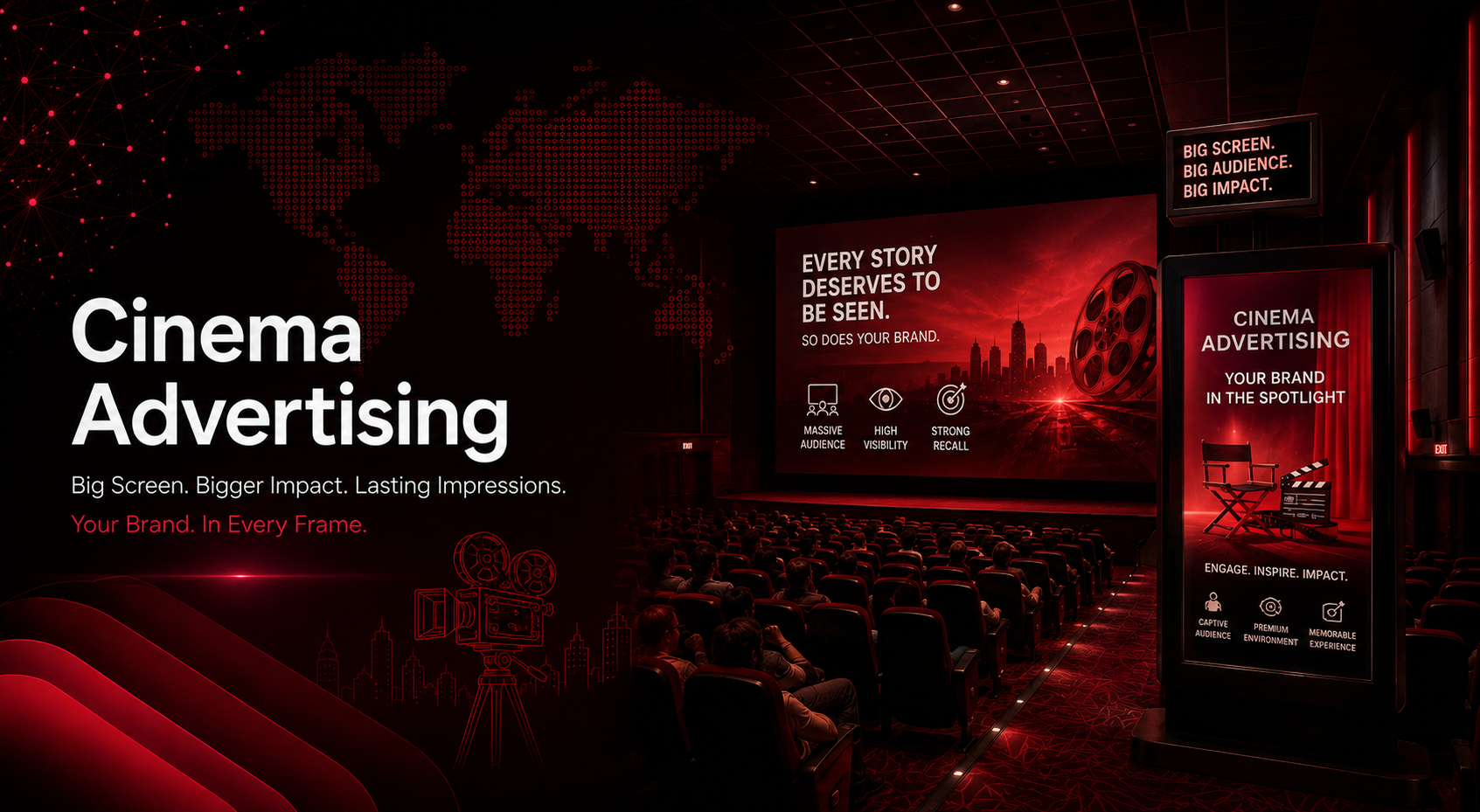
Cinema Advertising Cost in India (2026): Complete Pricing Guide for Brands & Businesses
Cinema advertising has emerged as among the top effective offline marketing channels available to brands that want to engage with highly active audience members. Unlike digital advertisements that people typically ignore or block, advertisements in cinemas are shown on large, wide screens that feature premium audio, which guarantees full attention before the start of the movie.
Whether you run a start-up, a local business, a real estate project, an educational institution, an auto brand, a healthcare service, or a national corporation, understanding cinema advertising costs in India is essential before you commit budget to a campaign. Cinema is one of the few advertising mediums left where the audience cannot skip, scroll past, or mute the message — and that undivided attention comes at a price that varies enormously depending on where, when, and how you choose to advertise.
This guide walks through everything a marketer needs to know: how cinema advertising rates work, what drives Multiplex Advertising Cost up or down, how PVR Advertising Cost and INOX Advertising Cost compare, and how to plan a campaign that gets real value rather than just screen time.
What Cinema Advertising Actually Involves
Cinema advertising is often assumed to mean nothing more than a 30-second commercial before the film starts, but that undersells what a modern multiplex actually offers a brand. Today's cinema experience gives advertisers multiple touchpoints across the entire visit — from the moment a customer books a ticket online to the walk through the lobby, the wait at the food counter, the time spent in their seat before the film begins, and even the washroom break during interval. A brand can show up as a pre-film video commercial, a digital screen advertisement near the entrance, a standee in a high-footfall corner, branding on the ticket itself, signage at the food counter, seat-back branding, washroom branding, LED displays throughout the property, or even a live sampling activation where a product is handed directly to moviegoers. Because of this range, cinema advertising in India has evolved from being a single ad slot into something closer to a full-funnel brand experience compressed into a two-to-three-hour visit.
Why Cinema Advertising Is Growing in India
India's film industry is among the largest in the world by ticket volume, and millions of people walk into a cinema hall every single month across metros, tier-2 cities, and increasingly tier-3 towns as multiplex chains expand their footprint. Brands are leaning into this medium harder than before for a fairly simple reason: attention in a cinema hall is close to guaranteed. There is no scroll-away option, no mute button, and no competing tab open in the background the way there is with a digital ad. The environment itself is premium, the audience is emotionally engaged with the content around them, and studies on ad recall consistently show that cinema advertising is remembered longer than a typical social media impression. It also allows for precise regional and language-based targeting, since a brand can choose exactly which cities, theatres, and even which film's audience it wants to reach, and per-impression cost is often lower than television once you account for the size and engagement of the audience actually watching. In short, while a digital ad can be skipped in under five seconds, a cinema audience remains seated and facing the screen for the full duration of the ad.
Cinema Advertising Cost in India
Cinema Advertising Cost in India varies considerably based on the city, cinema chain, campaign scale, advertising format, movie selection, and campaign duration. While advertisers often look for a fixed rate card, cinema advertising is usually planned as a customised media campaign, where pricing depends on audience reach, screen inventory, and branding objectives. Premium multiplex chains in metropolitan cities typically command higher advertising investments due to superior audience quality, higher occupancy, and premium locations, whereas regional cinema chains and independent theatres offer economical alternatives for brands focusing on specific markets.
One of the major advantages of Movie Theater Advertising is its flexibility. Businesses can advertise across a single multiplex, selected theatres within a city, multiple cities, or even execute nationwide campaigns covering hundreds of screens. In addition to traditional on-screen commercials, advertisers can also utilise lobby branding, standee displays, digital lobby screens, ticket branding, seat branding, promotional kiosks, product sampling, and experiential activations to create a stronger brand presence throughout the cinema environment.
The table below provides indicative pricing for 10–30 second on-screen cinema commercials across major Indian cities. Actual pricing may vary depending on cinema chain, movie selection, campaign duration, and inventory availability.
|
City |
Popular Cinema Chains |
Indicative Cost |
Billing Unit |
|
Delhi NCR |
PVR INOX, Cinepolis |
₹700 onwards |
Per Screen / Day |
|
Mumbai |
PVR INOX, Cinepolis |
₹800 onwards |
Per Screen / Day |
|
Bengaluru |
PVR INOX, Cinepolis, Miraj |
₹650 onwards |
Per Screen / Day |
|
Hyderabad |
PVR INOX, Cinepolis |
₹600 onwards |
Per Screen / Day |
|
Chennai |
PVR INOX, Cinepolis |
₹600 onwards |
Per Screen / Day |
|
Kolkata |
PVR INOX, Miraj |
₹550 onwards |
Per Screen / Day |
|
Pune |
PVR INOX, Cinepolis |
₹500 onwards |
Per Screen / Day |
|
Ahmedabad |
PVR INOX, Cinepolis |
₹500 onwards |
Per Screen / Day |
|
Jaipur |
PVR INOX, Cinepolis |
₹450 onwards |
Per Screen / Day |
|
Lucknow |
PVR INOX, Cinepolis |
₹450 onwards |
Per Screen / Day |
|
Chandigarh |
PVR INOX, Cinepolis |
₹400 onwards |
Per Screen / Day |
|
Kochi |
PVR INOX, Cinepolis |
₹450 onwards |
Per Screen / Day |
|
Indore |
PVR INOX, Miraj |
₹400 onwards |
Per Screen / Day |
|
Nagpur |
PVR INOX, Cinepolis |
₹400 onwards |
Per Screen / Day |
|
Other Cities |
Multiplex & Regional Chains |
On Request |
Based on Campaign Scope |
Apart from on-screen advertising, brands can further increase campaign visibility through lobby branding, standee displays, digital lobby screens, ticket branding, seat branding, product sampling, promotional kiosks, and experiential marketing activities. The investment for these formats depends on the selected cinema chain, city, campaign duration, branding requirements, and available advertising inventory.
Since every campaign differs in terms of objectives and audience targeting, the final cinema advertising budget is determined after evaluating the preferred cities, number of screens, movie schedule, advertising format, and campaign duration. A professionally planned media strategy not only helps optimise costs but also ensures maximum audience reach and campaign effectiveness.
Note: The above prices are indicative only and may vary depending on the cinema chain, city, movie schedule, screen inventory, campaign duration, branding format, applicable taxes, and partner confirmation.
How Movie Theater Advertising Cost in India Actually Works
There is no single number you can quote for what a cinema campaign costs in India, because pricing moves with a long list of variables — the city, the theatre chain, the number of screens booked, how long the campaign runs, how popular the film is, the length of the ad itself, the specific time slot, the language of the market, whether it coincides with a festival season, and how many people are actually walking through the doors during that window. That said, it helps to have a rough sense of scale. A single-screen theatre campaign in a smaller market can start as low as five thousand rupees and go up to around twenty thousand, while booking a local multiplex typically runs somewhere between fifteen thousand and seventy-five thousand rupees depending on the chain and footfall. Once a brand wants city-wide coverage across several screens, the budget usually sits between fifty thousand and three lakh rupees, and a campaign spanning multiple cities can range from three lakh up to twenty-five lakh rupees. A true pan-India campaign across major multiplex chains and cities generally starts at twenty-five lakh rupees and can go significantly higher depending on scale. These are directional figures rather than fixed rates, since actual pricing depends heavily on inventory availability at the time of booking and how specific the campaign requirements are.
Understanding Cinema Advertising Rates
When advertisers talk about cinema advertising rates, the first thing to understand is that pricing is not uniform across the country, or even across theatres in the same city. Rates move with screen count, seating capacity, and how full a theatre typically runs, which is why weekend slots almost always cost more than weekday slots — occupancy is simply higher. A big film release changes pricing too, since a blockbuster opening weekend guarantees a packed house and advertisers are willing to pay a premium for that guaranteed audience. Premium formats such as IMAX or recliner-seating auditoriums also carry higher rates because they draw a more affluent, higher-spending audience. And geography matters as much as any of this — a metro multiplex in Mumbai or Delhi will almost always command a higher rate than an equivalent screen in a tier-2 or tier-3 city, simply because the audience profile and the surrounding real estate costs are both higher.
Factors Affecting Cinema Advertising Cost
There is no standard pricing model for Cinema Advertising because every campaign is designed around specific business objectives and target audiences. The final investment is influenced by multiple operational and media planning factors that determine both campaign reach and advertising effectiveness. Understanding these variables helps advertisers allocate budgets efficiently while selecting the right combination of cinemas, locations, and advertising formats.
Cinema Chain: The choice of cinema chain has a direct impact on advertising costs. Premium multiplex operators such as PVR INOX and Cinepolis generally charge higher rates due to their superior infrastructure, premium locations, higher occupancy levels, and affluent audience profile. Regional cinema chains and independent theatres often provide a more economical solution for advertisers focusing on local markets.
Geographic Market: Advertising costs differ from one city to another based on audience demand and cinema occupancy. Metropolitan markets such as Delhi NCR, Mumbai, Bengaluru, Hyderabad, Chennai, and Kolkata typically command higher media investments, whereas Tier II and Tier III cities offer competitive pricing while still delivering substantial regional reach.
Campaign Scale: The number of cinema screens included in the campaign significantly affects the overall budget. Advertisers may choose to advertise in a single theatre, selected multiplexes within a city, multiple cities, or execute nationwide campaigns covering hundreds of screens depending on campaign objectives.
Movie Selection: Advertising alongside blockbuster releases, highly anticipated films, family entertainers, and major regional releases usually requires a higher investment because these movies attract larger audiences and achieve stronger occupancy levels than regular screenings.
Show Schedule: The selected show timings also influence campaign pricing. Evening shows, weekends, holidays, and festival periods generally experience higher audience attendance than weekday afternoon screenings, making these slots more valuable for advertisers.
Advertising Format: Cinema offers numerous branding opportunities beyond traditional on-screen commercials. Formats such as digital lobby screens, standee displays, lobby branding, seat branding, ticket branding, promotional kiosks, product sampling, and experiential activations require different levels of investment depending on visibility, execution complexity, and audience interaction.
Campaign Duration: Longer campaigns covering several weeks or multiple movie releases involve a higher overall investment but generally deliver stronger brand recall through repeated audience exposure.
Geographic Coverage: Brands can choose local, regional, or nationwide cinema campaigns. As campaign coverage expands across additional cities and cinema networks, media investment increases proportionately while delivering significantly greater audience reach.
Seasonal Demand: Advertising demand rises considerably during blockbuster movie releases, festive seasons, summer vacations, long weekends, and school holidays. During these high-demand periods, premium advertising inventory becomes more competitive, which may result in higher advertising rates.
Strategic Media Planning: Careful media planning enables advertisers to optimise budgets by selecting the most suitable cinema chains, cities, movie schedules, advertising formats, and campaign duration. Early campaign planning often provides better inventory availability, greater flexibility, and more competitive pricing.
By evaluating these factors before launching a campaign, advertisers can build a cinema advertising strategy that balances budget efficiency with audience reach. A professionally planned campaign not only improves advertising performance but also maximises brand visibility across India's leading multiplex and regional cinema networks.
Multiplex Advertising Cost and Why It Commands a Premium
Multiplex advertising tends to cost more than single-screen theatre advertising, and the reason comes down to who is actually in the audience. Multiplexes generally attract a wealthier, more urban crowd — young professionals, families, and students with higher disposable income — and that audience quality is part of what advertisers are paying for, not just the screen itself. Within a multiplex, brands typically choose between a handful of formats: the classic video commercial shown before the film starts, digital screens placed near entrances, ticket counters, and food courts, standee branding positioned in the highest-footfall corners of the lobby, and food court branding, which works particularly well for catching attention during the intermission when people are least focused on the film and most focused on their surroundings.
Movie Theatre Advertising Cost by Format
The cost of movie theatre advertising also depends on which type of venue a brand chooses to advertise in — a single independent theatre, a small local multiplex, a national chain, or a regional cinema group with strong local loyalty. As a general rule, local campaigns confined to one or two theatres require a much smaller investment than a national rollout spanning multiple cities and hundreds of screens, and the duration of the booking has a direct effect on overall cost as well. Campaigns are typically booked in blocks of one, two, four, eight, or twelve weeks, and longer bookings almost always come with better per-week pricing than short, one-off placements, since theatre chains prefer the predictability of a longer commitment.
PVR Advertising Cost
PVR is one of India's largest and most recognisable multiplex chains, and it consistently draws an affluent, brand-conscious audience, which is reflected in its pricing. PVR advertising cost depends on how many PVR properties are included in the campaign, whether those properties sit in metro or non-metro markets, the category and popularity of the film being screened, how long the ad runs and how many screenings it appears in, and whether the booking includes premium weekend inventory. Advertising formats available on PVR span on-screen commercials, lobby branding, LED screens, standee displays, digital kiosks, sampling campaigns, and dedicated activation zones for more experiential brand engagement. Premium formats such as IMAX auditoriums or recliner-seating halls generally cost more within the PVR network specifically because they draw larger, higher-spending crowds.
INOX Advertising Cost
INOX has built a strong reputation as a preferred choice for brands targeting urban, experience-driven audiences, and its advertising cost is shaped by screening availability, seat occupancy, whether the campaign coincides with a major film release, the overall length of the campaign, and how many cities are included in the booking. INOX's advertising formats include audio-visual commercials, digital displays, standee branding, food court branding, interactive promotions, and event sponsorship opportunities. It is fairly common for advertisers to run a combined PVR and INOX campaign to maximise national reach, since the two chains together cover a large share of India's organised multiplex footprint.
What Drives Cinema Hall Advertising Cost
Several recurring factors explain why cinema hall advertising pricing swings so widely from one booking to the next. Location is the single biggest driver — advertising in metro cities such as Mumbai, Delhi, Bengaluru, Hyderabad, Chennai, Pune, and Ahmedabad is consistently more expensive than advertising in smaller towns, simply because the real estate, footfall, and audience spending power are all higher. Screen count matters too, since booking across more screens naturally increases both reach and cost. Audience size and occupancy play a direct role, because a fuller theatre means more impressions for the same ad slot, and the type of film being screened has a similar effect — a major blockbuster commands a premium price precisely because it guarantees a packed house, while festival releases tend to push advertising demand and pricing up across the board due to the seasonal spike in footfall.
Ad duration is another lever worth understanding. Cinema ads are typically sold in fixed lengths — ten, fifteen, twenty, thirty, forty-five, or sixty seconds — and, unsurprisingly, longer ads cost more. Campaign duration works the opposite way: booking a longer run, whether that's several weeks or a couple of months, usually brings the effective per-day rate down compared to a short, one-off placement. Weekend slots consistently carry a premium over weekday slots because occupancy is higher, and this weekday-versus-weekend gap is one of the easiest variables for a brand to use strategically when trying to manage budget without sacrificing too much reach.
The Different Formats of Cinema Advertising
On-screen advertising remains the most familiar and widely used format, shown directly before the film begins, and it continues to deliver the strongest brand recall because the audience is fully seated and attentive. Lobby branding extends visibility to the moments just before and after the film, catching people while they're waiting or exiting. LED digital displays work well for dynamic, frequently updated creative, while standee advertising is particularly effective for new product launches since it can be placed in high-traffic corners of the theatre. Food counter branding captures attention at a moment when audiences are relaxed and browsing, washroom branding offers a less conventional but highly visible touchpoint, and ticket branding turns something every moviegoer already interacts with — the physical or digital ticket — into a small but consistent brand impression. Seat branding keeps a brand visible throughout the entire duration of the visit, sampling activities let a brand put its product directly into a customer's hands, and interactive promotions such as contests, QR codes, and digital activations add an engagement layer that static formats simply cannot match.
Why Brands Choose Cinema Advertising
Cinema advertising works because it solves a problem most other channels struggle with: attention. Viewers are focused on the screen with essentially no distractions, and the scale of cinematic visuals tends to create a stronger, more lasting impression than a small-screen ad ever could. The premium environment of a movie theatre also lends a certain credibility to whatever brand appears on screen, and because campaigns can be geo-targeted down to specific towns or regional markets, a business doesn't need a national budget to make cinema advertising work for them. Cost-effectiveness is often underestimated too — a single well-placed campaign can reach thousands of viewers, and because cinema audiences typically include entire families and household decision-makers, it's a particularly strong channel for brands trying to influence household-level purchase decisions. Regional marketing benefits as well, since campaigns created in the local language tend to see noticeably higher engagement than a generic, one-size-fits-all creative.
This combination of factors is why cinema advertising performs especially well for real estate developers, automobile companies, educational institutes, hospitals and healthcare brands, restaurants, FMCG companies, mobile and consumer electronics brands, retail stores, jewellery brands, fashion labels, banks, insurance companies, government awareness campaigns, and tourism boards — essentially any business that benefits from strong recall, emotional engagement, or localised targeting.
How to Reduce Cinema Advertising Cost Without Losing Impact
Brands working with a tighter budget do have real levers to pull. Choosing a regional campaign instead of a national one immediately brings cost down while still delivering strong local impact, and selecting non-peak movie slots — rather than insisting on a guaranteed blockbuster weekend — can meaningfully lower the price without sacrificing much reach. Running a longer campaign rather than a short burst almost always improves the effective rate, since theatre chains reward longer commitments with better per-week pricing. Combining multiple cities strategically, rather than trying to cover every major market at once, helps control spend while still building geographic reach, and using a shorter ad format where the message doesn't need a full thirty seconds can meaningfully reduce cost per screening. Planning campaigns well in advance also helps, since last-minute bookings around high-demand releases or festival periods tend to carry the steepest premiums. Working with an experienced media buying agency is often the single most effective cost lever of all, since agencies typically have existing relationships with theatre chains and can negotiate pricing and inventory access that an individual advertiser booking directly usually cannot.
Cinema Advertising Versus Digital Advertising
It's worth being clear-eyed about how cinema compares to digital, since the two mediums solve different problems. Digital advertising wins on measurability, retargeting, and sheer scale at a low cost per impression, but it loses badly on attention — viewers can skip, scroll past, or simply ignore a digital ad within seconds, and ad-blocking software has made this even easier. Cinema advertising, by contrast, offers very high audience attention with no skip option at all, excellent brand recall, strong local targeting, and a premium viewing experience on a screen size digital simply cannot replicate, and there is no equivalent of an ad blocker inside a movie theatre. The two channels aren't really competitors so much as complements — most well-rounded marketing strategies today combine cinema advertising for high-attention brand building with digital advertising for measurable performance and retargeting, using each channel for what it does best.
Tips for Running a Successful Cinema Advertising Campaign
Creative length matters more than most advertisers expect — keeping an ad between twenty and thirty seconds tends to maximise engagement without testing the audience's patience. High-quality cinematic visuals and audio make a disproportionate difference in a cinema setting compared to smaller screens, since the format itself is unforgiving of low-production creative. Every campaign should include a clear call to action, whether that's a website, a QR code, or a contact number, since attention without a next step is wasted attention. Timing a campaign around blockbuster releases can significantly boost reach, though it typically comes at a higher cost, so it's worth weighing against a longer run during a quieter release window. Choosing theatres that genuinely match a brand's target demographic and geography matters more than simply booking the biggest available screen count, and tracking campaign performance afterwards — through footfall data, QR code scans, or post-campaign brand recall surveys — helps sharpen media planning for the next round rather than repeating the same booking pattern by default.
Conclusion
Cinema advertising remains one of the most powerful offline marketing channels available in India today, offering a level of audience attention that few other mediums can match, along with strong brand recall and genuine emotional engagement. Whether the goal is understanding cinema advertising cost in India, comparing cinema advertising rates across chains, evaluating multiplex advertising cost, estimating movie theatre advertising cost, or specifically weighing PVR advertising cost against INOX advertising cost, the underlying principle stays the same: pricing is a function of location, audience, timing, and format, and understanding how these variables interact is what allows a brand to get real value out of a campaign rather than simply buying screen time. By choosing the right cities, the right theatres for the target audience, an appropriate campaign duration, and creative that's built for the format, brands of almost any size can put together a cinema campaign that reaches people at the exact moment they're most attentive and most receptive.
Whether the objective is building brand recognition, driving local awareness, or launching a genuinely national campaign, cinema advertising continues to offer a cost-effective, high-impact route to an audience that isn't going anywhere for the next two hours.
Frequently Asked Questions
1. What is the average cost of cinema advertising in India?
Pricing depends heavily on location, theatre chain, campaign length, and screen size. A local, single-theatre campaign can start from around five thousand rupees, while a national campaign spanning multiple multiplex chains can exceed twenty-five lakh rupees.
2. How are cinema advertising rates determined?
Rates are shaped by a combination of location, audience footfall, the popularity of the film being screened, the number of screenings booked, ad duration, and the overall length of the campaign.
3. What is the multiplex advertising cost compared to single-screen theatres?
Multiplex advertising typically costs more than single-screen theatre advertising because multiplexes draw larger, more affluent audiences and offer better facilities and stronger brand association.
4. Can local businesses afford movie theatre advertising?
Yes — local businesses can run targeted campaigns in specific nearby cinemas with budgets scaled to their marketing goals, which makes cinema advertising accessible even for regional or hyperlocal marketing needs, not just large national brands.
5. Is PVR advertising more expensive than other theatre chains?
Generally yes. PVR campaigns tend to carry a premium because of the chain's large network, affluent audience base, and access to premium viewing formats.
6. What determines INOX advertising cost specifically?
INOX pricing is driven by location, screen inventory, campaign duration, and overall reach, with exact costs varying based on the specific requirements of each campaign.
7. Which industries benefit most from cinema advertising?
Automobiles, real estate, healthcare, education, retail, FMCG, entertainment, banking and finance, hospitality, and government awareness campaigns all tend to see strong results from cinema advertising, largely due to the medium's high attention levels and strong recall.
Latest Posts
-
-
-
August 01, 2026