
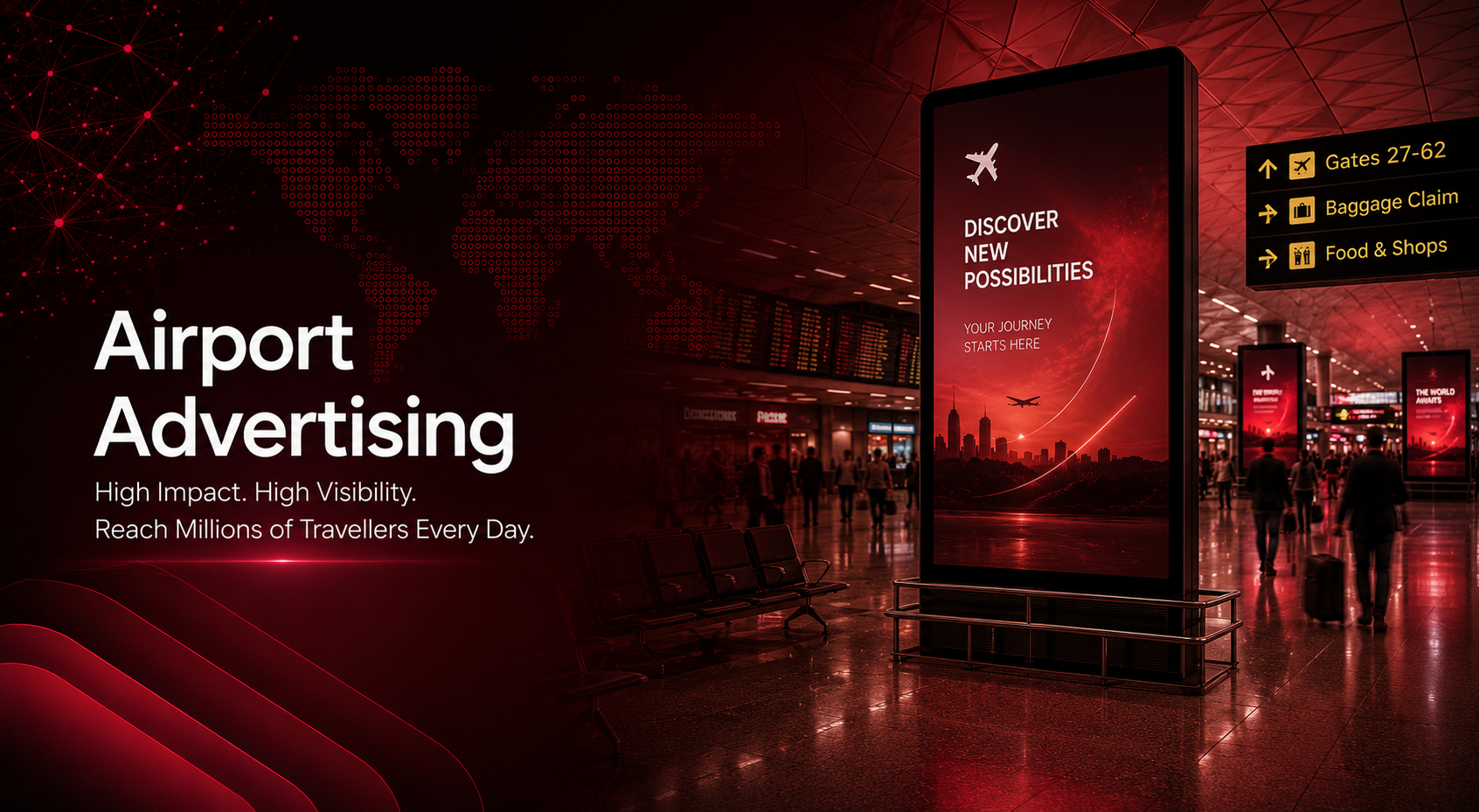
Airport Advertising: The Smart Brand Guide to Maximum Visibility
Airport Advertising has evolved into one of the most effective premium out-of-home (OOH) advertising mediums, enabling brands to engage affluent, business, leisure, and international travelers in a high-attention environment. Unlike traditional outdoor media, airport advertising offers repeated exposure throughout the passenger journey—from check-in and security screening to boarding gates, lounges, baggage claim, and arrival areas. With millions of passengers spending significant time inside airport terminals every day, brands benefit from extended visibility, stronger message recall, and a highly engaged audience.
India's aviation sector is witnessing remarkable growth, driven by increasing air travel, expanding airport infrastructure, rising disposable incomes, and improved regional connectivity. As new airports are developed and existing terminals undergo modernisation, advertising opportunities continue to expand across digital screens, LED video walls, airport trolleys, baggage belts, security trays, lounges, experiential zones, and numerous other premium media assets. This growth has transformed airports into strategic advertising destinations for brands seeking nationwide reach as well as city-specific visibility.
Whether the objective is building brand awareness, launching a new product, promoting premium services, or engaging high-value consumers, airport advertising provides access to a diverse audience with strong purchasing power and considerable dwell time. Industries such as banking, automobiles, luxury goods, real estate, tourism, hospitality, technology, healthcare, education, and consumer brands increasingly use airport media to enhance brand perception and connect with decision-makers.
This comprehensive Airport Advertising Guide explores everything businesses need to know—from the fundamentals of airport advertising and the various media formats available to industry trends, campaign planning, advertising costs, and best practices. Whether you are considering your first airport campaign or looking to optimise an existing one, this guide will help you understand how airport advertising works and how to maximise its impact in India's rapidly growing aviation landscape.
What is Airport Advertising?
Airport Advertising is a premium form of out-of-home (OOH) advertising that enables brands to reach passengers through strategically placed media across airport terminals and surrounding infrastructure. From check-in areas and security checkpoints to boarding gates, lounges, baggage claim, and arrival halls, airport advertising integrates brand messages into every stage of the passenger journey. These placements are designed to capture attention in an environment where travellers spend considerable time waiting, making airport media one of the most effective channels for high-impact brand communication.
Unlike conventional outdoor advertising, airport advertising reaches a highly desirable audience that includes business executives, corporate decision-makers, frequent flyers, affluent consumers, international travellers, tourists, and families. The combination of longer dwell times, a premium atmosphere, and relatively low advertising clutter allows brands to achieve greater visibility, stronger recall, and a lasting impression. Whether displayed through digital screens, LED video walls, airport trolley branding, baggage belt advertising, security tray branding, or experiential activations, airport media helps businesses engage consumers in a focused and distraction-limited setting.
Airport advertising serves a wide range of marketing objectives, from launching new products and increasing brand awareness to promoting destinations, driving app downloads, generating leads, and strengthening brand credibility. Campaigns can be executed at a single airport to target a specific city or simultaneously across multiple airports to achieve nationwide reach. As India's aviation sector continues to expand and airports become modern, technology-driven hubs, airport advertising has become an essential component of integrated marketing strategies for brands seeking premium visibility and meaningful consumer engagement.
Evolution of Airport Advertising
Airport advertising has evolved significantly over the past few decades, transforming from simple static displays into an advanced, technology-driven advertising ecosystem. Earlier, airports primarily offered traditional media such as billboards, wall panels, backlit displays, and signboards positioned at entrances and terminal buildings. While these formats provided visibility, advertisers had limited options to engage passengers or measure campaign effectiveness.
As airports expanded and passenger traffic increased, advertising opportunities diversified across different touchpoints within the terminal. Media owners introduced formats such as baggage belt advertising, airport trolley branding, security tray advertising, check-in counter branding, boarding gate displays, and lounge advertising. These innovations enabled brands to connect with passengers throughout their journey rather than at a single location, resulting in higher frequency of exposure and improved brand recall.
The digital transformation of airports has further revolutionised airport advertising. Today, premium airports feature high-definition LED video walls, digital screens, interactive kiosks, programmatic Digital Out-of-Home (DOOH) networks, and immersive experiential zones that deliver dynamic, real-time content. Brands can now schedule campaigns based on time of day, flight schedules, audience profiles, or specific events, making airport advertising more flexible, targeted, and measurable than ever before.
Looking ahead, the future of airport advertising lies in smart airport ecosystems powered by artificial intelligence, data analytics, automation, and interactive technologies. Personalised messaging, augmented reality (AR) experiences, QR code integrations, and data-driven digital campaigns are becoming increasingly common, allowing brands to create more engaging and memorable interactions with travellers. As airports continue to modernise and passenger expectations evolve, airport advertising is expected to play an even greater role in helping brands build awareness, enhance customer experiences, and deliver measurable marketing outcomes.
Airport Advertising Industry in India
India's aviation industry has emerged as one of the fastest-growing aviation markets in the world, creating significant opportunities for airport advertising. Rising disposable incomes, improved regional connectivity, expanding airline networks, and government initiatives such as the UDAN (Ude Desh ka Aam Nagrik) scheme have made air travel more accessible than ever before. As passenger traffic continues to grow across both metro and regional airports, airports have become valuable destinations for brands looking to engage a premium and highly mobile audience.
Today, India has 150+ operational airports, including domestic, international, customs, and civil enclave airports, with several new airports under development to meet increasing travel demand. Major aviation hubs such as Delhi, Mumbai, Bengaluru, Hyderabad, Chennai, and Kolkata collectively handle tens of millions of passengers every year, while regional airports are witnessing rapid growth in passenger movement. This expanding airport network enables advertisers to execute campaigns ranging from city-specific promotions to nationwide brand-building initiatives.
Modern airports are no longer just transportation hubs—they have evolved into commercial destinations featuring retail stores, food courts, premium lounges, entertainment zones, business facilities, and digital infrastructure. Passengers often spend anywhere from 60 to 180 minutes within airport terminals before departure, providing brands with multiple opportunities to engage them through digital screens, LED video walls, airport trolleys, baggage belts, security trays, boarding gates, lounges, and experiential activations. This extended dwell time contributes to stronger advertisement visibility and higher brand recall compared to many traditional advertising environments.
The future of airport advertising in India is closely tied to continued investments in airport modernisation and infrastructure expansion. New terminals, smart airport technologies, digital media networks, and increasing passenger volumes are expected to create even more premium advertising opportunities in the coming years. As brands seek high-quality audiences and measurable campaign impact, airport advertising is set to remain one of the most influential channels within India's out-of-home (OOH) advertising landscape.
Airport Advertising in India: Key Highlights
|
Metric |
Insight |
|
Operational Airports |
150+ airports across India |
|
Fastest-Growing Aviation Markets |
Among the fastest-growing globally |
|
Major Airport Hubs |
Delhi, Mumbai, Bengaluru, Hyderabad, Chennai, Kolkata |
|
Passenger Dwell Time |
Approximately 60–180 minutes inside terminals |
|
Key Advertising Formats |
Digital Screens, LED Video Walls, Trolley Branding, Baggage Belts, Security Trays, Lounges, Experiential Activations |
|
Primary Audience |
Business travellers, leisure travellers, affluent consumers, international passengers, decision-makers |
|
Growth Drivers |
Airport expansion, regional connectivity, rising air travel, digital transformation, premium retail ecosystem |
Why Airport Advertising is Growing in India
Airport advertising is experiencing rapid growth in India as brands increasingly seek premium environments that deliver both high visibility and meaningful audience engagement. The expansion of the aviation sector, rising passenger traffic, and modernisation of airport infrastructure have transformed airports into powerful advertising destinations. Unlike many traditional media channels where audiences are constantly exposed to competing messages, airports provide a controlled environment in which advertisements can capture attention for longer periods and create a lasting impression.
One of the primary drivers behind this growth is the steady increase in domestic and international air travel. As more people choose air transport for business, leisure, education, and medical tourism, airports attract a diverse mix of high-value consumers with strong purchasing power. This enables brands to connect with affluent professionals, corporate decision-makers, frequent flyers, families, and international travellers through a single advertising platform.
Another factor contributing to the popularity of airport advertising is the evolution of modern airport terminals. Today's airports are designed as integrated lifestyle and commercial spaces featuring premium retail outlets, restaurants, lounges, digital infrastructure, and entertainment zones. Passengers typically spend a considerable amount of time inside terminals before departure, allowing brands to engage them through multiple advertising touchpoints such as digital screens, LED video walls, airport trolleys, baggage belts, security trays, and boarding gate displays. This repeated exposure significantly enhances brand recognition and message retention.
The rapid adoption of Digital Out-of-Home (DOOH) advertising has further accelerated the growth of airport media. Digital screens enable advertisers to deliver dynamic content, schedule campaigns based on time or audience, and update creatives in real time. Interactive technologies, QR code integrations, and data-driven campaign planning are making airport advertising more measurable, flexible, and engaging than traditional static media.
As India's airport network continues to expand with new terminals and greenfield airports, the scope for airport advertising will only increase. Brands are no longer viewing airports solely as transit points but as premium marketing environments that combine broad reach with a high-quality audience. This shift is expected to keep airport advertising at the forefront of India's out-of-home advertising industry for years to come.
Understanding the Airport Passenger Journey
An airport advertising campaign is most effective when it aligns with the passenger journey. From the moment travellers enter the airport until they leave their destination terminal, they interact with multiple touchpoints where advertisements can influence awareness, consideration, and recall. Understanding this journey helps brands select the right advertising formats, locations, and messaging to maximise campaign impact.
Arrival at the Airport: The passenger journey begins as travellers approach the airport. Exterior billboards, digital displays, parking area branding, and entrance signage create the first brand interaction even before passengers enter the terminal. These high-visibility placements are ideal for building awareness and creating a strong first impression.
Check-in Area: Passengers typically spend time at airline check-in counters and self-service kiosks before proceeding to security. Advertising at check-in zones, queue barriers, digital screens, and nearby display panels ensures repeated exposure while passengers wait, making this one of the most valuable branding locations inside the terminal.
Security Screening: Security checkpoints naturally involve waiting time, allowing passengers to notice nearby advertising. Security tray branding, digital displays, wall graphics, and queue line advertising capture attention in a focused environment where distractions are minimal.
Retail & Food Court Zone: After clearing security, many passengers explore duty-free stores, retail outlets, cafés, and restaurants. Advertising in these commercial areas helps brands engage consumers who are already in a shopping mindset, making it particularly effective for luxury brands, consumer products, financial services, and travel-related businesses.
Airport Lounges: Airport lounges attract business executives, frequent flyers, premium travellers, and corporate decision-makers. Lounge branding, digital displays, magazine advertising, product showcases, and experiential activations allow brands to connect with an affluent audience in a relaxed and premium environment.
Boarding Gates: Passengers often spend considerable time waiting near their boarding gates before departure. Digital screens, LED video walls, gate branding, seating area displays, and nearby media placements provide repeated visibility during one of the longest dwell-time stages of the journey.
Arrival & Baggage Claim: Advertising continues even after the flight lands. Baggage belt branding, arrival hall displays, digital screens, and directional signage engage passengers while they wait to collect their luggage, extending campaign exposure beyond the departure experience.
Exit & Ground Transportation: The final stage of the journey includes airport exits, taxi pick-up zones, car rental areas, metro connections, and parking facilities. Advertisements placed in these locations reinforce brand messaging just before passengers leave the airport, improving overall campaign recall.
By leveraging multiple touchpoints across the passenger journey instead of relying on a single advertising format, brands can achieve higher visibility, greater message frequency, and a more memorable customer experience. This integrated approach is one of the key reasons airport advertising consistently delivers strong brand awareness and recall.
Types of Airport Advertising
Modern airports offer a wide range of advertising opportunities that enable brands to engage passengers at different stages of their journey. From high-impact digital displays to experiential activations, each advertising format serves a unique purpose depending on campaign objectives, target audience, and budget. By selecting the right combination of media, brands can maximise visibility, improve recall, and create a consistent presence throughout the airport environment.
Below are the most popular airport advertising formats available across major airports in India.
Airport Digital Screens: Digital screens are among the most widely used advertising formats in airports. Strategically installed in high-footfall areas such as entrances, check-in halls, security checkpoints, boarding gates, and arrival terminals, these displays showcase dynamic content that captures passenger attention. Advertisers can update creatives in real time, schedule campaigns for specific time slots, and run multiple advertisements throughout the day.
LED Video Wall Advertising: Large-format LED video walls provide maximum visual impact and are typically positioned in premium locations with heavy passenger traffic. Their high-resolution displays and vibrant visuals make them ideal for brand launches, luxury products, automotive campaigns, technology brands, and large-scale awareness initiatives.
Airport Trolley Advertising: Airport trolley branding transforms luggage trolleys into moving advertisements that travel throughout the terminal. As passengers use trolleys from arrival to departure, brands benefit from continuous exposure across multiple airport zones, making this one of the most effective airport advertising formats.
Baggage Belt Advertising: Advertisements placed around baggage conveyor belts engage passengers while they wait to collect their luggage. Since baggage claim areas involve unavoidable waiting time, baggage belt advertising offers excellent visibility and repeated brand exposure.
Security Tray Advertising: Security tray branding places advertisements directly on trays used during the security screening process. Every passenger interacts with these trays, creating a unique opportunity for close-range advertising and strong brand recall.
Check-in Counter Branding: Check-in counters attract high passenger volumes throughout the day. Branding opportunities include counter wraps, queue barriers, backdrops, and nearby digital displays, allowing advertisers to engage travellers during the check-in process.
Boarding Gate Advertising: Passengers often spend significant time waiting at boarding gates before flights depart. Digital screens, illuminated panels, gate wraps, and seating area displays provide repeated exposure in a relatively distraction-free environment.
Airport Lounge Advertising: Airport lounges offer access to premium travellers, business executives, corporate decision-makers, and frequent flyers. Lounge branding includes digital displays, standees, product showcases, branded seating areas, magazine placements, and exclusive experiential campaigns.
Escalator & Walkway Branding: Escalators, moving walkways, and travelators connect different parts of the terminal and are used by thousands of passengers daily. Side panel branding, pillar wraps, and overhead displays ensure continuous visibility as travellers move through the airport.
Floor & Glass Branding: Floor graphics and glass branding convert unused airport surfaces into attractive advertising spaces. These formats help guide passenger attention while reinforcing brand messaging in waiting areas, corridors, and terminal entrances.
Charging Station Advertising: Mobile charging stations have become essential amenities in modern airports. Branding these areas allows advertisers to engage passengers who spend several minutes charging their devices, resulting in longer interaction with the advertisement.
Experiential Marketing & Brand Activations: Experiential marketing enables brands to create memorable interactions through product demonstrations, sampling campaigns, immersive installations, virtual reality experiences, contests, and live brand engagements. These campaigns encourage direct customer participation and often generate significant social media visibility.
Airport Sampling Campaigns: Sampling activities allow brands to distribute products, promotional materials, or trial packs directly to passengers. This format is particularly effective for food and beverages, personal care, travel services, fintech, healthcare, and consumer goods brands looking to encourage product trials and immediate engagement.
Why Brands Invest in Airport Advertising
Airport advertising has become an integral part of the marketing strategy for many leading brands because it offers a unique combination of premium audience, extended exposure, and high-impact media formats. Unlike conventional advertising channels that often compete for consumer attention, airports provide a controlled environment where passengers naturally spend time waiting, shopping, dining, and relaxing. This allows brands to communicate with audiences in a less cluttered setting, leading to greater visibility and stronger message retention.
One of the biggest advantages of airport advertising is its ability to reach affluent and influential consumers. Airports attract business executives, entrepreneurs, corporate decision-makers, frequent flyers, international travellers, and high-income leisure passengers—many of whom represent valuable customer segments. For brands targeting premium audiences, airports provide access to consumers with significant purchasing power and a higher likelihood of engaging with quality products and services.
Another key reason brands choose airport advertising is the extended dwell time within airport terminals. Passengers typically spend between one and three hours completing check-in, security procedures, shopping, dining, or waiting for boarding announcements. During this period, they encounter advertisements across multiple touchpoints, including digital screens, LED video walls, airport trolleys, baggage belts, security trays, lounges, and boarding gates. This repeated exposure enhances brand recognition and significantly improves advertising recall compared to media that receives only a glance.
Airport advertising also enhances brand credibility and perception. Being present in a modern airport environment often associates a brand with quality, trust, innovation, and prestige. This is particularly valuable for industries such as banking, luxury goods, automobiles, hospitality, technology, healthcare, education, and real estate, where brand image plays an important role in influencing customer decisions.
Another advantage is the flexibility offered by airport media. Businesses can choose to advertise at a single airport to target a local market or launch campaigns across multiple airports to achieve regional or national coverage. With the growing adoption of digital airport media, advertisers can also display dynamic content, update creatives in real time, and tailor campaigns to specific audiences or time periods.
Ultimately, airport advertising is not just about reaching large numbers of passengers—it is about reaching the right audience in an environment where they are more attentive, have longer engagement time, and are more receptive to premium brand messaging. These qualities make airport advertising one of the most effective media channels for building brand awareness, strengthening brand perception, and supporting long-term marketing objectives.
Industries That Benefit Most from Airport Advertising
Airport advertising is a versatile marketing medium that serves businesses across a wide range of industries. Since airports attract a diverse mix of business travellers, leisure tourists, international visitors, professionals, families, and high-income consumers, brands from different sectors can use airport media to achieve objectives such as brand awareness, product launches, lead generation, and customer engagement. The choice of airport, terminal, and advertising format depends on the target audience and campaign goals.
Banking & Financial Services: Banks, insurance companies, fintech platforms, and investment firms frequently use airport advertising to promote premium banking services, credit cards, wealth management solutions, travel insurance, and digital payment platforms. Airport environments help these brands connect with professionals and high-net-worth individuals.
Automobile Industry: Automobile manufacturers leverage airport advertising to launch new vehicles, strengthen brand positioning, and showcase premium models. Large-format digital screens, experiential displays, and vehicle showcases are particularly effective in creating high-impact brand experiences.
Travel & Tourism: Airlines, tourism boards, hotels, resorts, travel agencies, cruise operators, and online travel platforms use airport advertising to inspire future travel and encourage bookings. Since passengers are already in a travel mindset, this audience is highly receptive to destination marketing and travel-related offers.
Hospitality & Luxury Brands: Luxury hotels, premium retail brands, fashion labels, jewellery companies, and lifestyle brands use airport advertising to reinforce exclusivity and reach affluent consumers. Airports provide an ideal environment for positioning premium products and services.
Real Estate: Real estate developers promote residential projects, commercial properties, luxury residences, and investment opportunities through airport advertising. Business executives, NRIs, investors, and high-income travellers often represent an ideal audience for premium real estate campaigns.
Technology & Consumer Electronics: Technology companies use airport media to introduce new smartphones, laptops, software solutions, gadgets, and digital services. Interactive displays and digital screens allow brands to demonstrate product features and create engaging experiences.
Healthcare & Pharmaceuticals: Hospitals, healthcare providers, diagnostic centres, wellness brands, and pharmaceutical companies use airport advertising to build trust and increase awareness among domestic and international travellers seeking quality healthcare services.
Education & EdTech: Universities, business schools, online learning platforms, and overseas education consultants use airport advertising to reach students, parents, working professionals, and international travellers interested in higher education and skill development.
FMCG & Consumer Brands: Food and beverage companies, personal care brands, household products, and lifestyle brands use airport advertising to increase product visibility and encourage consumer engagement. Sampling activities and experiential campaigns are particularly effective for product launches.
Government & Public Awareness Campaigns: Government departments, public sector organisations, and tourism authorities use airport advertising to promote national campaigns, public awareness initiatives, investment opportunities, and destination branding to both domestic and international audiences.
Regardless of the industry, airport advertising offers brands the opportunity to communicate with a high-value audience in a premium environment. By selecting the right airport, advertising format, and campaign strategy, businesses can maximise visibility, strengthen brand perception, and achieve meaningful marketing results.
Major Airports for Advertising in India
India's expanding aviation network offers advertisers access to a wide range of airport media opportunities, from globally connected metro airports to rapidly growing regional hubs. The choice of airport depends on campaign objectives, target audience, geographic coverage, and budget. While metro airports provide massive passenger volumes and premium international exposure, regional airports are ideal for localised campaigns and city-specific brand visibility.
The country's busiest airports—including Delhi, Mumbai, Bengaluru, Hyderabad, Chennai, and Kolkata—handle millions of domestic and international passengers every year. These airports offer the widest range of advertising formats, including digital screens, LED video walls, airport trolley branding, baggage belt advertising, security tray branding, lounge advertising, check-in counter branding, boarding gate displays, and experiential activations.
In addition to these major hubs, several Tier-2 and Tier-3 airports have witnessed significant growth due to increasing regional connectivity and expanding airline networks. Airports such as Pune, Ahmedabad, Kochi, Goa, Jaipur, Lucknow, Chandigarh, Coimbatore, Indore, and Bhubaneswar are becoming attractive advertising destinations for brands looking to reach specific regional markets while benefiting from lower media costs compared to metro airports.
The table below highlights some of India's leading airports and their advertising potential.
|
Airport |
Approx. Annual Passenger Traffic |
Advertising Advantage |
|
Delhi (DEL) |
78+ Million |
India's busiest international hub with premium domestic and international audience |
|
Mumbai (BOM) |
55+ Million |
Strong business and luxury traveller base with high brand visibility |
|
Bengaluru (BLR) |
44+ Million |
Technology professionals, startups, and corporate travellers |
|
Hyderabad (HYD) |
30+ Million |
Fast-growing business, IT, and pharmaceutical hub |
|
Chennai (MAA) |
24+ Million |
Strong mix of business, industrial, and international passengers |
|
Kolkata (CCU) |
22+ Million |
Gateway to Eastern and North-Eastern India |
|
Pune (PNQ) |
10+ Million |
IT professionals, students, and corporate travellers |
|
Ahmedabad (AMD) |
13+ Million |
Commercial and industrial audience with strong business traffic |
|
Kochi (COK) |
11+ Million |
International travellers, NRIs, and tourism market |
|
Goa (GOX & GOI) |
13+ Million (combined) |
Leisure travellers, holidaymakers, and hospitality-focused campaigns |
Whether a brand wants to launch a nationwide campaign across multiple airports or target passengers in a specific city, India's diverse airport network provides flexible advertising opportunities for businesses of all sizes. Selecting the right airport—or a combination of airports—ensures that campaigns reach the most relevant audience while maximising visibility and return on investment.
Airport Advertising Cost in India
The cost of airport advertising in India varies significantly depending on the airport, advertising format, media location, campaign duration, and passenger traffic. Premium airports such as Delhi, Mumbai, Bengaluru, and Hyderabad generally command higher advertising rates due to their large passenger volumes, extensive domestic and international connectivity, and premium traveller demographics. Regional airports, on the other hand, often provide a more cost-effective option for brands looking to target specific cities or markets.
There is no fixed pricing model for airport advertising, as each campaign is customised based on the selected media inventory and marketing objectives. Digital advertising formats, large-format LED video walls, and premium locations such as departure halls, boarding gates, and airport lounges typically carry higher costs than static advertising formats. Similarly, campaigns running for longer durations or across multiple airports often benefit from better commercial terms and greater overall reach.
Production and installation costs should also be considered while planning an airport advertising campaign. Static media may require printing, fabrication, and installation, whereas digital campaigns involve creative adaptation and scheduling. Experiential marketing activities, product displays, and sampling campaigns may have additional operational costs depending on the scale of activation and airport regulations.
The table below provides indicative price ranges for some of the most popular airport advertising formats in India. Actual rates may vary depending on the airport, media owner, campaign period, and inventory availability.
|
Advertising Format |
Indicative Cost (Per Month)* |
|
Airport Digital Screens |
₹50,000 – ₹5,00,000+ |
|
LED Video Walls |
₹2,00,000 – ₹15,00,000+ |
|
Airport Trolley Advertising |
₹1,800 – ₹2,500 per trolley |
|
Baggage Belt Advertising |
₹2,00,000 – ₹10,00,000+ |
|
Security Tray Advertising |
₹1,00,000 – ₹8,00,000+ |
|
Check-in Counter Branding |
On Request |
|
Boarding Gate Advertising |
₹2,00,000 – ₹10,00,000+ |
|
Airport Lounge Advertising |
₹3,00,000 – ₹20,00,000+ |
|
Experiential Marketing & Activations |
Based on campaign scope |
The above figures are indicative and may vary depending on the airport, terminal, media location, campaign duration, production requirements, and availability of advertising inventory.
Understanding the factors that influence airport advertising costs is essential before finalising a campaign. In the next section, we explore the key elements that determine pricing and how brands can optimise their media investment for maximum impact.
Factors Affecting Airport Advertising Cost
Airport advertising rates are influenced by several factors beyond the advertising format itself. The overall campaign cost depends on where the advertisement is displayed, the audience it reaches, the duration of the campaign, and the level of visibility offered by the selected media. Understanding these factors helps advertisers choose the right combination of airports and media formats while optimising their advertising budget.
1. Airport Location
The airport selected for the campaign is one of the biggest pricing factors. Major airports such as Delhi, Mumbai, Bengaluru, Hyderabad, and Chennai attract significantly higher passenger traffic than regional airports, resulting in higher advertising rates. Airports with greater international connectivity also command premium pricing.
2. Passenger Traffic
Advertising costs generally increase with passenger footfall. Media placed in airports handling millions of passengers annually offers greater reach and visibility, making it more valuable for advertisers seeking nationwide brand exposure.
3. Domestic vs. International Terminal
International terminals typically attract business travellers, foreign tourists, NRIs, and premium passengers with higher purchasing power. As a result, advertising inventory in international terminals is often priced higher than comparable media in domestic terminals.
4. Advertising Format
Different media formats have different pricing structures. Large LED video walls, digital displays, airport lounge branding, and experiential activations usually require a higher investment than static displays or airport trolley branding due to their premium visibility and engagement potential.
5. Media Location Within the Airport
Not all advertising locations offer the same level of exposure. Media placed in high-traffic areas such as terminal entrances, check-in halls, security checkpoints, boarding gates, baggage claim areas, and airport lounges generally command higher rates because they receive maximum passenger attention.
6. Campaign Duration
Longer campaign durations often provide better commercial value. While short-term campaigns are suitable for product launches or seasonal promotions, advertisers booking media for several months may receive more competitive pricing and improved media planning opportunities.
7. Number of Airports
Brands running campaigns across multiple airports benefit from wider geographic coverage and consistent brand visibility. Multi-airport campaigns may also offer cost efficiencies through bundled media planning and centralised campaign management.
8. Production & Installation Requirements
Static advertising formats involve additional costs for artwork production, printing, fabrication, transportation, installation, and removal. Digital campaigns generally eliminate printing expenses but may require creative adaptation for different screen specifications and resolutions.
9. Seasonality & Demand
Airport advertising demand fluctuates throughout the year. Peak travel seasons, festive periods, school holidays, major sporting events, and large exhibitions often lead to increased demand for premium advertising inventory, which can influence pricing and media availability.
10. Exclusivity & Premium Placements
Some advertisers prefer exclusive branding of specific airport zones, such as an entire boarding gate, airport lounge, baggage claim area, or terminal section. Exclusive media ownership offers unmatched visibility but comes at a premium compared to standard advertising placements.
By evaluating these factors before planning a campaign, businesses can select the most suitable airports, advertising formats, and campaign durations based on their objectives and budget. A well-planned airport advertising strategy not only optimises media investment but also ensures maximum reach, stronger brand recall, and better overall campaign performance.
How to Plan an Effective Airport Advertising Campaign
A successful airport advertising campaign begins with clear planning rather than simply selecting an advertising format. Every campaign should be aligned with specific business objectives, the target audience, and the airports that offer the greatest potential to achieve those goals. By following a structured planning process, brands can maximise campaign effectiveness while making the best use of their advertising budget.
Step 1: Define Your Campaign Objective
The first step is to identify what you want to achieve. Your objective could be increasing brand awareness, launching a new product, promoting a service, generating leads, driving app downloads, increasing store visits, or strengthening brand perception. A clearly defined objective helps determine the most suitable advertising formats and campaign strategy.
Step 2: Identify Your Target Audience
Understanding your audience is essential for selecting the right airport and advertising medium. Consider factors such as age, income level, profession, travel purpose, geographic location, and purchasing behaviour. Business travellers, leisure tourists, international passengers, students, and families all have different travel patterns and media consumption habits.
Step 3: Select the Right Airport
Choose airports that align with your target market and campaign goals. Metro airports are ideal for nationwide brand visibility, while regional airports are effective for city-specific campaigns. Evaluate passenger traffic, traveller demographics, domestic versus international connectivity, and airport facilities before making a decision.
Step 4: Choose the Most Suitable Advertising Formats
Different advertising formats serve different purposes. Large LED video walls and digital screens are ideal for high-impact brand awareness, while airport trolley branding, baggage belt advertising, security tray branding, and lounge advertising provide repeated exposure throughout the passenger journey. Many successful campaigns combine multiple formats to maximise visibility.
Step 5: Develop Engaging Creative Content
Airport advertisements should be visually appealing, easy to understand, and designed to capture attention within a few seconds. Use clear messaging, strong visuals, consistent branding, and a compelling call-to-action. For digital media, motion graphics and short videos can significantly improve engagement.
Step 6: Determine Campaign Duration
The campaign duration should align with your marketing objectives. Product launches and event promotions may require short-term campaigns, while long-term branding initiatives often benefit from sustained visibility over several months. Longer campaigns also help reinforce brand recall through repeated exposure.
Step 7: Execute and Monitor the Campaign
Once the campaign is live, monitor its performance to ensure smooth execution. Verify that advertisements are displayed correctly, media placements remain visible, and campaign timelines are followed. Regular monitoring helps identify any issues early and ensures the campaign delivers the expected visibility.
Step 8: Measure Campaign Performance
After the campaign concludes, evaluate its effectiveness using relevant performance indicators such as estimated reach, impressions, website traffic, QR code scans, enquiries, lead generation, customer engagement, and overall brand awareness. Comparing these results with the original campaign objectives provides valuable insights for future airport advertising initiatives.
A well-planned airport advertising campaign combines the right airport, the right audience, and the right media formats to deliver meaningful business outcomes. By following a systematic planning approach, brands can improve campaign efficiency, enhance customer engagement, and achieve a stronger return on their advertising investment.
How to Measure the Success of Airport Advertising
Measuring the effectiveness of an airport advertising campaign is essential to understand whether it has achieved its intended objectives. While airport advertising is primarily used to build brand awareness and strengthen brand perception, modern campaign measurement techniques enable businesses to evaluate both brand impact and business outcomes. By tracking the right metrics, advertisers can optimise future campaigns and make better media investment decisions.
Brand Reach & Impressions
The first indicator of campaign performance is the number of passengers exposed to the advertisement. Estimated reach and impressions are calculated based on airport footfall, passenger movement, media location, and campaign duration. High-footfall airports and premium advertising locations generally generate greater exposure.
Brand Recall & Awareness: One of the biggest advantages of airport advertising is its ability to improve brand recall. Repeated exposure across multiple airport touchpoints helps passengers remember the brand long after they have completed their journey. Surveys, market research, and brand lift studies can be used to assess changes in awareness and recall following a campaign.
Customer Engagement: Interactive advertising formats provide opportunities to measure passenger engagement. Metrics such as QR code scans, NFC interactions, website visits, app downloads, social media engagement, and participation in experiential activities help advertisers understand how audiences are responding to the campaign.
Lead Generation & Conversions: For performance-driven campaigns, lead generation is an important success metric. Businesses can measure enquiries, registrations, bookings, purchases, or other conversions generated through dedicated landing pages, promotional codes, QR codes, or campaign-specific contact channels.
Digital Analytics: When airport advertising is integrated with digital marketing, advertisers can track increases in website traffic, branded search volume, online enquiries, app installs, and conversion rates during the campaign period. Comparing these metrics with historical performance helps evaluate the campaign's contribution to overall marketing objectives.
Return on Investment (ROI): Ultimately, campaign success should be evaluated against the original objectives and investment. Factors such as campaign reach, customer engagement, lead quality, sales impact, and long-term brand value should all be considered when calculating the overall return on investment. While branding campaigns may not produce immediate sales, they often deliver significant long-term value by strengthening brand recognition and customer trust.
Key Metrics to Track
|
Performance Metric |
What It Measures |
|
Estimated Reach |
Number of passengers exposed to the advertisement |
|
Impressions |
Total advertising views generated during the campaign |
|
Brand Recall |
Improvement in brand recognition and awareness |
|
QR Code Scans |
Direct passenger interaction with the advertisement |
|
Website Traffic |
Increase in visits generated by the campaign |
|
App Downloads |
New users acquired through airport advertising |
|
Lead Generation |
Enquiries, registrations, or qualified prospects |
|
Conversion Rate |
Percentage of users completing the desired action |
|
Social Media Engagement |
Mentions, shares, comments, and campaign interactions |
|
Return on Investment (ROI) |
Overall business value generated relative to campaign spend |
A successful airport advertising campaign should not be measured solely by visibility. The most effective campaigns combine premium media placements with compelling creative, clear calls-to-action, and measurable performance indicators to deliver both immediate engagement and long-term brand growth.
Airport Advertising Trends
Airport advertising is evolving rapidly as airports become smarter, more connected, and increasingly focused on enhancing the passenger experience. Advancements in digital technology, data-driven media planning, and interactive advertising solutions are changing how brands engage with travellers. Today, advertisers are moving beyond traditional static displays and adopting innovative formats that deliver greater flexibility, improved audience engagement, and measurable campaign performance.
Digital Out-of-Home (DOOH) Advertising: Digital Out-of-Home (DOOH) has become one of the fastest-growing segments of airport advertising. High-definition digital screens and LED video walls enable brands to display dynamic content, schedule advertisements throughout the day, and update creatives instantly without replacing physical media. This flexibility allows advertisers to run time-sensitive promotions and multiple campaigns simultaneously.
Programmatic Digital Advertising: Programmatic DOOH is making airport advertising more intelligent and data-driven. Advertisers can purchase digital media inventory using automated platforms and schedule campaigns based on audience profiles, time of day, flight schedules, or specific events. This approach improves campaign efficiency while ensuring advertisements reach the most relevant audience.
Interactive & Contactless Experiences: Modern airport campaigns increasingly incorporate interactive technologies such as QR codes, NFC-enabled displays, touchless engagement, and augmented reality (AR) experiences. These features encourage passengers to interact directly with brands, visit websites, download mobile applications, participate in promotions, or explore products without interrupting their travel journey.
Experiential Marketing: Brands are investing more in experiential marketing to create memorable customer experiences within airport terminals. Product demonstrations, immersive installations, live showcases, sampling activities, and branded engagement zones allow passengers to interact with products and services, generating stronger emotional connections and higher brand recall.
Data-Driven Campaign Planning: Advances in passenger analytics and airport data are helping advertisers make better media decisions. Campaigns can now be planned using insights such as passenger demographics, travel patterns, dwell time, and peak traffic periods. This enables brands to select the most effective airports, terminals, and advertising formats for their target audience.
Sustainability in Airport Advertising: As airports and advertisers place greater emphasis on environmental responsibility, sustainable advertising practices are becoming increasingly important. Digital media reduces the need for frequent printing, while recyclable materials, energy-efficient LED displays, and environmentally friendly production methods help minimise the environmental impact of advertising campaigns.
Omnichannel Marketing Integration: Airport advertising is increasingly being integrated with digital marketing channels to create a seamless customer experience. Brands combine airport media with search advertising, social media campaigns, influencer marketing, email marketing, mobile applications, and connected TV to reinforce messaging across multiple touchpoints. This integrated approach helps improve campaign effectiveness and customer engagement.
AI-Powered Personalisation: Artificial intelligence is expected to play a growing role in the future of airport advertising. AI-driven content scheduling, audience segmentation, real-time campaign optimisation, and personalised digital messaging will enable advertisers to deliver more relevant and impactful experiences while maximising media efficiency.
As airports continue to modernise and passenger expectations evolve, airport advertising will become even more innovative, measurable, and technology-driven. Brands that embrace these emerging trends will be better positioned to engage travellers, strengthen brand visibility, and achieve greater marketing success in an increasingly competitive advertising landscape.
Common Mistakes to Avoid in Airport Advertising
Airport advertising offers exceptional opportunities for brand visibility, but achieving the desired results requires careful planning and execution. Many campaigns fail to deliver their full potential because of avoidable mistakes in media selection, creative strategy, or campaign planning. Understanding these common pitfalls can help businesses maximise their investment and improve overall campaign effectiveness.
Choosing Airports Based Only on Cost: Selecting an airport solely because it offers lower advertising rates may not produce the desired results. Instead, brands should evaluate passenger demographics, annual footfall, domestic versus international traffic, and campaign objectives to ensure they reach the right audience.
Ignoring the Target Audience: Not every airport attracts the same type of travellers. Business hubs such as Delhi, Mumbai, and Bengaluru may be ideal for B2B or premium brands, while leisure-focused destinations like Goa are better suited for tourism, hospitality, and lifestyle campaigns. Choosing the wrong airport can reduce campaign effectiveness.
Selecting the Wrong Advertising Format: Each airport advertising format serves a different purpose. For example, LED video walls are ideal for high-impact brand awareness, while airport trolley branding provides repeated exposure throughout the terminal. Selecting media without considering campaign objectives can limit overall performance.
Overloading the Creative with Information: Passengers usually notice an advertisement for only a few seconds while moving through the airport. Designs that contain excessive text or multiple messages can be difficult to understand. Simple visuals, a clear headline, strong branding, and a concise call-to-action are generally more effective.
Running Campaigns for a Very Short Duration: Short campaigns may generate initial visibility but often fail to create meaningful brand recall. Longer campaign durations allow passengers to encounter the brand repeatedly, increasing familiarity and improving the overall effectiveness of the campaign.
Focusing Only on One Touchpoint: Relying on a single advertising location limits audience exposure. Combining multiple formats—such as digital screens, airport trolleys, baggage belts, boarding gates, and lounge advertising—creates repeated brand interactions throughout the passenger journey and significantly improves recall.
Not Integrating with Digital Marketing: Airport advertising works best when supported by digital channels. QR codes, dedicated landing pages, social media campaigns, search advertising, and mobile applications can extend the customer journey beyond the airport and provide measurable engagement.
Ignoring Campaign Monitoring: Once a campaign goes live, it should be monitored regularly to ensure advertisements are displayed correctly, remain well maintained, and continue running throughout the agreed campaign period. Regular monitoring helps identify issues quickly and ensures the campaign delivers the expected visibility.
Not Measuring Campaign Performance: Many advertisers conclude a campaign without evaluating its results. Tracking metrics such as reach, website traffic, QR code scans, enquiries, lead generation, and brand recall provides valuable insights for improving future airport advertising campaigns.
Working Without an Experienced Airport Advertising Agency: Airport advertising involves media planning, airport approvals, production, installation, campaign execution, and performance monitoring. Partnering with an experienced airport advertising agency helps businesses select the right media, manage execution efficiently, and optimise campaign performance while avoiding costly mistakes.
By avoiding these common pitfalls and following a well-planned strategy, businesses can maximise the value of their airport advertising investment, reach the right audience, and achieve stronger brand awareness, engagement, and long-term marketing success.
How to Choose the Right Airport Advertising Agency
Selecting the right airport advertising agency is just as important as choosing the right airport or advertising format. A knowledgeable agency does more than book advertising space—it helps brands develop an effective media strategy, identify the most suitable airports, negotiate competitive rates, manage production and installation, and ensure campaigns are executed smoothly from start to finish. The right partner can significantly improve campaign performance while helping businesses make the most of their advertising investment.
Industry Experience: Look for an agency with proven experience in airport advertising and a strong understanding of airport media planning. An experienced agency will be familiar with airport operations, media owners, advertising regulations, approval processes, and campaign execution requirements across different airports.
Access to Multiple Airports: A good airport advertising agency should have access to advertising opportunities across major domestic and international airports, as well as regional airports. This enables brands to compare different media options and build campaigns that match their geographic reach and target audience.
Comprehensive Media Planning: Rather than recommending a single advertising format, the agency should evaluate your campaign objectives, target audience, budget, and timeline before suggesting the most suitable combination of airports and media. Strategic media planning helps maximise visibility while optimising costs.
Transparent Pricing: Airport advertising involves media costs, production, installation, and campaign management. Choose an agency that provides transparent quotations with a clear breakdown of all applicable charges, ensuring there are no unexpected costs during campaign execution.
Creative & Production Support: The effectiveness of an airport advertising campaign depends heavily on the quality of its creative execution. An agency should assist with artwork adaptation, production specifications, printing, fabrication, installation, and quality checks to ensure advertisements meet airport standards and achieve maximum visual impact.
Campaign Management & Monitoring: Successful campaigns require continuous coordination and monitoring. A reliable agency should oversee the installation process, verify that media is displayed correctly, address operational issues promptly, and provide regular campaign updates throughout the advertising period.
Performance Reporting: Where applicable, the agency should provide campaign documentation, photographs, proof of display, and performance insights. These reports help advertisers confirm successful execution and evaluate campaign effectiveness for future planning.
Proven Track Record: Before finalising an agency, review its portfolio, client testimonials, industry experience, and previous campaigns. Agencies with experience across industries and multiple airport locations are generally better equipped to manage campaigns of varying scales and objectives.
Why Choose The Media Spaces for Airport Advertising?
At The Media Spaces, we help businesses plan and execute airport advertising campaigns across major airports in India. From media planning and airport selection to creative execution, production, installation, and campaign management, we provide end-to-end support tailored to your marketing objectives.
Our team works closely with brands to identify the most effective airport advertising formats based on target audience, campaign goals, and budget. Whether you're looking to advertise at a single airport or launch a nationwide airport campaign, we help you build a strategy that maximises visibility, enhances brand recall, and delivers measurable value.
With access to a wide range of airport advertising formats—including digital screens, LED video walls, airport trolley branding, baggage belt advertising, security tray branding, airport lounges, boarding gates, and experiential activations—The Media Spaces offers customised solutions for businesses across industries.
If you're planning an airport advertising campaign in India, our team can help you identify the right airports, select the most suitable media, and manage every stage of the campaign efficiently, ensuring a seamless advertising experience from planning to execution.
Frequently Asked Questions (FAQs)
1. What is airport advertising?
Airport advertising is a form of out-of-home (OOH) advertising that enables brands to promote their products and services through various media formats inside airport terminals and surrounding airport infrastructure. Common advertising options include digital screens, LED video walls, airport trolley branding, baggage belt advertising, security tray advertising, lounges, and experiential activations.
2. Why is airport advertising considered a premium advertising medium?
Airports attract business executives, affluent consumers, international travellers, and frequent flyers who generally have higher purchasing power. Combined with longer dwell times and a premium environment, airport advertising delivers high visibility, better brand recall, and strong brand perception.
3. What are the different types of airport advertising?
Airport advertising includes digital screens, LED video walls, airport trolley advertising, baggage belt branding, security tray advertising, check-in counter branding, boarding gate advertising, airport lounge advertising, floor graphics, glass branding, charging station advertising, and experiential marketing campaigns.
4. How does airport advertising work?
Businesses book advertising inventory at one or multiple airports for a specified duration. Depending on the selected media, advertisements are displayed digitally or installed at strategic passenger touchpoints throughout the airport.
5. Who should invest in airport advertising?
Airport advertising is suitable for airlines, tourism boards, hotels, banks, insurance companies, luxury brands, automobile manufacturers, real estate developers, technology companies, healthcare providers, educational institutions, FMCG brands, and government organisations.
6. Is airport advertising effective for brand awareness?
Yes. Airport advertising provides repeated exposure throughout the passenger journey, resulting in strong brand visibility, higher recall, and improved brand recognition.
7. Which are the busiest airports for advertising in India?
Delhi, Mumbai, Bengaluru, Hyderabad, Chennai, Kolkata, Ahmedabad, Pune, Kochi, and Goa are among the most popular airports for advertising due to their high passenger traffic and premium audience.
8. How much does airport advertising cost in India?
Airport advertising costs vary depending on the airport, advertising format, media location, campaign duration, passenger traffic, and production requirements. Premium airports and high-impact digital formats generally command higher rates.
9. What is the ideal duration for an airport advertising campaign?
Most campaigns run for one month, three months, six months, or one year. Longer campaigns generally provide better brand recall through repeated passenger exposure.
10. Which airport advertising format offers the highest visibility?
Large LED video walls, digital screens, airport trolley branding, and baggage belt advertising are among the most visible formats because they receive continuous passenger attention.
11. Can brands advertise only in international terminals?
Yes. Brands can choose domestic terminals, international terminals, or both, depending on their target audience and campaign objectives.
12. Is airport advertising suitable for startups and SMEs?
Yes. Businesses of all sizes can choose airports and advertising formats that match their marketing objectives and budget.
13. What factors influence airport advertising costs?
Key factors include airport location, passenger traffic, domestic or international terminal, advertising format, media location, campaign duration, production costs, seasonality, and inventory availability.
14. How is airport advertising different from traditional outdoor advertising?
Unlike roadside billboards or transit media, airport advertising reaches a captive audience in a premium environment where passengers spend considerable time, resulting in higher engagement and stronger brand recall.
15. Can airport advertising be integrated with digital marketing?
Yes. Airport advertising can be combined with search marketing, social media, QR codes, mobile apps, email campaigns, and other digital channels to create an integrated marketing strategy.
16. Which industries benefit the most from airport advertising?
Industries such as banking, finance, tourism, hospitality, luxury goods, automobiles, real estate, technology, healthcare, education, and consumer products regularly use airport advertising to reach premium audiences.
17. How can businesses choose the right airport for advertising?
The choice depends on the target audience, campaign objective, passenger profile, airport connectivity, geographic coverage, and available budget. Metro airports are suitable for nationwide campaigns, while regional airports work well for localised marketing.
18. How is the success of an airport advertising campaign measured?
Performance can be evaluated using metrics such as estimated reach, impressions, brand recall, website traffic, QR code scans, enquiries, lead generation, and overall return on investment (ROI).
19. What are the latest trends in airport advertising?
Current trends include Digital Out-of-Home (DOOH), programmatic advertising, AI-powered content management, experiential marketing, interactive displays, QR code integration, and sustainability-focused advertising solutions.
20. How can businesses book airport advertising in India?
Businesses can work with an experienced airport advertising agency that assists with airport selection, media planning, inventory booking, creative adaptation, production, installation, campaign management, and reporting.
The only section remaining is the Contact/CTA. Since this is a guide, the CTA should be informative rather than overly sales-oriented.
Ready to Launch Your Airport Advertising Campaign?
Airport advertising offers brands a unique opportunity to engage millions of domestic and international travellers in a premium, high-attention environment. Whether your objective is to increase brand awareness, launch a new product, strengthen market presence, or connect with high-value consumers, choosing the right airport, advertising format, and campaign strategy is essential to achieving the best results.
At The Media Spaces, we help businesses plan and execute airport advertising campaigns across major airports in India. From media planning and airport selection to creative development, production, installation, and campaign management, our team provides end-to-end support to ensure every campaign delivers maximum visibility and impact.
Whether you are looking to advertise at a single airport or create a nationwide airport advertising campaign, we'll help you identify the most suitable advertising opportunities based on your target audience, campaign objectives, and budget.
Get in touch with The Media Spaces today to discuss your airport advertising requirements and receive expert guidance on planning a campaign that delivers measurable results.
Latest Posts
-
-
-
August 01, 2026